

10.5 Electrons in Semiconductors
557
which may be compared with the thermal energy k B T = 208.50 cm −1 for T = 300 K.
Thus, we see that for Te, μ F is much greater than k B T at room temperature. This
side calculation justifies the simplification that we utilized in order to obtain formal
expressions for N ce and N h .
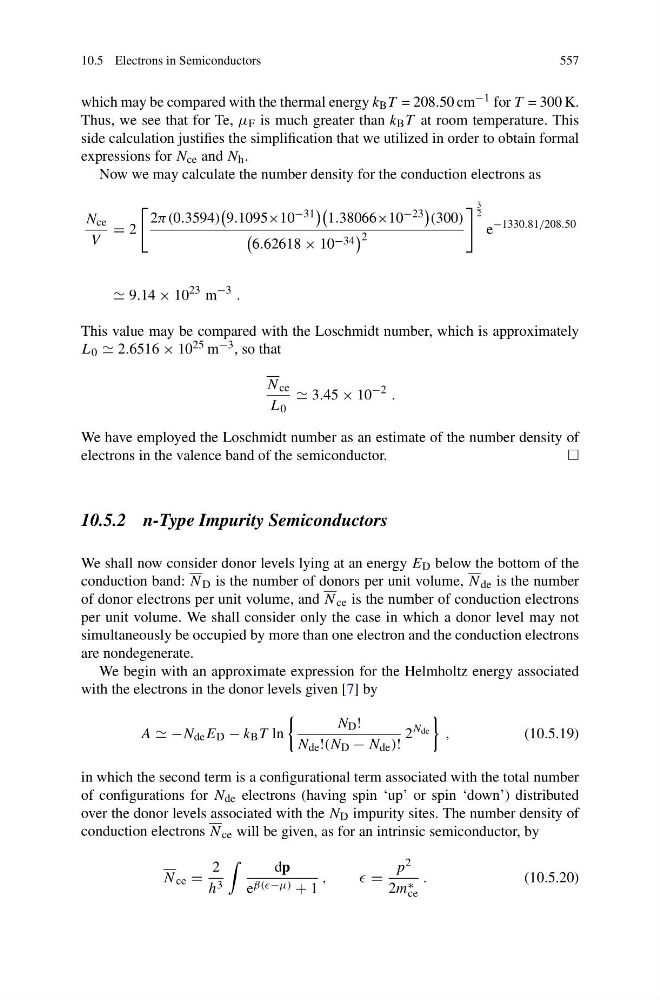
Now we may calculate the number density for the conduction electrons as
N ce
V
= 2
2π(0.3594)
9.1095×10 −31
1.38066×10 −23
(300)
6.62618 × 10 −34
2
3
2
e
−1330.81/208.50
9.14 × 10
23 m
−3 .
This value may be compared with the Loschmidt number, which is approximately
L 0 2.6516 × 10 25 m −3 , so that
N ce
L 0
3.45 × 10
−2 .
We have employed the Loschmidt number as an estimate of the number density of
electrons in the valence band of the semiconductor.
10.5.2 n-Type Impurity Semiconductors
We shall now consider donor levels lying at an energy E D below the bottom of the
conduction band: N D is the number of donors per unit volume, N de is the number
of donor electrons per unit volume, and N ce is the number of conduction electrons
per unit volume. We shall consider only the case in which a donor level may not
simultaneously be occupied by more than one electron and the conduction electrons
are nondegenerate.
We begin with an approximate expression for the Helmholtz energy associated
with the electrons in the donor levels given [7] by
A −N de E D − k B T ln
N D !
N de !(N D − N de )!
2
N de
,
(10.5.19)
in which the second term is a configurational term associated with the total number
of configurations for N de electrons (having spin ‘up’ or spin ‘down’) distributed
over the donor levels associated with the N D impurity sites. The number density of
conduction electrons N ce will be given, as for an intrinsic semiconductor, by
N ce =
2
h 3
dp
e β((−μ) + 1
,
, =
p 2
2m ∗
ce
.
(10.5.20)
557
which may be compared with the thermal energy k B T = 208.50 cm −1 for T = 300 K.
Thus, we see that for Te, μ F is much greater than k B T at room temperature. This
side calculation justifies the simplification that we utilized in order to obtain formal
expressions for N ce and N h .
Now we may calculate the number density for the conduction electrons as
N ce
V
= 2
2π(0.3594)
9.1095×10 −31
1.38066×10 −23
(300)
6.62618 × 10 −34
2
3
2
e
−1330.81/208.50
9.14 × 10
23 m
−3 .
This value may be compared with the Loschmidt number, which is approximately
L 0 2.6516 × 10 25 m −3 , so that
N ce
L 0
3.45 × 10
−2 .
We have employed the Loschmidt number as an estimate of the number density of
electrons in the valence band of the semiconductor.
10.5.2 n-Type Impurity Semiconductors
We shall now consider donor levels lying at an energy E D below the bottom of the
conduction band: N D is the number of donors per unit volume, N de is the number
of donor electrons per unit volume, and N ce is the number of conduction electrons
per unit volume. We shall consider only the case in which a donor level may not
simultaneously be occupied by more than one electron and the conduction electrons
are nondegenerate.
We begin with an approximate expression for the Helmholtz energy associated
with the electrons in the donor levels given [7] by
A −N de E D − k B T ln
N D !
N de !(N D − N de )!
2
N de
,
(10.5.19)
in which the second term is a configurational term associated with the total number
of configurations for N de electrons (having spin ‘up’ or spin ‘down’) distributed
over the donor levels associated with the N D impurity sites. The number density of
conduction electrons N ce will be given, as for an intrinsic semiconductor, by
N ce =
2
h 3
dp
e β((−μ) + 1
,
, =
p 2
2m ∗
ce
.
(10.5.20)