

556
10 Quantum Statistics
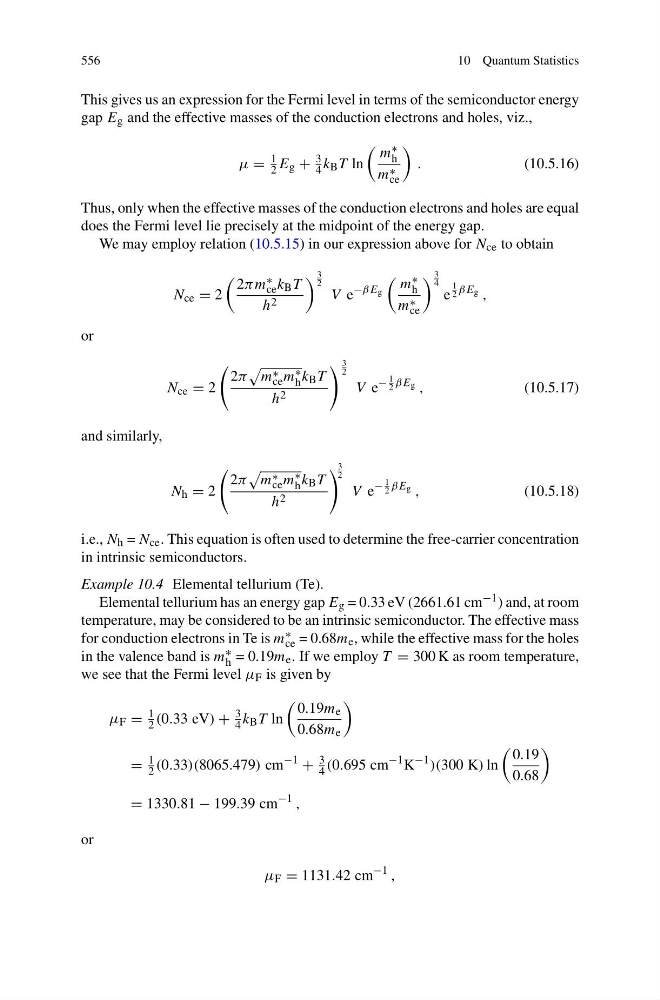
This gives us an expression for the Fermi level in terms of the semiconductor energy
gap E g and the effective masses of the conduction electrons and holes, viz.,
μ =
1
2 E g +
3
4 k B T ln
m ∗
h
m ∗
ce
.
(10.5.16)
Thus, only when the effective masses of the conduction electrons and holes are equal
does the Fermi level lie precisely at the midpoint of the energy gap.
We may employ relation (10.5.15) in our expression above for N ce to obtain
N ce = 2
2πm ∗
ce k B T
h 2
3
2
V e
−βE g
m ∗
h
m ∗
ce
3
4
e
1
2 βE g ,
or
N ce = 2
2π
m ∗
ce m ∗
h k B T
h 2
3
2
V e
−
1
2 βE g ,
(10.5.17)
and similarly,
N h = 2
2π
m ∗
ce m ∗
h k B T
h 2
3
2
V e
−
1
2 βE g ,
(10.5.18)
i.e., N h = N ce . This equation is often used to determine the free-carrier concentration
in intrinsic semiconductors.
Example 10.4 Elemental tellurium (Te).
Elemental tellurium has an energy gap E g = 0.33 eV (2661.61 cm −1 ) and, at room
temperature, may be considered to be an intrinsic semiconductor. The effective mass
for conduction electrons in Te is m ∗
ce = 0.68m e , while the effective mass for the holes
in the valence band is m ∗
h = 0.19m e . If we employ T = 300 K as room temperature,
we see that the Fermi level μ F is given by
μ F =
1
2 (0.33 eV) +
3
4 k B T ln
0.19m e
0.68m e
=
1
2 (0.33)(8065.479) cm
−1
+
3
4 (0.695 cm
−1 K
−1 )(300 K) ln
0.19
0.68
= 1330.81 − 199.39 cm
−1 ,
or
μ F = 1131.42 cm
−1 ,
10 Quantum Statistics
This gives us an expression for the Fermi level in terms of the semiconductor energy
gap E g and the effective masses of the conduction electrons and holes, viz.,
μ =
1
2 E g +
3
4 k B T ln
m ∗
h
m ∗
ce
.
(10.5.16)
Thus, only when the effective masses of the conduction electrons and holes are equal
does the Fermi level lie precisely at the midpoint of the energy gap.
We may employ relation (10.5.15) in our expression above for N ce to obtain
N ce = 2
2πm ∗
ce k B T
h 2
3
2
V e
−βE g
m ∗
h
m ∗
ce
3
4
e
1
2 βE g ,
or
N ce = 2
2π
m ∗
ce m ∗
h k B T
h 2
3
2
V e
−
1
2 βE g ,
(10.5.17)
and similarly,
N h = 2
2π
m ∗
ce m ∗
h k B T
h 2
3
2
V e
−
1
2 βE g ,
(10.5.18)
i.e., N h = N ce . This equation is often used to determine the free-carrier concentration
in intrinsic semiconductors.
Example 10.4 Elemental tellurium (Te).
Elemental tellurium has an energy gap E g = 0.33 eV (2661.61 cm −1 ) and, at room
temperature, may be considered to be an intrinsic semiconductor. The effective mass
for conduction electrons in Te is m ∗
ce = 0.68m e , while the effective mass for the holes
in the valence band is m ∗
h = 0.19m e . If we employ T = 300 K as room temperature,
we see that the Fermi level μ F is given by
μ F =
1
2 (0.33 eV) +
3
4 k B T ln
0.19m e
0.68m e
=
1
2 (0.33)(8065.479) cm
−1
+
3
4 (0.695 cm
−1 K
−1 )(300 K) ln
0.19
0.68
= 1330.81 − 199.39 cm
−1 ,
or
μ F = 1131.42 cm
−1 ,