

10.5 Electrons in Semiconductors
551
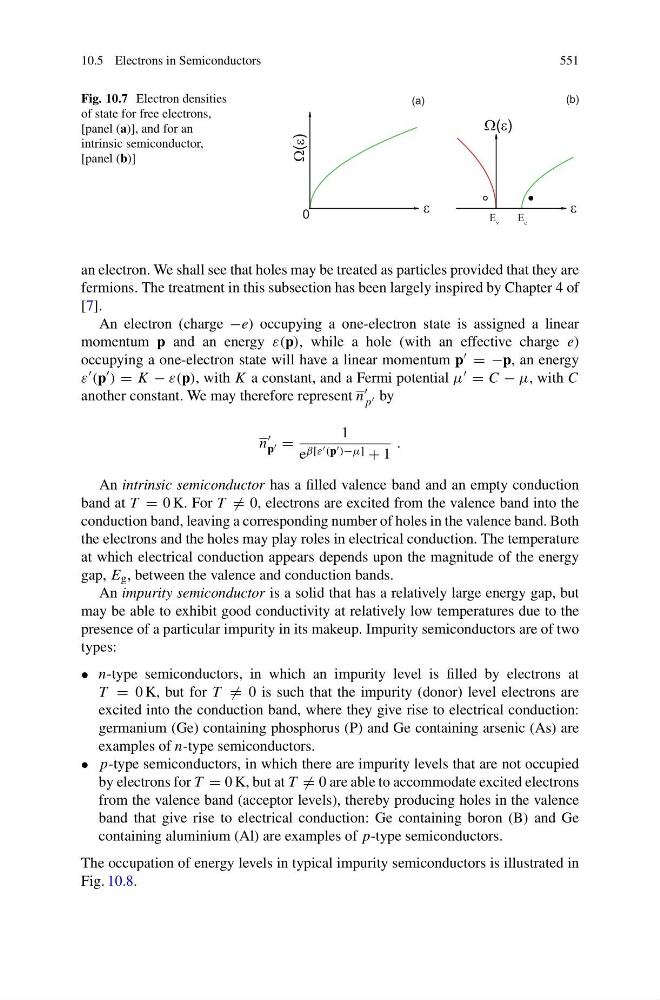
Fig. 10.7 Electron densities
of state for free electrons,
[panel (a)], and for an
intrinsic semiconductor,
[panel (b)]
Ω(ε)
ε
0
(a)
Ω(ε)
ε
E v
E c
(b)
an electron. We shall see that holes may be treated as particles provided that they are
fermions. The treatment in this subsection has been largely inspired by Chapter 4 of
[7].
An electron (charge −e) occupying a one-electron state is assigned a linear
momentum p and an energy ε(p), while a hole (with an effective charge e)
occupying a one-electron state will have a linear momentum p = −p, an energy
ε (p ) = K − ε(p), with K a constant, and a Fermi potential μ = C − μ, with C
another constant. We may therefore represent n
p by
n
p =
1
e β[ε (p )−μ] + 1
.
An intrinsic semiconductor has a filled valence band and an empty conduction
band at T = 0 K. For T = 0, electrons are excited from the valence band into the
conduction band, leaving a corresponding number of holes in the valence band. Both
the electrons and the holes may play roles in electrical conduction. The temperature
at which electrical conduction appears depends upon the magnitude of the energy
gap, E g , between the valence and conduction bands.
An impurity semiconductor is a solid that has a relatively large energy gap, but
may be able to exhibit good conductivity at relatively low temperatures due to the
presence of a particular impurity in its makeup. Impurity semiconductors are of two
types:
• n-type semiconductors, in which an impurity level is filled by electrons at
T = 0 K, but for T = 0 is such that the impurity (donor) level electrons are
excited into the conduction band, where they give rise to electrical conduction:
germanium (Ge) containing phosphorus (P) and Ge containing arsenic (As) are
examples of n-type semiconductors.
• p-type semiconductors, in which there are impurity levels that are not occupied
by electrons for T = 0 K, but at T = 0 are able to accommodate excited electrons
from the valence band (acceptor levels), thereby producing holes in the valence
band that give rise to electrical conduction: Ge containing boron (B) and Ge
containing aluminium (Al) are examples of p-type semiconductors.
The occupation of energy levels in typical impurity semiconductors is illustrated in
Fig. 10.8.
551
Fig. 10.7 Electron densities
of state for free electrons,
[panel (a)], and for an
intrinsic semiconductor,
[panel (b)]
Ω(ε)
ε
0
(a)
Ω(ε)
ε
E v
E c
(b)
an electron. We shall see that holes may be treated as particles provided that they are
fermions. The treatment in this subsection has been largely inspired by Chapter 4 of
[7].
An electron (charge −e) occupying a one-electron state is assigned a linear
momentum p and an energy ε(p), while a hole (with an effective charge e)
occupying a one-electron state will have a linear momentum p = −p, an energy
ε (p ) = K − ε(p), with K a constant, and a Fermi potential μ = C − μ, with C
another constant. We may therefore represent n
p by
n
p =
1
e β[ε (p )−μ] + 1
.
An intrinsic semiconductor has a filled valence band and an empty conduction
band at T = 0 K. For T = 0, electrons are excited from the valence band into the
conduction band, leaving a corresponding number of holes in the valence band. Both
the electrons and the holes may play roles in electrical conduction. The temperature
at which electrical conduction appears depends upon the magnitude of the energy
gap, E g , between the valence and conduction bands.
An impurity semiconductor is a solid that has a relatively large energy gap, but
may be able to exhibit good conductivity at relatively low temperatures due to the
presence of a particular impurity in its makeup. Impurity semiconductors are of two
types:
• n-type semiconductors, in which an impurity level is filled by electrons at
T = 0 K, but for T = 0 is such that the impurity (donor) level electrons are
excited into the conduction band, where they give rise to electrical conduction:
germanium (Ge) containing phosphorus (P) and Ge containing arsenic (As) are
examples of n-type semiconductors.
• p-type semiconductors, in which there are impurity levels that are not occupied
by electrons for T = 0 K, but at T = 0 are able to accommodate excited electrons
from the valence band (acceptor levels), thereby producing holes in the valence
band that give rise to electrical conduction: Ge containing boron (B) and Ge
containing aluminium (Al) are examples of p-type semiconductors.
The occupation of energy levels in typical impurity semiconductors is illustrated in
Fig. 10.8.