

516
10 Quantum Statistics
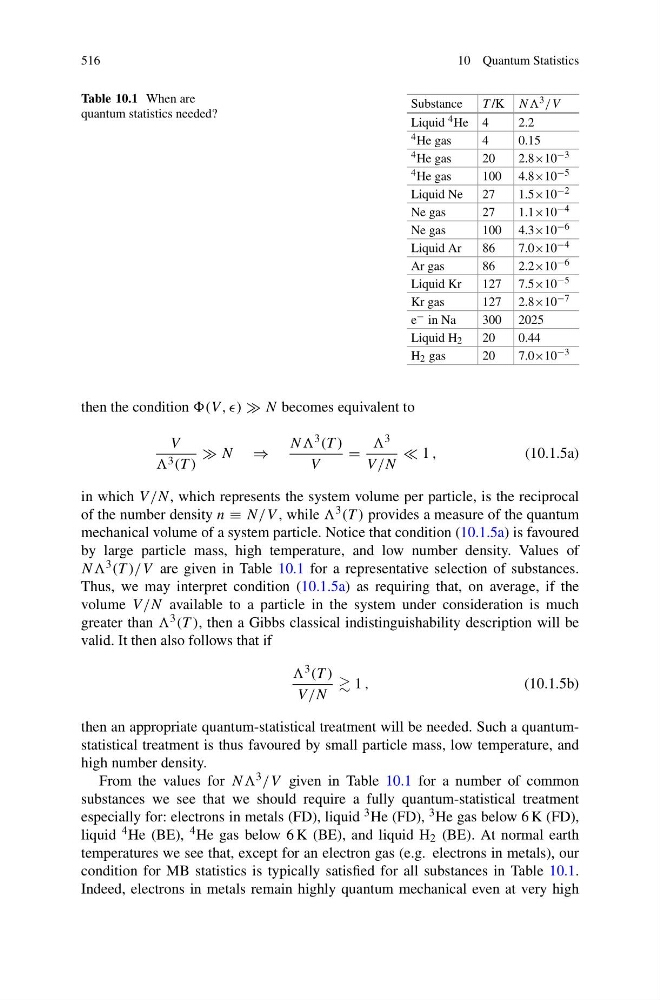
Table 10.1 When are
quantum statistics needed?
Substance
T /K NN 3 /V
Liquid 4 He 4
2.2
4 He gas
4
0.15
4 He gas
20
2.8×10 −3
4 He gas
100 4.8×10 −5
Liquid Ne
27
1.5×10 −2
Ne gas
27
1.1×10 −4
Ne gas
100 4.3×10 −6
Liquid Ar
86
7.0×10 −4
Ar gas
86
2.2×10 −6
Liquid Kr
127 7.5×10 −5
Kr gas
127 2.8×10 −7
e − in Na
300 2025
Liquid H 2
20
0.44
H 2 gas
20
7.0×10 −3
then the condition (V , ,) N becomes equivalent to
V
3 (T )
N ⇒
NN 3 (T )
V
=
3
V /N
1 ,
(10.1.5a)
in which V /N, which represents the system volume per particle, is the reciprocal
of the number density n ≡ N/V , while 3 (T ) provides a measure of the quantum
mechanical volume of a system particle. Notice that condition (10.1.5a) is favoured
by large particle mass, high temperature, and low number density. Values of
NN 3 (T )/V are given in Table 10.1 for a representative selection of substances.
Thus, we may interpret condition (10.1.5a) as requiring that, on average, if the
volume V /N available to a particle in the system under consideration is much
greater than 3 (T ), then a Gibbs classical indistinguishability description will be
valid. It then also follows that if
3 (T )
V /N
1 ,
(10.1.5b)
then an appropriate quantum-statistical treatment will be needed. Such a quantumstatistical treatment is thus favoured by small particle mass, low temperature, and
high number density.
From the values for NN 3 /V given in Table 10.1 for a number of common
substances we see that we should require a fully quantum-statistical treatment
especially for: electrons in metals (FD), liquid 3 He (FD), 3 He gas below 6 K (FD),
liquid 4 He (BE), 4 He gas below 6 K (BE), and liquid H 2 (BE). At normal earth
temperatures we see that, except for an electron gas (e.g. electrons in metals), our
condition for MB statistics is typically satisfied for all substances in Table 10.1.
Indeed, electrons in metals remain highly quantum mechanical even at very high
10 Quantum Statistics
Table 10.1 When are
quantum statistics needed?
Substance
T /K NN 3 /V
Liquid 4 He 4
2.2
4 He gas
4
0.15
4 He gas
20
2.8×10 −3
4 He gas
100 4.8×10 −5
Liquid Ne
27
1.5×10 −2
Ne gas
27
1.1×10 −4
Ne gas
100 4.3×10 −6
Liquid Ar
86
7.0×10 −4
Ar gas
86
2.2×10 −6
Liquid Kr
127 7.5×10 −5
Kr gas
127 2.8×10 −7
e − in Na
300 2025
Liquid H 2
20
0.44
H 2 gas
20
7.0×10 −3
then the condition (V , ,) N becomes equivalent to
V
3 (T )
N ⇒
NN 3 (T )
V
=
3
V /N
1 ,
(10.1.5a)
in which V /N, which represents the system volume per particle, is the reciprocal
of the number density n ≡ N/V , while 3 (T ) provides a measure of the quantum
mechanical volume of a system particle. Notice that condition (10.1.5a) is favoured
by large particle mass, high temperature, and low number density. Values of
NN 3 (T )/V are given in Table 10.1 for a representative selection of substances.
Thus, we may interpret condition (10.1.5a) as requiring that, on average, if the
volume V /N available to a particle in the system under consideration is much
greater than 3 (T ), then a Gibbs classical indistinguishability description will be
valid. It then also follows that if
3 (T )
V /N
1 ,
(10.1.5b)
then an appropriate quantum-statistical treatment will be needed. Such a quantumstatistical treatment is thus favoured by small particle mass, low temperature, and
high number density.
From the values for NN 3 /V given in Table 10.1 for a number of common
substances we see that we should require a fully quantum-statistical treatment
especially for: electrons in metals (FD), liquid 3 He (FD), 3 He gas below 6 K (FD),
liquid 4 He (BE), 4 He gas below 6 K (BE), and liquid H 2 (BE). At normal earth
temperatures we see that, except for an electron gas (e.g. electrons in metals), our
condition for MB statistics is typically satisfied for all substances in Table 10.1.
Indeed, electrons in metals remain highly quantum mechanical even at very high