

10.1 Setting the Stage
515
E ij kl... = i + j + k + l + . . . ,
(10.1.2)
while the canonical partition function is given by
Z(N, T , V ) =
ij kl...
e
−β(( i + j +...) .
(10.1.3)
When the molecules are indistinguishable, we cannot in principle sum over
i, j, k, l, . . . separately, as we could have done had they been distinguishable.
We have seen that there are two cases to consider:
(a) fermions: severely restricted occupation of available single-particle energy
states, as the antisymmetry of the wavefunction requires that no two identical
fermions occupy the same single-particle state. This means that any terms in
which two or more indices are the same must be excluded from the summation
in an expression for the canonical partition function Z(N, T , V ).
(b) bosons: unrestricted occupation of available single-particle energy states is
allowed. However, there are just as many problems for bosons as for fermions.
For example, if we consider the case in which all indices except one are the
same, we have i + j + j + · · · + j , i = j , and this is the same as
j + i + j + · · · + j , i = j , and so on, so that this case will be included N
times in the summation over all states if the sums are done independently.
In both cases, if all particles are in different states, an unrestricted summation will
have included N ! terms where only one should have been allowed.
These facts make a direct summation to obtain Z(N, T , V ) extremely difficult
to perform, both for fermions and for bosons. The real problem occurs here when
we cannot simply ignore those terms in which two or more indices are the same in
comparison with those terms for which all indices are different. We have already
seen that when such terms can be ignored, it is sufficient to sum over all indices
unrestrictedly, and then divide by N! to correct for the overcounting made thereby.
We have said earlier that this will be valid when the number of N-body energy states
available for the system of N particles greatly exceeds the number of particles.
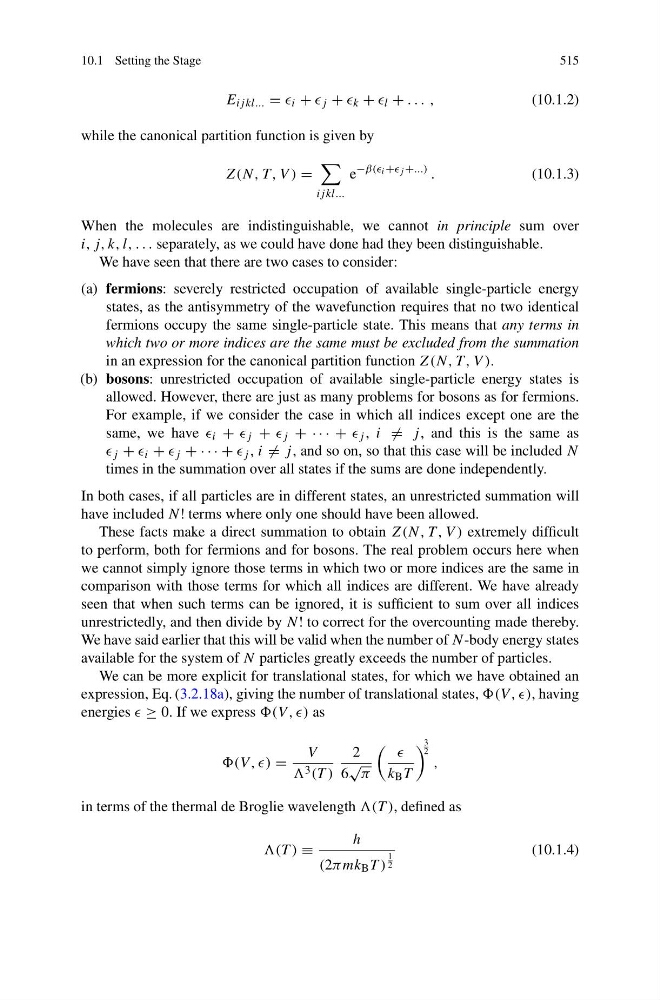
We can be more explicit for translational states, for which we have obtained an
expression, Eq. (3.2.18a), giving the number of translational states, (V , ,), having
energies ≥ 0. If we express (V , ,) as
(V , ,) =
V
3 (T )
2
6
√
π
k B T
3
2
,
in terms of the thermal de Broglie wavelength (T ), defined as
(T ) ≡
h
(2πmk B T )
1
2
(10.1.4)
515
E ij kl... = i + j + k + l + . . . ,
(10.1.2)
while the canonical partition function is given by
Z(N, T , V ) =
ij kl...
e
−β(( i + j +...) .
(10.1.3)
When the molecules are indistinguishable, we cannot in principle sum over
i, j, k, l, . . . separately, as we could have done had they been distinguishable.
We have seen that there are two cases to consider:
(a) fermions: severely restricted occupation of available single-particle energy
states, as the antisymmetry of the wavefunction requires that no two identical
fermions occupy the same single-particle state. This means that any terms in
which two or more indices are the same must be excluded from the summation
in an expression for the canonical partition function Z(N, T , V ).
(b) bosons: unrestricted occupation of available single-particle energy states is
allowed. However, there are just as many problems for bosons as for fermions.
For example, if we consider the case in which all indices except one are the
same, we have i + j + j + · · · + j , i = j , and this is the same as
j + i + j + · · · + j , i = j , and so on, so that this case will be included N
times in the summation over all states if the sums are done independently.
In both cases, if all particles are in different states, an unrestricted summation will
have included N ! terms where only one should have been allowed.
These facts make a direct summation to obtain Z(N, T , V ) extremely difficult
to perform, both for fermions and for bosons. The real problem occurs here when
we cannot simply ignore those terms in which two or more indices are the same in
comparison with those terms for which all indices are different. We have already
seen that when such terms can be ignored, it is sufficient to sum over all indices
unrestrictedly, and then divide by N! to correct for the overcounting made thereby.
We have said earlier that this will be valid when the number of N-body energy states
available for the system of N particles greatly exceeds the number of particles.
We can be more explicit for translational states, for which we have obtained an
expression, Eq. (3.2.18a), giving the number of translational states, (V , ,), having
energies ≥ 0. If we express (V , ,) as
(V , ,) =
V
3 (T )
2
6
√
π
k B T
3
2
,
in terms of the thermal de Broglie wavelength (T ), defined as
(T ) ≡
h
(2πmk B T )
1
2
(10.1.4)