

500
9 Chemical Equilibrium
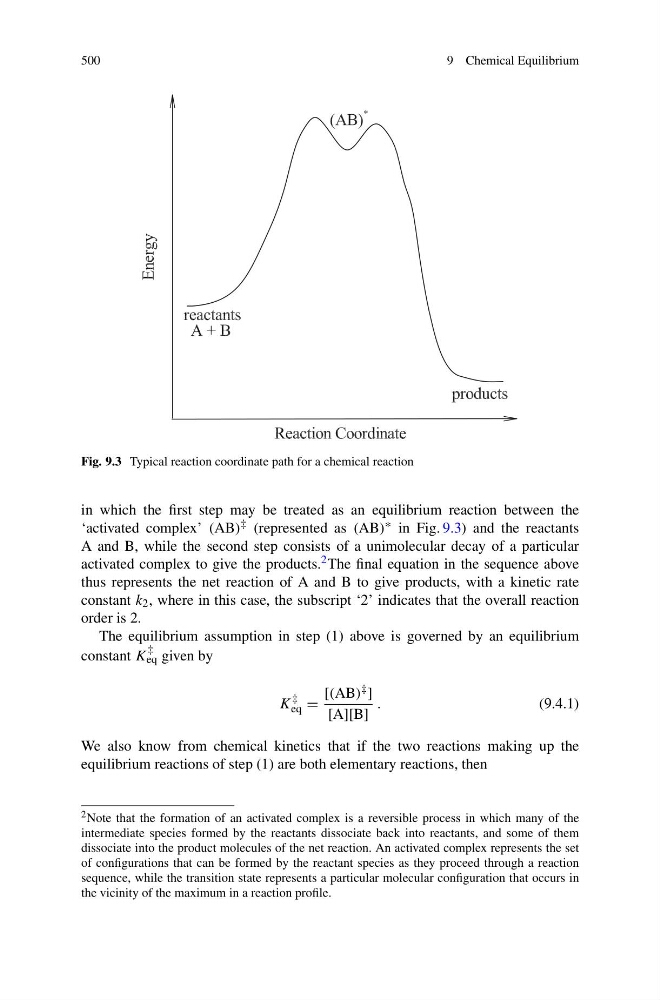
Fig. 9.3 Typical reaction coordinate path for a chemical reaction
in which the first step may be treated as an equilibrium reaction between the
‘activated complex’ (AB) ‡ (represented as (AB) ∗ in Fig. 9.3) and the reactants
A and B, while the second step consists of a unimolecular decay of a particular
activated complex to give the products. 2 The final equation in the sequence above
thus represents the net reaction of A and B to give products, with a kinetic rate
constant k 2 , where in this case, the subscript ‘2’ indicates that the overall reaction
order is 2.
The equilibrium assumption in step (1) above is governed by an equilibrium
constant K
‡
eq given by
K
‡
eq =
[(AB) ‡ ]
[A][B]
.
(9.4.1)
We also know from chemical kinetics that if the two reactions making up the
equilibrium reactions of step (1) are both elementary reactions, then
2 Note that the formation of an activated complex is a reversible process in which many of the
intermediate species formed by the reactants dissociate back into reactants, and some of them
dissociate into the product molecules of the net reaction. An activated complex represents the set
of configurations that can be formed by the reactant species as they proceed through a reaction
sequence, while the transition state represents a particular molecular configuration that occurs in
the vicinity of the maximum in a reaction profile.
9 Chemical Equilibrium
Fig. 9.3 Typical reaction coordinate path for a chemical reaction
in which the first step may be treated as an equilibrium reaction between the
‘activated complex’ (AB) ‡ (represented as (AB) ∗ in Fig. 9.3) and the reactants
A and B, while the second step consists of a unimolecular decay of a particular
activated complex to give the products. 2 The final equation in the sequence above
thus represents the net reaction of A and B to give products, with a kinetic rate
constant k 2 , where in this case, the subscript ‘2’ indicates that the overall reaction
order is 2.
The equilibrium assumption in step (1) above is governed by an equilibrium
constant K
‡
eq given by
K
‡
eq =
[(AB) ‡ ]
[A][B]
.
(9.4.1)
We also know from chemical kinetics that if the two reactions making up the
equilibrium reactions of step (1) are both elementary reactions, then
2 Note that the formation of an activated complex is a reversible process in which many of the
intermediate species formed by the reactants dissociate back into reactants, and some of them
dissociate into the product molecules of the net reaction. An activated complex represents the set
of configurations that can be formed by the reactant species as they proceed through a reaction
sequence, while the transition state represents a particular molecular configuration that occurs in
the vicinity of the maximum in a reaction profile.