

9.4 Application to Chemical Kinetics
499
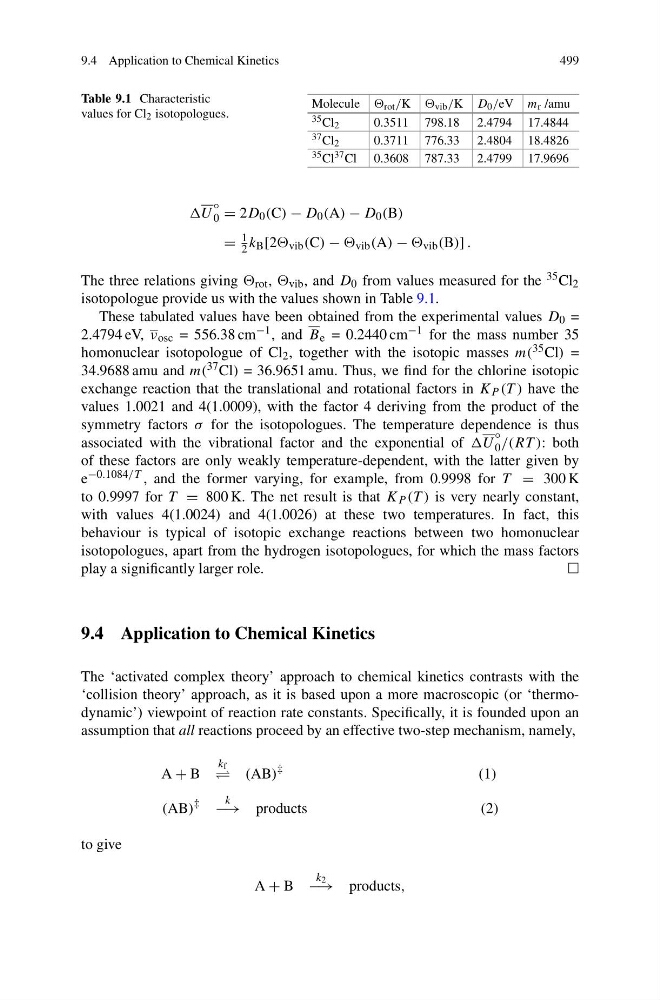
Table 9.1 Characteristic
values for Cl 2 isotopologues.
Molecule rot /K vib /K D 0 /eV m r /amu
35 Cl 2
0.3511 798.18 2.4794 17.4844
37 Cl 2
0.3711 776.33 2.4804 18.4826
35 Cl 37 Cl 0.3608 787.33 2.4799 17.9696
U
◦
0 = 2D 0 (C) − D 0 (A) − D 0 (B)
=
1
2 k B [2 vib (C) − vib (A) − vib (B)] .
The three relations giving rot , vib , and D 0 from values measured for the 35 Cl 2
isotopologue provide us with the values shown in Table 9.1.
These tabulated values have been obtained from the experimental values D 0 =
2.4794 eV, ν osc = 556.38 cm −1 , and B e = 0.2440 cm −1 for the mass number 35
homonuclear isotopologue of Cl 2 , together with the isotopic masses m( 35 Cl) =
34.9688 amu and m( 37 Cl) = 36.9651 amu. Thus, we find for the chlorine isotopic
exchange reaction that the translational and rotational factors in K P (T ) have the
values 1.0021 and 4(1.0009), with the factor 4 deriving from the product of the
symmetry factors σ for the isotopologues. The temperature dependence is thus
associated with the vibrational factor and the exponential of U
◦
0 /(RT ): both
of these factors are only weakly temperature-dependent, with the latter given by
e −0.1084/T , and the former varying, for example, from 0.9998 for T = 300 K
to 0.9997 for T = 800 K. The net result is that K P (T ) is very nearly constant,
with values 4(1.0024) and 4(1.0026) at these two temperatures. In fact, this
behaviour is typical of isotopic exchange reactions between two homonuclear
isotopologues, apart from the hydrogen isotopologues, for which the mass factors
play a significantly larger role.
9.4 Application to Chemical Kinetics
The ‘activated complex theory’ approach to chemical kinetics contrasts with the
‘collision theory’ approach, as it is based upon a more macroscopic (or ‘thermodynamic’) viewpoint of reaction rate constants. Specifically, it is founded upon an
assumption that all reactions proceed by an effective two-step mechanism, namely,
A + B
k f
(AB)
‡
(1)
(AB)
‡
k
−→ products
(2)
to give
A + B
k 2
−→ products,
499
Table 9.1 Characteristic
values for Cl 2 isotopologues.
Molecule rot /K vib /K D 0 /eV m r /amu
35 Cl 2
0.3511 798.18 2.4794 17.4844
37 Cl 2
0.3711 776.33 2.4804 18.4826
35 Cl 37 Cl 0.3608 787.33 2.4799 17.9696
U
◦
0 = 2D 0 (C) − D 0 (A) − D 0 (B)
=
1
2 k B [2 vib (C) − vib (A) − vib (B)] .
The three relations giving rot , vib , and D 0 from values measured for the 35 Cl 2
isotopologue provide us with the values shown in Table 9.1.
These tabulated values have been obtained from the experimental values D 0 =
2.4794 eV, ν osc = 556.38 cm −1 , and B e = 0.2440 cm −1 for the mass number 35
homonuclear isotopologue of Cl 2 , together with the isotopic masses m( 35 Cl) =
34.9688 amu and m( 37 Cl) = 36.9651 amu. Thus, we find for the chlorine isotopic
exchange reaction that the translational and rotational factors in K P (T ) have the
values 1.0021 and 4(1.0009), with the factor 4 deriving from the product of the
symmetry factors σ for the isotopologues. The temperature dependence is thus
associated with the vibrational factor and the exponential of U
◦
0 /(RT ): both
of these factors are only weakly temperature-dependent, with the latter given by
e −0.1084/T , and the former varying, for example, from 0.9998 for T = 300 K
to 0.9997 for T = 800 K. The net result is that K P (T ) is very nearly constant,
with values 4(1.0024) and 4(1.0026) at these two temperatures. In fact, this
behaviour is typical of isotopic exchange reactions between two homonuclear
isotopologues, apart from the hydrogen isotopologues, for which the mass factors
play a significantly larger role.
9.4 Application to Chemical Kinetics
The ‘activated complex theory’ approach to chemical kinetics contrasts with the
‘collision theory’ approach, as it is based upon a more macroscopic (or ‘thermodynamic’) viewpoint of reaction rate constants. Specifically, it is founded upon an
assumption that all reactions proceed by an effective two-step mechanism, namely,
A + B
k f
(AB)
‡
(1)
(AB)
‡
k
−→ products
(2)
to give
A + B
k 2
−→ products,