

414
8 Electric and Magnetic Phenomena
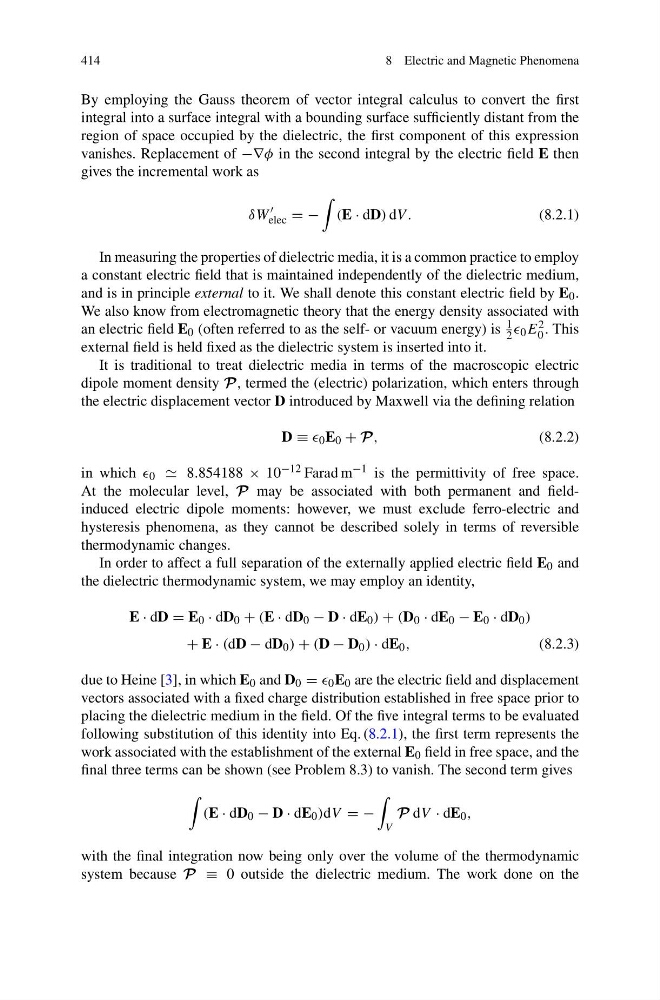
By employing the Gauss theorem of vector integral calculus to convert the first
integral into a surface integral with a bounding surface sufficiently distant from the
region of space occupied by the dielectric, the first component of this expression
vanishes. Replacement of −∇φ in the second integral by the electric field E then
gives the incremental work as
δW
elec = −
(E · dD) dV .
(8.2.1)
In measuring the properties of dielectric media, it is a common practice to employ
a constant electric field that is maintained independently of the dielectric medium,
and is in principle external to it. We shall denote this constant electric field by E 0 .
We also know from electromagnetic theory that the energy density associated with
an electric field E 0 (often referred to as the self- or vacuum energy) is
1
2 0 E 2
0 . This
external field is held fixed as the dielectric system is inserted into it.
It is traditional to treat dielectric media in terms of the macroscopic electric
dipole moment density P, termed the (electric) polarization, which enters through
the electric displacement vector D introduced by Maxwell via the defining relation
D ≡ 0 E 0 + P,
(8.2.2)
in which 0 8.854188 × 10 −12 Farad m −1 is the permittivity of free space.
At the molecular level, P may be associated with both permanent and fieldinduced electric dipole moments: however, we must exclude ferro-electric and
hysteresis phenomena, as they cannot be described solely in terms of reversible
thermodynamic changes.
In order to affect a full separation of the externally applied electric field E 0 and
the dielectric thermodynamic system, we may employ an identity,
E · dD = E 0 · dD 0 + (E · dD 0 − D · dE 0 ) + (D 0 · dE 0 − E 0 · dD 0 )
+ E · (dD − dD 0 ) + (D − D 0 ) · dE 0 ,
(8.2.3)
due to Heine [3], in which E 0 and D 0 = 0 E 0 are the electric field and displacement
vectors associated with a fixed charge distribution established in free space prior to
placing the dielectric medium in the field. Of the five integral terms to be evaluated
following substitution of this identity into Eq. (8.2.1), the first term represents the
work associated with the establishment of the external E 0 field in free space, and the
final three terms can be shown (see Problem 8.3) to vanish. The second term gives
(E · dD 0 − D · dE 0 )dV = −
V
P dV · dE 0 ,
with the final integration now being only over the volume of the thermodynamic
system because P ≡ 0 outside the dielectric medium. The work done on the
8 Electric and Magnetic Phenomena
By employing the Gauss theorem of vector integral calculus to convert the first
integral into a surface integral with a bounding surface sufficiently distant from the
region of space occupied by the dielectric, the first component of this expression
vanishes. Replacement of −∇φ in the second integral by the electric field E then
gives the incremental work as
δW
elec = −
(E · dD) dV .
(8.2.1)
In measuring the properties of dielectric media, it is a common practice to employ
a constant electric field that is maintained independently of the dielectric medium,
and is in principle external to it. We shall denote this constant electric field by E 0 .
We also know from electromagnetic theory that the energy density associated with
an electric field E 0 (often referred to as the self- or vacuum energy) is
1
2 0 E 2
0 . This
external field is held fixed as the dielectric system is inserted into it.
It is traditional to treat dielectric media in terms of the macroscopic electric
dipole moment density P, termed the (electric) polarization, which enters through
the electric displacement vector D introduced by Maxwell via the defining relation
D ≡ 0 E 0 + P,
(8.2.2)
in which 0 8.854188 × 10 −12 Farad m −1 is the permittivity of free space.
At the molecular level, P may be associated with both permanent and fieldinduced electric dipole moments: however, we must exclude ferro-electric and
hysteresis phenomena, as they cannot be described solely in terms of reversible
thermodynamic changes.
In order to affect a full separation of the externally applied electric field E 0 and
the dielectric thermodynamic system, we may employ an identity,
E · dD = E 0 · dD 0 + (E · dD 0 − D · dE 0 ) + (D 0 · dE 0 − E 0 · dD 0 )
+ E · (dD − dD 0 ) + (D − D 0 ) · dE 0 ,
(8.2.3)
due to Heine [3], in which E 0 and D 0 = 0 E 0 are the electric field and displacement
vectors associated with a fixed charge distribution established in free space prior to
placing the dielectric medium in the field. Of the five integral terms to be evaluated
following substitution of this identity into Eq. (8.2.1), the first term represents the
work associated with the establishment of the external E 0 field in free space, and the
final three terms can be shown (see Problem 8.3) to vanish. The second term gives
(E · dD 0 − D · dE 0 )dV = −
V
P dV · dE 0 ,
with the final integration now being only over the volume of the thermodynamic
system because P ≡ 0 outside the dielectric medium. The work done on the