

8.2 Thermodynamics of Polarizable Media
413
μ
(m)
d = − g J ¯
hμ B J,
(8.1.2)
in which g J is called the Landé g-factor (whose value depends upon the set
of electronic angular momentum quantum numbers characterizing the atom or
molecule), while μ B ≡ 9.2740101 × 10 −24 J T −1 is the Bohr magneton (the basic
unit for electronic magnetic dipole moments).
8.2 Thermodynamics of Polarizable Media
A polarizable medium consists of molecules that possess permanent electric dipole
moments or molecules in which an electric dipole moment can be induced by an
applied electric field. An appropriate thermodynamic system thus consists of an
amount of a polarizable substance bounded by a surface (for example, lying between
a pair of flat condenser plates) and subject to a time-independent electric field, E(r),
produced by a conductor carrying charge q.
It has been pointed out by Honig [2] that considerable care should be exercised
when dealing with the thermodynamics of dielectric media in the presence of
external electric fields. We shall consider a macroscopic volume V of a dielectric
material that is surrounded by free space, maintained at a specified electrostatic
potential φ(r), and has a charge density ρ(r) consistent with the Maxwell equation,
∇ · D(r) = ρ(r),
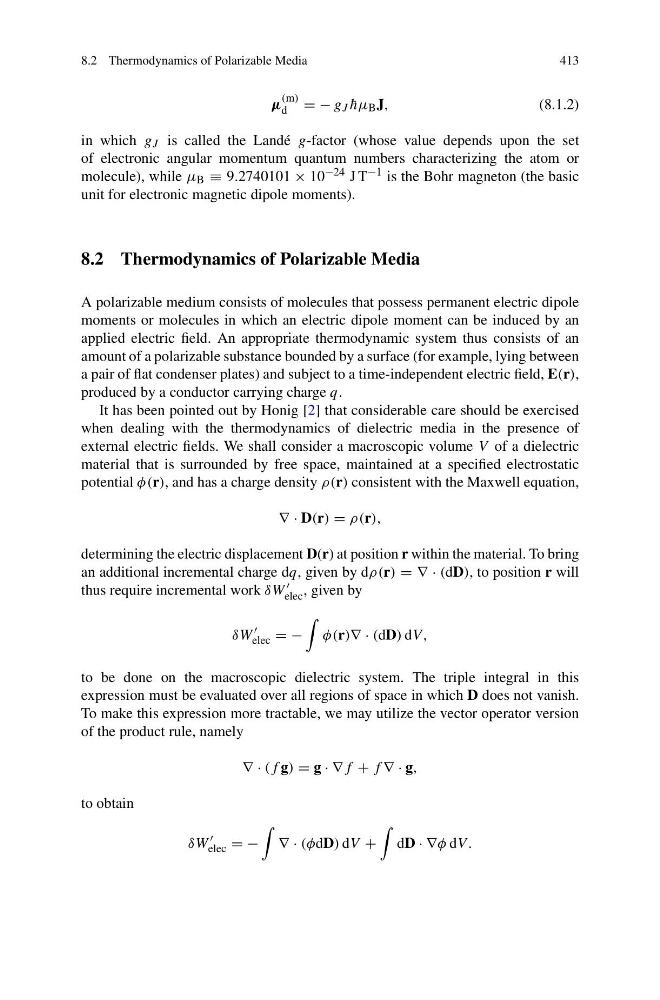
determining the electric displacement D(r) at position r within the material. To bring
an additional incremental charge dq, given by dρ(r) = ∇ · (dD), to position r will
thus require incremental work δW
elec , given by
δW
elec = −
φ(r)∇ · (dD) dV ,
to be done on the macroscopic dielectric system. The triple integral in this
expression must be evaluated over all regions of space in which D does not vanish.
To make this expression more tractable, we may utilize the vector operator version
of the product rule, namely
∇ · (f g) = g · ∇f + f ∇ · g,
to obtain
δW
elec = −
∇ · (φdD) dV +
dD · ∇φ dV .
413
μ
(m)
d = − g J ¯
hμ B J,
(8.1.2)
in which g J is called the Landé g-factor (whose value depends upon the set
of electronic angular momentum quantum numbers characterizing the atom or
molecule), while μ B ≡ 9.2740101 × 10 −24 J T −1 is the Bohr magneton (the basic
unit for electronic magnetic dipole moments).
8.2 Thermodynamics of Polarizable Media
A polarizable medium consists of molecules that possess permanent electric dipole
moments or molecules in which an electric dipole moment can be induced by an
applied electric field. An appropriate thermodynamic system thus consists of an
amount of a polarizable substance bounded by a surface (for example, lying between
a pair of flat condenser plates) and subject to a time-independent electric field, E(r),
produced by a conductor carrying charge q.
It has been pointed out by Honig [2] that considerable care should be exercised
when dealing with the thermodynamics of dielectric media in the presence of
external electric fields. We shall consider a macroscopic volume V of a dielectric
material that is surrounded by free space, maintained at a specified electrostatic
potential φ(r), and has a charge density ρ(r) consistent with the Maxwell equation,
∇ · D(r) = ρ(r),
determining the electric displacement D(r) at position r within the material. To bring
an additional incremental charge dq, given by dρ(r) = ∇ · (dD), to position r will
thus require incremental work δW
elec , given by
δW
elec = −
φ(r)∇ · (dD) dV ,
to be done on the macroscopic dielectric system. The triple integral in this
expression must be evaluated over all regions of space in which D does not vanish.
To make this expression more tractable, we may utilize the vector operator version
of the product rule, namely
∇ · (f g) = g · ∇f + f ∇ · g,
to obtain
δW
elec = −
∇ · (φdD) dV +
dD · ∇φ dV .