

1.5 Problems for This Chapter
25
σ n
n
=
(Npq)
1
2
Np
=
q
p
1
2
1
√
N
,
(1.4.23)
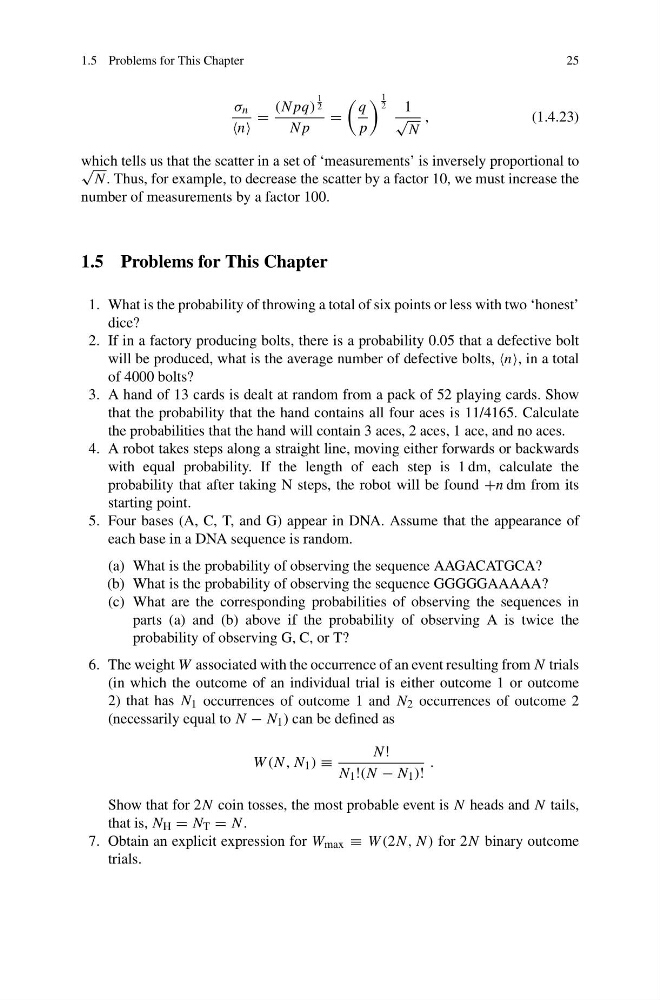
which tells us that the scatter in a set of ‘measurements’ is inversely proportional to
√
N. Thus, for example, to decrease the scatter by a factor 10, we must increase the
number of measurements by a factor 100.
1.5 Problems for This Chapter
1. What is the probability of throwing a total of six points or less with two ‘honest’
dice?
2. If in a factory producing bolts, there is a probability 0.05 that a defective bolt
will be produced, what is the average number of defective bolts, n, in a total
of 4000 bolts?
3. A hand of 13 cards is dealt at random from a pack of 52 playing cards. Show
that the probability that the hand contains all four aces is 11/4165. Calculate
the probabilities that the hand will contain 3 aces, 2 aces, 1 ace, and no aces.
4. A robot takes steps along a straight line, moving either forwards or backwards
with equal probability. If the length of each step is 1 dm, calculate the
probability that after taking N steps, the robot will be found +n dm from its
starting point.
5. Four bases (A, C, T, and G) appear in DNA. Assume that the appearance of
each base in a DNA sequence is random.
(a) What is the probability of observing the sequence AAGACATGCA?
(b) What is the probability of observing the sequence GGGGGAAAAA?
(c) What are the corresponding probabilities of observing the sequences in
parts (a) and (b) above if the probability of observing A is twice the
probability of observing G, C, or T?
6. The weight W associated with the occurrence of an event resulting from N trials
(in which the outcome of an individual trial is either outcome 1 or outcome
2) that has N 1 occurrences of outcome 1 and N 2 occurrences of outcome 2
(necessarily equal to N − N 1 ) can be defined as
W (N, N 1 ) ≡
N !
N 1 !(N − N 1 )!
.
Show that for 2N coin tosses, the most probable event is N heads and N tails,
that is, N H = N T = N.
7. Obtain an explicit expression for W max ≡ W (2N, N) for 2N binary outcome
trials.
25
σ n
n
=
(Npq)
1
2
Np
=
q
p
1
2
1
√
N
,
(1.4.23)
which tells us that the scatter in a set of ‘measurements’ is inversely proportional to
√
N. Thus, for example, to decrease the scatter by a factor 10, we must increase the
number of measurements by a factor 100.
1.5 Problems for This Chapter
1. What is the probability of throwing a total of six points or less with two ‘honest’
dice?
2. If in a factory producing bolts, there is a probability 0.05 that a defective bolt
will be produced, what is the average number of defective bolts, n, in a total
of 4000 bolts?
3. A hand of 13 cards is dealt at random from a pack of 52 playing cards. Show
that the probability that the hand contains all four aces is 11/4165. Calculate
the probabilities that the hand will contain 3 aces, 2 aces, 1 ace, and no aces.
4. A robot takes steps along a straight line, moving either forwards or backwards
with equal probability. If the length of each step is 1 dm, calculate the
probability that after taking N steps, the robot will be found +n dm from its
starting point.
5. Four bases (A, C, T, and G) appear in DNA. Assume that the appearance of
each base in a DNA sequence is random.
(a) What is the probability of observing the sequence AAGACATGCA?
(b) What is the probability of observing the sequence GGGGGAAAAA?
(c) What are the corresponding probabilities of observing the sequences in
parts (a) and (b) above if the probability of observing A is twice the
probability of observing G, C, or T?
6. The weight W associated with the occurrence of an event resulting from N trials
(in which the outcome of an individual trial is either outcome 1 or outcome
2) that has N 1 occurrences of outcome 1 and N 2 occurrences of outcome 2
(necessarily equal to N − N 1 ) can be defined as
W (N, N 1 ) ≡
N !
N 1 !(N − N 1 )!
.
Show that for 2N coin tosses, the most probable event is N heads and N tails,
that is, N H = N T = N.
7. Obtain an explicit expression for W max ≡ W (2N, N) for 2N binary outcome
trials.