

362
7 Classical Statistical Mechanics
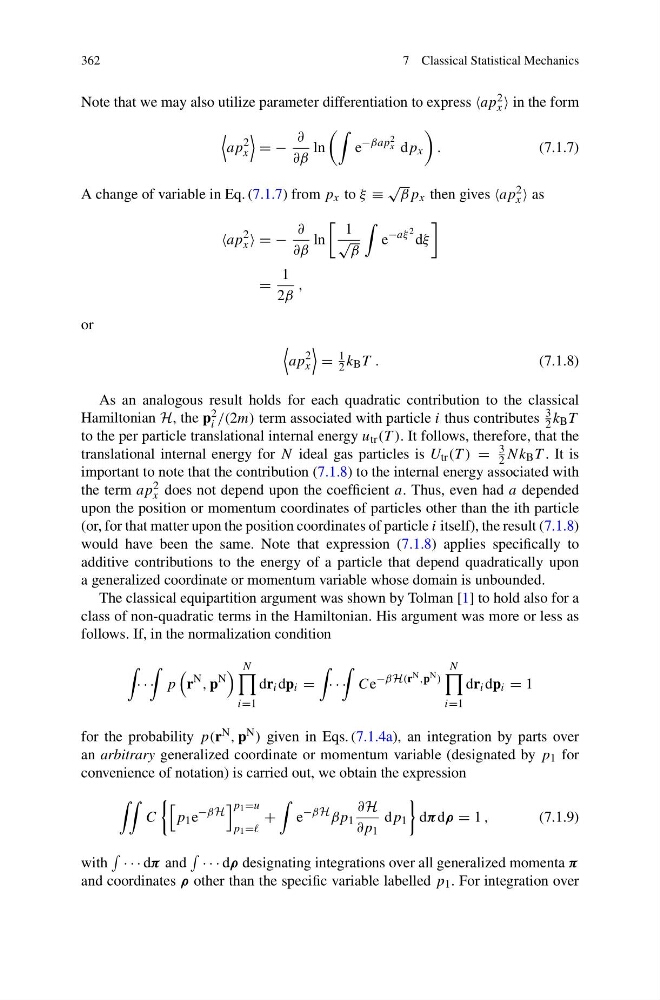
Note that we may also utilize parameter differentiation to express ap 2
x in the form
ap
2
x
= −
∂
∂β
ln
e
−βap 2
x dp x
.
(7.1.7)
A change of variable in Eq. (7.1.7) from p x to ξ ≡
√
βp x then gives ap 2
x as
ap
2
x = −
∂
∂β
ln
1
√
β
e
−aξ 2 dξ
=
1
2β
,
or
ap
2
x
=
1
2 k B T .
(7.1.8)
As an analogous result holds for each quadratic contribution to the classical
Hamiltonian H, the p 2
i /(2m) term associated with particle i thus contributes
3
2 k B T
to the per particle translational internal energy u tr (T ). It follows, therefore, that the
translational internal energy for N ideal gas particles is U tr (T ) =
3
2 Nk B T . It is
important to note that the contribution (7.1.8) to the internal energy associated with
the term ap 2
x does not depend upon the coefficient a. Thus, even had a depended
upon the position or momentum coordinates of particles other than the ith particle
(or, for that matter upon the position coordinates of particle i itself), the result (7.1.8)
would have been the same. Note that expression (7.1.8) applies specifically to
additive contributions to the energy of a particle that depend quadratically upon
a generalized coordinate or momentum variable whose domain is unbounded.
The classical equipartition argument was shown by Tolman [1] to hold also for a
class of non-quadratic terms in the Hamiltonian. His argument was more or less as
follows. If, in the normalization condition
· · ·
p
r
N , p
N
N
i=1
dr i dp i =
· · ·
Ce
−βH(r N ,p N )
N
i=1
dr i dp i = 1
for the probability p(r N , p N ) given in Eqs. (7.1.4a), an integration by parts over
an arbitrary generalized coordinate or momentum variable (designated by p 1 for
convenience of notation) is carried out, we obtain the expression
C
p 1 e
−βH
p 1 =u
p 1 =
+
e
−βH βp 1
∂H
∂p 1
dp 1
dπ dρ = 1 ,
(7.1.9)
with
· · · dπ and
· · · dρ designating integrations over all generalized momenta π
and coordinates ρ other than the specific variable labelled p 1 . For integration over
7 Classical Statistical Mechanics
Note that we may also utilize parameter differentiation to express ap 2
x in the form
ap
2
x
= −
∂
∂β
ln
e
−βap 2
x dp x
.
(7.1.7)
A change of variable in Eq. (7.1.7) from p x to ξ ≡
√
βp x then gives ap 2
x as
ap
2
x = −
∂
∂β
ln
1
√
β
e
−aξ 2 dξ
=
1
2β
,
or
ap
2
x
=
1
2 k B T .
(7.1.8)
As an analogous result holds for each quadratic contribution to the classical
Hamiltonian H, the p 2
i /(2m) term associated with particle i thus contributes
3
2 k B T
to the per particle translational internal energy u tr (T ). It follows, therefore, that the
translational internal energy for N ideal gas particles is U tr (T ) =
3
2 Nk B T . It is
important to note that the contribution (7.1.8) to the internal energy associated with
the term ap 2
x does not depend upon the coefficient a. Thus, even had a depended
upon the position or momentum coordinates of particles other than the ith particle
(or, for that matter upon the position coordinates of particle i itself), the result (7.1.8)
would have been the same. Note that expression (7.1.8) applies specifically to
additive contributions to the energy of a particle that depend quadratically upon
a generalized coordinate or momentum variable whose domain is unbounded.
The classical equipartition argument was shown by Tolman [1] to hold also for a
class of non-quadratic terms in the Hamiltonian. His argument was more or less as
follows. If, in the normalization condition
· · ·
p
r
N , p
N
N
i=1
dr i dp i =
· · ·
Ce
−βH(r N ,p N )
N
i=1
dr i dp i = 1
for the probability p(r N , p N ) given in Eqs. (7.1.4a), an integration by parts over
an arbitrary generalized coordinate or momentum variable (designated by p 1 for
convenience of notation) is carried out, we obtain the expression
C
p 1 e
−βH
p 1 =u
p 1 =
+
e
−βH βp 1
∂H
∂p 1
dp 1
dπ dρ = 1 ,
(7.1.9)
with
· · · dπ and
· · · dρ designating integrations over all generalized momenta π
and coordinates ρ other than the specific variable labelled p 1 . For integration over