

7.1 Introduction
361
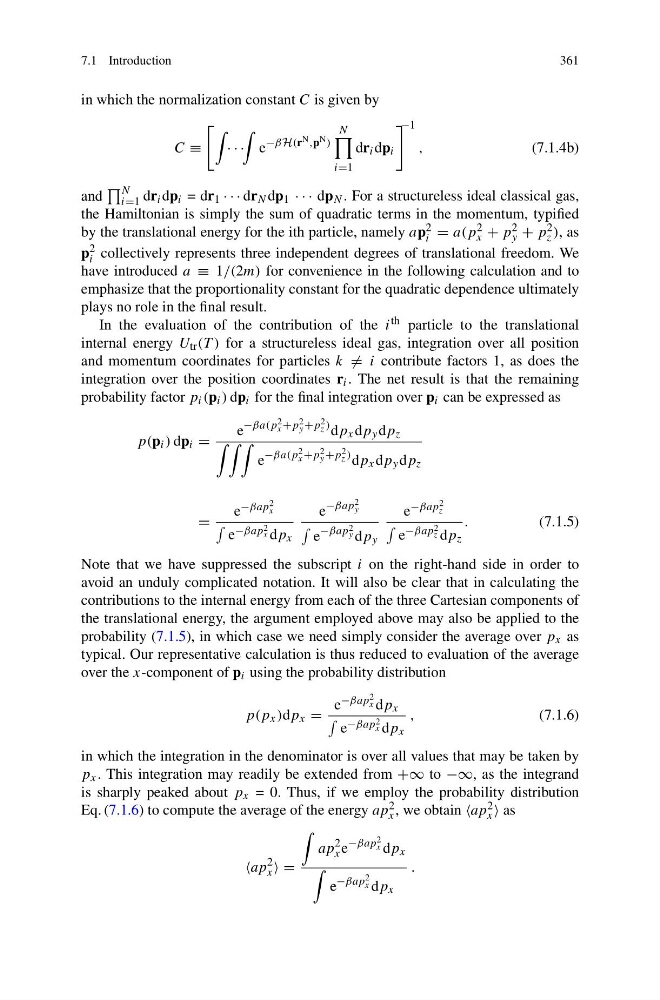
in which the normalization constant C is given by
C ≡
· · ·
e
−βH(r N ,p N )
N
i=1
dr i dp i
−1
,
(7.1.4b)
and
N
i=1 dr i dp i = dr 1 · · · dr N dp 1 · · · dp N . For a structureless ideal classical gas,
the Hamiltonian is simply the sum of quadratic terms in the momentum, typified
by the translational energy for the ith particle, namely ap 2
i = a(p 2
x + p 2
y + p 2
z ), as
p 2
i collectively represents three independent degrees of translational freedom. We
have introduced a ≡ 1/(2m) for convenience in the following calculation and to
emphasize that the proportionality constant for the quadratic dependence ultimately
plays no role in the final result.
In the evaluation of the contribution of the i th particle to the translational
internal energy U tr (T ) for a structureless ideal gas, integration over all position
and momentum coordinates for particles k = i contribute factors 1, as does the
integration over the position coordinates r i . The net result is that the remaining
probability factor p i (p i ) dp i for the final integration over p i can be expressed as
p(p i ) dp i =
e
−βa(p 2
x +p 2
y +p 2
z ) dp x dp y dp z
e
−βa(p 2
x +p 2
y +p 2
z ) dp x dp y dp z
=
e −βap 2
x
e −βap 2
x dp x
e
−βap 2
y
e
−βap 2
y dp y
e −βap 2
z
e −βap 2
z dp z
.
(7.1.5)
Note that we have suppressed the subscript i on the right-hand side in order to
avoid an unduly complicated notation. It will also be clear that in calculating the
contributions to the internal energy from each of the three Cartesian components of
the translational energy, the argument employed above may also be applied to the
probability (7.1.5), in which case we need simply consider the average over p x as
typical. Our representative calculation is thus reduced to evaluation of the average
over the x-component of p i using the probability distribution
p(p x )dp x =
e −βap 2
x dp x
e −βap 2
x dp x
,
(7.1.6)
in which the integration in the denominator is over all values that may be taken by
p x . This integration may readily be extended from +∞ to −∞, as the integrand
is sharply peaked about p x = 0. Thus, if we employ the probability distribution
Eq. (7.1.6) to compute the average of the energy ap 2
x , we obtain ap 2
x as
ap
2
x =
ap
2
x e
−βap 2
x dp x
e
−βap 2
x dp x
.
361
in which the normalization constant C is given by
C ≡
· · ·
e
−βH(r N ,p N )
N
i=1
dr i dp i
−1
,
(7.1.4b)
and
N
i=1 dr i dp i = dr 1 · · · dr N dp 1 · · · dp N . For a structureless ideal classical gas,
the Hamiltonian is simply the sum of quadratic terms in the momentum, typified
by the translational energy for the ith particle, namely ap 2
i = a(p 2
x + p 2
y + p 2
z ), as
p 2
i collectively represents three independent degrees of translational freedom. We
have introduced a ≡ 1/(2m) for convenience in the following calculation and to
emphasize that the proportionality constant for the quadratic dependence ultimately
plays no role in the final result.
In the evaluation of the contribution of the i th particle to the translational
internal energy U tr (T ) for a structureless ideal gas, integration over all position
and momentum coordinates for particles k = i contribute factors 1, as does the
integration over the position coordinates r i . The net result is that the remaining
probability factor p i (p i ) dp i for the final integration over p i can be expressed as
p(p i ) dp i =
e
−βa(p 2
x +p 2
y +p 2
z ) dp x dp y dp z
e
−βa(p 2
x +p 2
y +p 2
z ) dp x dp y dp z
=
e −βap 2
x
e −βap 2
x dp x
e
−βap 2
y
e
−βap 2
y dp y
e −βap 2
z
e −βap 2
z dp z
.
(7.1.5)
Note that we have suppressed the subscript i on the right-hand side in order to
avoid an unduly complicated notation. It will also be clear that in calculating the
contributions to the internal energy from each of the three Cartesian components of
the translational energy, the argument employed above may also be applied to the
probability (7.1.5), in which case we need simply consider the average over p x as
typical. Our representative calculation is thus reduced to evaluation of the average
over the x-component of p i using the probability distribution
p(p x )dp x =
e −βap 2
x dp x
e −βap 2
x dp x
,
(7.1.6)
in which the integration in the denominator is over all values that may be taken by
p x . This integration may readily be extended from +∞ to −∞, as the integrand
is sharply peaked about p x = 0. Thus, if we employ the probability distribution
Eq. (7.1.6) to compute the average of the energy ap 2
x , we obtain ap 2
x as
ap
2
x =
ap
2
x e
−βap 2
x dp x
e
−βap 2
x dp x
.