

346
6 Molecular Systems
100
200
300
400
500
600
700
0.4
0.5
0.6
0.7
0.8
0.9
1.
1.1
T /K
C
V /R
C 2 H 6
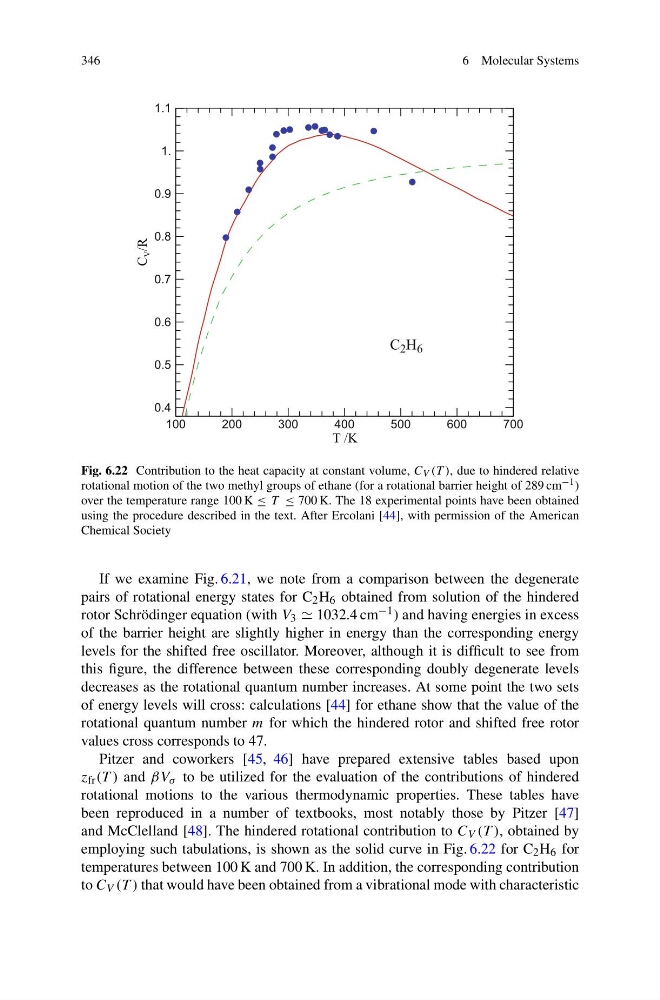
Fig. 6.22 Contribution to the heat capacity at constant volume, C V (T ), due to hindered relative
rotational motion of the two methyl groups of ethane (for a rotational barrier height of 289 cm −1 )
over the temperature range 100 K ≤ T ≤ 700 K. The 18 experimental points have been obtained
using the procedure described in the text. After Ercolani [44], with permission of the American
Chemical Society
If we examine Fig. 6.21, we note from a comparison between the degenerate
pairs of rotational energy states for C 2 H 6 obtained from solution of the hindered
rotor Schrödinger equation (with V 3 1032.4 cm −1 ) and having energies in excess
of the barrier height are slightly higher in energy than the corresponding energy
levels for the shifted free oscillator. Moreover, although it is difficult to see from
this figure, the difference between these corresponding doubly degenerate levels
decreases as the rotational quantum number increases. At some point the two sets
of energy levels will cross: calculations [44] for ethane show that the value of the
rotational quantum number m for which the hindered rotor and shifted free rotor
values cross corresponds to 47.
Pitzer and coworkers [45, 46] have prepared extensive tables based upon
z fr (T ) and βV σ to be utilized for the evaluation of the contributions of hindered
rotational motions to the various thermodynamic properties. These tables have
been reproduced in a number of textbooks, most notably those by Pitzer [47]
and McClelland [48]. The hindered rotational contribution to C V (T ), obtained by
employing such tabulations, is shown as the solid curve in Fig. 6.22 for C 2 H 6 for
temperatures between 100 K and 700 K. In addition, the corresponding contribution
to C V (T ) that would have been obtained from a vibrational mode with characteristic
6 Molecular Systems
100
200
300
400
500
600
700
0.4
0.5
0.6
0.7
0.8
0.9
1.
1.1
T /K
C
V /R
C 2 H 6
Fig. 6.22 Contribution to the heat capacity at constant volume, C V (T ), due to hindered relative
rotational motion of the two methyl groups of ethane (for a rotational barrier height of 289 cm −1 )
over the temperature range 100 K ≤ T ≤ 700 K. The 18 experimental points have been obtained
using the procedure described in the text. After Ercolani [44], with permission of the American
Chemical Society
If we examine Fig. 6.21, we note from a comparison between the degenerate
pairs of rotational energy states for C 2 H 6 obtained from solution of the hindered
rotor Schrödinger equation (with V 3 1032.4 cm −1 ) and having energies in excess
of the barrier height are slightly higher in energy than the corresponding energy
levels for the shifted free oscillator. Moreover, although it is difficult to see from
this figure, the difference between these corresponding doubly degenerate levels
decreases as the rotational quantum number increases. At some point the two sets
of energy levels will cross: calculations [44] for ethane show that the value of the
rotational quantum number m for which the hindered rotor and shifted free rotor
values cross corresponds to 47.
Pitzer and coworkers [45, 46] have prepared extensive tables based upon
z fr (T ) and βV σ to be utilized for the evaluation of the contributions of hindered
rotational motions to the various thermodynamic properties. These tables have
been reproduced in a number of textbooks, most notably those by Pitzer [47]
and McClelland [48]. The hindered rotational contribution to C V (T ), obtained by
employing such tabulations, is shown as the solid curve in Fig. 6.22 for C 2 H 6 for
temperatures between 100 K and 700 K. In addition, the corresponding contribution
to C V (T ) that would have been obtained from a vibrational mode with characteristic