

6.6 Effect of Hindered Rotational Motions
345
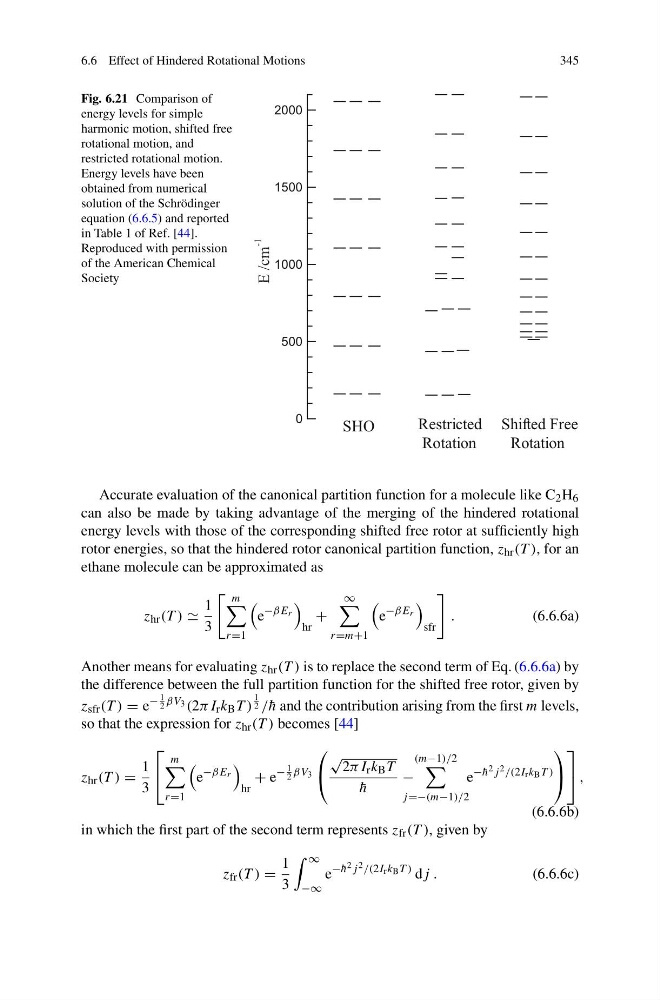
Fig. 6.21 Comparison of
energy levels for simple
harmonic motion, shifted free
rotational motion, and
restricted rotational motion.
Energy levels have been
obtained from numerical
solution of the Schrödinger
equation (6.6.5) and reported
in Table 1 of Ref. [44].
Reproduced with permission
of the American Chemical
Society
0
500
1000
1500
2000
SHO
Restricted
Rotation
Shifted Free
Rotation
Accurate evaluation of the canonical partition function for a molecule like C 2 H 6
can also be made by taking advantage of the merging of the hindered rotational
energy levels with those of the corresponding shifted free rotor at sufficiently high
rotor energies, so that the hindered rotor canonical partition function, z hr (T ), for an
ethane molecule can be approximated as
z hr (T )
1
3
m
r=1
e
−βE r
hr
+
∞
r=m+1
e
−βE r
sfr
.
(6.6.6a)
Another means for evaluating z hr (T ) is to replace the second term of Eq. (6.6.6a) by
the difference between the full partition function for the shifted free rotor, given by
z sfr (T ) = e
−
1
2 βV 3 (2πI r k B T )
1
2 / ¯
h and the contribution arising from the first m levels,
so that the expression for z hr (T ) becomes [44]
z hr (T ) =
1
3
⎡
⎣
m
r=1
e
−βE r
hr
+ e
−
1
2 βV 3
⎛
⎝
√
2πI r k B T
¯
h
−
(m−1)/2
j =−(m−1)/2
e
−¯ h 2 j 2 /(2I r k B T )
⎞
⎠
⎤
⎦ ,
(6.6.6b)
in which the first part of the second term represents z fr (T ), given by
z fr (T ) =
1
3
∞
−∞
e
−¯ h 2 j 2 /(2I r k B T ) dj .
(6.6.6c)
345
Fig. 6.21 Comparison of
energy levels for simple
harmonic motion, shifted free
rotational motion, and
restricted rotational motion.
Energy levels have been
obtained from numerical
solution of the Schrödinger
equation (6.6.5) and reported
in Table 1 of Ref. [44].
Reproduced with permission
of the American Chemical
Society
0
500
1000
1500
2000
SHO
Restricted
Rotation
Shifted Free
Rotation
Accurate evaluation of the canonical partition function for a molecule like C 2 H 6
can also be made by taking advantage of the merging of the hindered rotational
energy levels with those of the corresponding shifted free rotor at sufficiently high
rotor energies, so that the hindered rotor canonical partition function, z hr (T ), for an
ethane molecule can be approximated as
z hr (T )
1
3
m
r=1
e
−βE r
hr
+
∞
r=m+1
e
−βE r
sfr
.
(6.6.6a)
Another means for evaluating z hr (T ) is to replace the second term of Eq. (6.6.6a) by
the difference between the full partition function for the shifted free rotor, given by
z sfr (T ) = e
−
1
2 βV 3 (2πI r k B T )
1
2 / ¯
h and the contribution arising from the first m levels,
so that the expression for z hr (T ) becomes [44]
z hr (T ) =
1
3
⎡
⎣
m
r=1
e
−βE r
hr
+ e
−
1
2 βV 3
⎛
⎝
√
2πI r k B T
¯
h
−
(m−1)/2
j =−(m−1)/2
e
−¯ h 2 j 2 /(2I r k B T )
⎞
⎠
⎤
⎦ ,
(6.6.6b)
in which the first part of the second term represents z fr (T ), given by
z fr (T ) =
1
3
∞
−∞
e
−¯ h 2 j 2 /(2I r k B T ) dj .
(6.6.6c)