

332
6 Molecular Systems
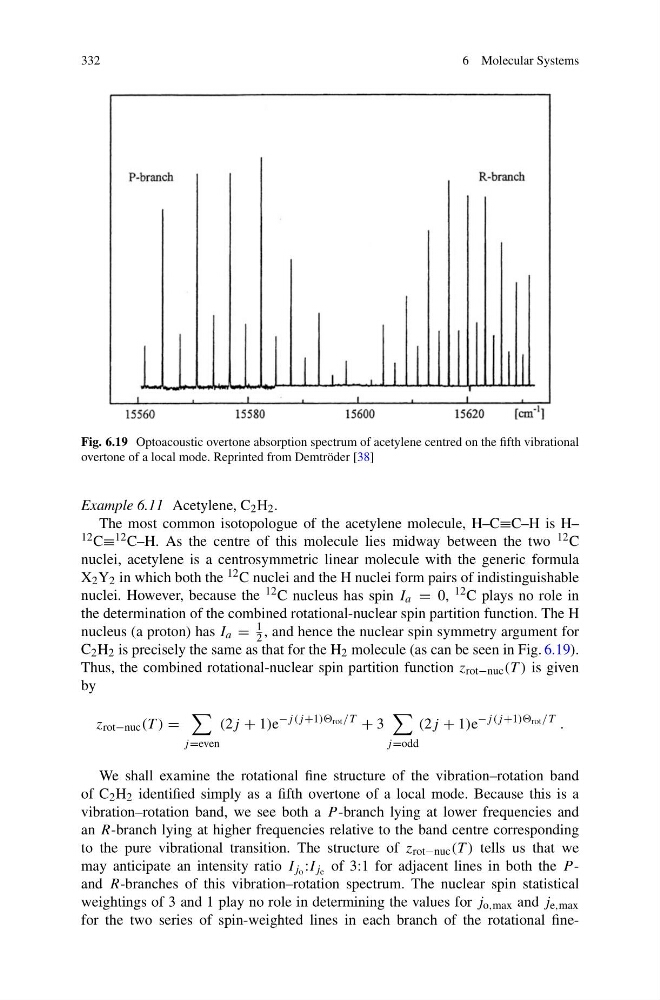
Fig. 6.19 Optoacoustic overtone absorption spectrum of acetylene centred on the fifth vibrational
overtone of a local mode. Reprinted from Demtröder [38]
Example 6.11 Acetylene, C 2 H 2 .
The most common isotopologue of the acetylene molecule, H–C≡C–H is H–
12 C≡ 12 C–H. As the centre of this molecule lies midway between the two 12 C
nuclei, acetylene is a centrosymmetric linear molecule with the generic formula
X 2 Y 2 in which both the 12 C nuclei and the H nuclei form pairs of indistinguishable
nuclei. However, because the 12 C nucleus has spin I a = 0, 12 C plays no role in
the determination of the combined rotational-nuclear spin partition function. The H
nucleus (a proton) has I a =
1
2 , and hence the nuclear spin symmetry argument for
C 2 H 2 is precisely the same as that for the H 2 molecule (as can be seen in Fig. 6.19).
Thus, the combined rotational-nuclear spin partition function z rot−nuc (T ) is given
by
z rot−nuc (T ) =
j =even
(2j + 1)e
−j (j+1)) rot /T
+ 3
j =odd
(2j + 1)e
−j (j+1)) rot /T .
We shall examine the rotational fine structure of the vibration–rotation band
of C 2 H 2 identified simply as a fifth overtone of a local mode. Because this is a
vibration–rotation band, we see both a P -branch lying at lower frequencies and
an R-branch lying at higher frequencies relative to the band centre corresponding
to the pure vibrational transition. The structure of z rot−nuc (T ) tells us that we
may anticipate an intensity ratio I j o :I j e of 3:1 for adjacent lines in both the P -
and R-branches of this vibration–rotation spectrum. The nuclear spin statistical
weightings of 3 and 1 play no role in determining the values for j o,max and j e,max
for the two series of spin-weighted lines in each branch of the rotational fine-
6 Molecular Systems
Fig. 6.19 Optoacoustic overtone absorption spectrum of acetylene centred on the fifth vibrational
overtone of a local mode. Reprinted from Demtröder [38]
Example 6.11 Acetylene, C 2 H 2 .
The most common isotopologue of the acetylene molecule, H–C≡C–H is H–
12 C≡ 12 C–H. As the centre of this molecule lies midway between the two 12 C
nuclei, acetylene is a centrosymmetric linear molecule with the generic formula
X 2 Y 2 in which both the 12 C nuclei and the H nuclei form pairs of indistinguishable
nuclei. However, because the 12 C nucleus has spin I a = 0, 12 C plays no role in
the determination of the combined rotational-nuclear spin partition function. The H
nucleus (a proton) has I a =
1
2 , and hence the nuclear spin symmetry argument for
C 2 H 2 is precisely the same as that for the H 2 molecule (as can be seen in Fig. 6.19).
Thus, the combined rotational-nuclear spin partition function z rot−nuc (T ) is given
by
z rot−nuc (T ) =
j =even
(2j + 1)e
−j (j+1)) rot /T
+ 3
j =odd
(2j + 1)e
−j (j+1)) rot /T .
We shall examine the rotational fine structure of the vibration–rotation band
of C 2 H 2 identified simply as a fifth overtone of a local mode. Because this is a
vibration–rotation band, we see both a P -branch lying at lower frequencies and
an R-branch lying at higher frequencies relative to the band centre corresponding
to the pure vibrational transition. The structure of z rot−nuc (T ) tells us that we
may anticipate an intensity ratio I j o :I j e of 3:1 for adjacent lines in both the P -
and R-branches of this vibration–rotation spectrum. The nuclear spin statistical
weightings of 3 and 1 play no role in determining the values for j o,max and j e,max
for the two series of spin-weighted lines in each branch of the rotational fine-