

6.4 Molecular Spectra: Nuclear Spin Effects
331
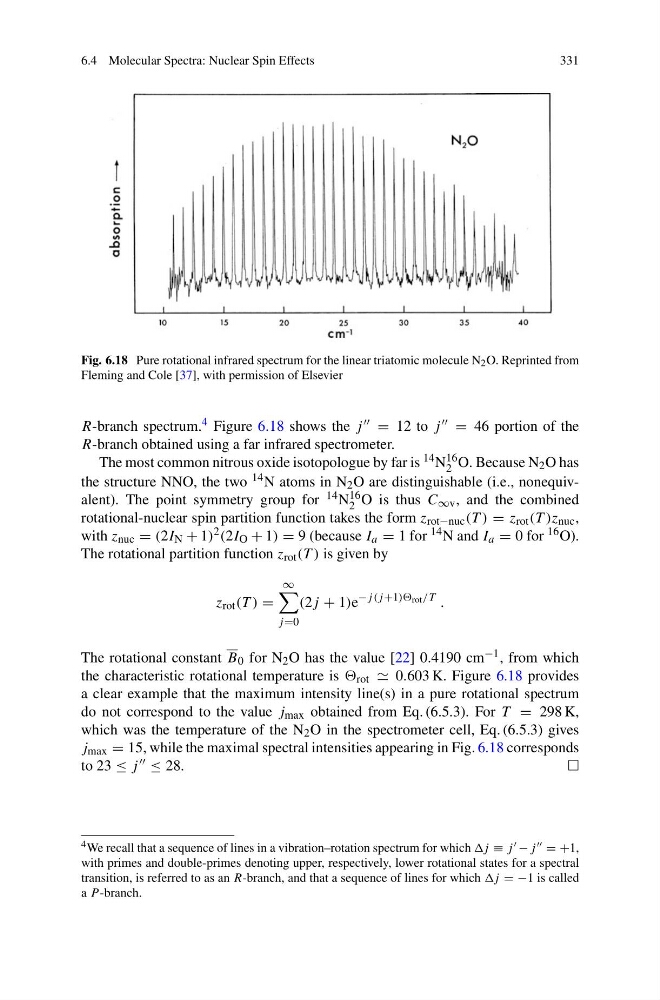
Fig. 6.18 Pure rotational infrared spectrum for the linear triatomic molecule N 2 O. Reprinted from
Fleming and Cole [37], with permission of Elsevier
R-branch spectrum. 4 Figure 6.18 shows the j = 12 to j = 46 portion of the
R-branch obtained using a far infrared spectrometer.
The most common nitrous oxide isotopologue by far is 14 N 16
2 O. Because N 2 O has
the structure NNO, the two 14 N atoms in N 2 O are distinguishable (i.e., nonequivalent). The point symmetry group for 14 N 16
2 O is thus C ∞v , and the combined
rotational-nuclear spin partition function takes the form z rot−nuc (T ) = z rot (T )z nuc ,
with z nuc = (2I N + 1) 2 (2I O + 1) = 9 (because I a = 1 for 14 N and I a = 0 for 16 O).
The rotational partition function z rot (T ) is given by
z rot (T ) =
∞
j =0
(2j + 1)e
−j (j+1)) rot /T .
The rotational constant B 0 for N 2 O has the value [22] 0.4190 cm −1 , from which
the characteristic rotational temperature is rot 0.603 K. Figure 6.18 provides
a clear example that the maximum intensity line(s) in a pure rotational spectrum
do not correspond to the value j max obtained from Eq. (6.5.3). For T = 298 K,
which was the temperature of the N 2 O in the spectrometer cell, Eq. (6.5.3) gives
j max = 15, while the maximal spectral intensities appearing in Fig. 6.18 corresponds
to 23 ≤ j ≤ 28.
4 We recall that a sequence of lines in a vibration–rotation spectrum for which ≡ j − j = +1,
with primes and double-primes denoting upper, respectively, lower rotational states for a spectral
transition, is referred to as an R-branch, and that a sequence of lines for which j = −1 is called
a P -branch.
331
Fig. 6.18 Pure rotational infrared spectrum for the linear triatomic molecule N 2 O. Reprinted from
Fleming and Cole [37], with permission of Elsevier
R-branch spectrum. 4 Figure 6.18 shows the j = 12 to j = 46 portion of the
R-branch obtained using a far infrared spectrometer.
The most common nitrous oxide isotopologue by far is 14 N 16
2 O. Because N 2 O has
the structure NNO, the two 14 N atoms in N 2 O are distinguishable (i.e., nonequivalent). The point symmetry group for 14 N 16
2 O is thus C ∞v , and the combined
rotational-nuclear spin partition function takes the form z rot−nuc (T ) = z rot (T )z nuc ,
with z nuc = (2I N + 1) 2 (2I O + 1) = 9 (because I a = 1 for 14 N and I a = 0 for 16 O).
The rotational partition function z rot (T ) is given by
z rot (T ) =
∞
j =0
(2j + 1)e
−j (j+1)) rot /T .
The rotational constant B 0 for N 2 O has the value [22] 0.4190 cm −1 , from which
the characteristic rotational temperature is rot 0.603 K. Figure 6.18 provides
a clear example that the maximum intensity line(s) in a pure rotational spectrum
do not correspond to the value j max obtained from Eq. (6.5.3). For T = 298 K,
which was the temperature of the N 2 O in the spectrometer cell, Eq. (6.5.3) gives
j max = 15, while the maximal spectral intensities appearing in Fig. 6.18 corresponds
to 23 ≤ j ≤ 28.
4 We recall that a sequence of lines in a vibration–rotation spectrum for which ≡ j − j = +1,
with primes and double-primes denoting upper, respectively, lower rotational states for a spectral
transition, is referred to as an R-branch, and that a sequence of lines for which j = −1 is called
a P -branch.