

6.4 Molecular Spectra: Nuclear Spin Effects
329
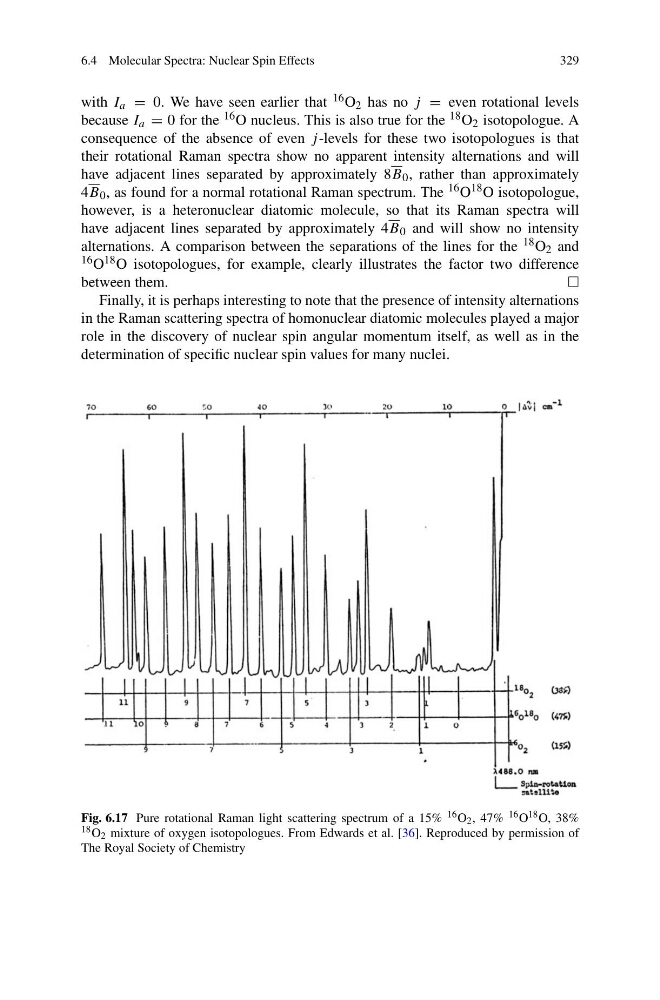
with I a = 0. We have seen earlier that 16 O 2 has no j = even rotational levels
because I a = 0 for the 16 O nucleus. This is also true for the 18 O 2 isotopologue. A
consequence of the absence of even j -levels for these two isotopologues is that
their rotational Raman spectra show no apparent intensity alternations and will
have adjacent lines separated by approximately 8B 0 , rather than approximately
4B 0 , as found for a normal rotational Raman spectrum. The 16 O 18 O isotopologue,
however, is a heteronuclear diatomic molecule, so that its Raman spectra will
have adjacent lines separated by approximately 4B 0 and will show no intensity
alternations. A comparison between the separations of the lines for the 18 O 2 and
16 O 18 O isotopologues, for example, clearly illustrates the factor two difference
between them.
Finally, it is perhaps interesting to note that the presence of intensity alternations
in the Raman scattering spectra of homonuclear diatomic molecules played a major
role in the discovery of nuclear spin angular momentum itself, as well as in the
determination of specific nuclear spin values for many nuclei.
Fig. 6.17 Pure rotational Raman light scattering spectrum of a 15% 16 O 2 , 47% 16 O 18 O, 38%
18 O 2 mixture of oxygen isotopologues. From Edwards et al. [36]. Reproduced by permission of
The Royal Society of Chemistry
329
with I a = 0. We have seen earlier that 16 O 2 has no j = even rotational levels
because I a = 0 for the 16 O nucleus. This is also true for the 18 O 2 isotopologue. A
consequence of the absence of even j -levels for these two isotopologues is that
their rotational Raman spectra show no apparent intensity alternations and will
have adjacent lines separated by approximately 8B 0 , rather than approximately
4B 0 , as found for a normal rotational Raman spectrum. The 16 O 18 O isotopologue,
however, is a heteronuclear diatomic molecule, so that its Raman spectra will
have adjacent lines separated by approximately 4B 0 and will show no intensity
alternations. A comparison between the separations of the lines for the 18 O 2 and
16 O 18 O isotopologues, for example, clearly illustrates the factor two difference
between them.
Finally, it is perhaps interesting to note that the presence of intensity alternations
in the Raman scattering spectra of homonuclear diatomic molecules played a major
role in the discovery of nuclear spin angular momentum itself, as well as in the
determination of specific nuclear spin values for many nuclei.
Fig. 6.17 Pure rotational Raman light scattering spectrum of a 15% 16 O 2 , 47% 16 O 18 O, 38%
18 O 2 mixture of oxygen isotopologues. From Edwards et al. [36]. Reproduced by permission of
The Royal Society of Chemistry