

6.4 Molecular Spectra: Nuclear Spin Effects
327
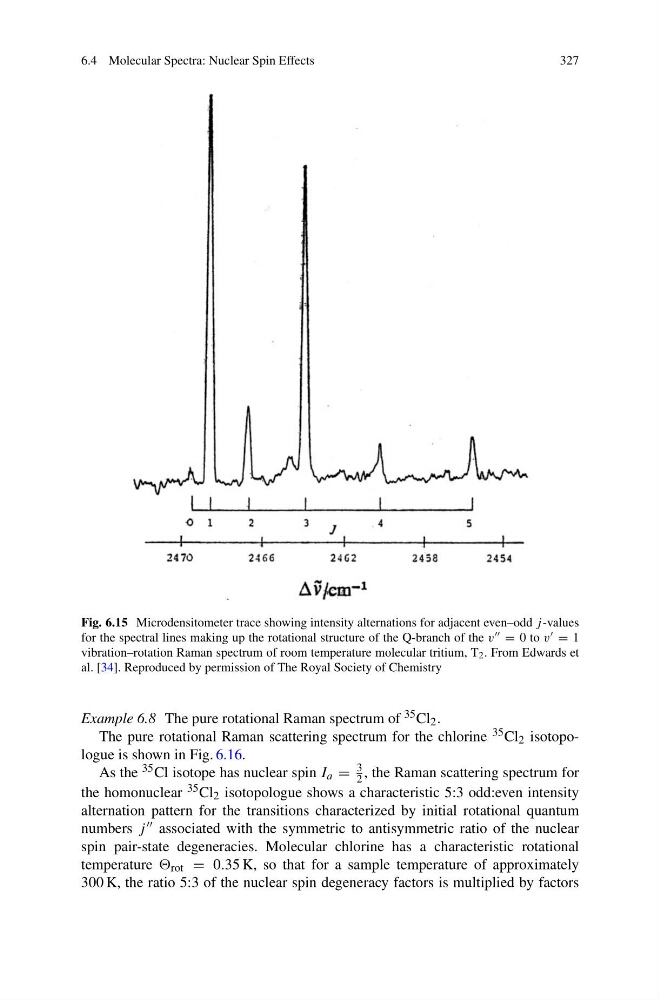
Fig. 6.15 Microdensitometer trace showing intensity alternations for adjacent even–odd j -values
for the spectral lines making up the rotational structure of the Q-branch of the v = 0 to v = 1
vibration–rotation Raman spectrum of room temperature molecular tritium, T 2 . From Edwards et
al. [34]. Reproduced by permission of The Royal Society of Chemistry
Example 6.8 The pure rotational Raman spectrum of 35 Cl 2 .
The pure rotational Raman scattering spectrum for the chlorine 35 Cl 2 isotopologue is shown in Fig. 6.16.
As the 35 Cl isotope has nuclear spin I a =
3
2 , the Raman scattering spectrum for
the homonuclear 35 Cl 2 isotopologue shows a characteristic 5:3 odd:even intensity
alternation pattern for the transitions characterized by initial rotational quantum
numbers j associated with the symmetric to antisymmetric ratio of the nuclear
spin pair-state degeneracies. Molecular chlorine has a characteristic rotational
temperature rot = 0.35 K, so that for a sample temperature of approximately
300 K, the ratio 5:3 of the nuclear spin degeneracy factors is multiplied by factors
327
Fig. 6.15 Microdensitometer trace showing intensity alternations for adjacent even–odd j -values
for the spectral lines making up the rotational structure of the Q-branch of the v = 0 to v = 1
vibration–rotation Raman spectrum of room temperature molecular tritium, T 2 . From Edwards et
al. [34]. Reproduced by permission of The Royal Society of Chemistry
Example 6.8 The pure rotational Raman spectrum of 35 Cl 2 .
The pure rotational Raman scattering spectrum for the chlorine 35 Cl 2 isotopologue is shown in Fig. 6.16.
As the 35 Cl isotope has nuclear spin I a =
3
2 , the Raman scattering spectrum for
the homonuclear 35 Cl 2 isotopologue shows a characteristic 5:3 odd:even intensity
alternation pattern for the transitions characterized by initial rotational quantum
numbers j associated with the symmetric to antisymmetric ratio of the nuclear
spin pair-state degeneracies. Molecular chlorine has a characteristic rotational
temperature rot = 0.35 K, so that for a sample temperature of approximately
300 K, the ratio 5:3 of the nuclear spin degeneracy factors is multiplied by factors