

6.4 Molecular Spectra: Nuclear Spin Effects
325
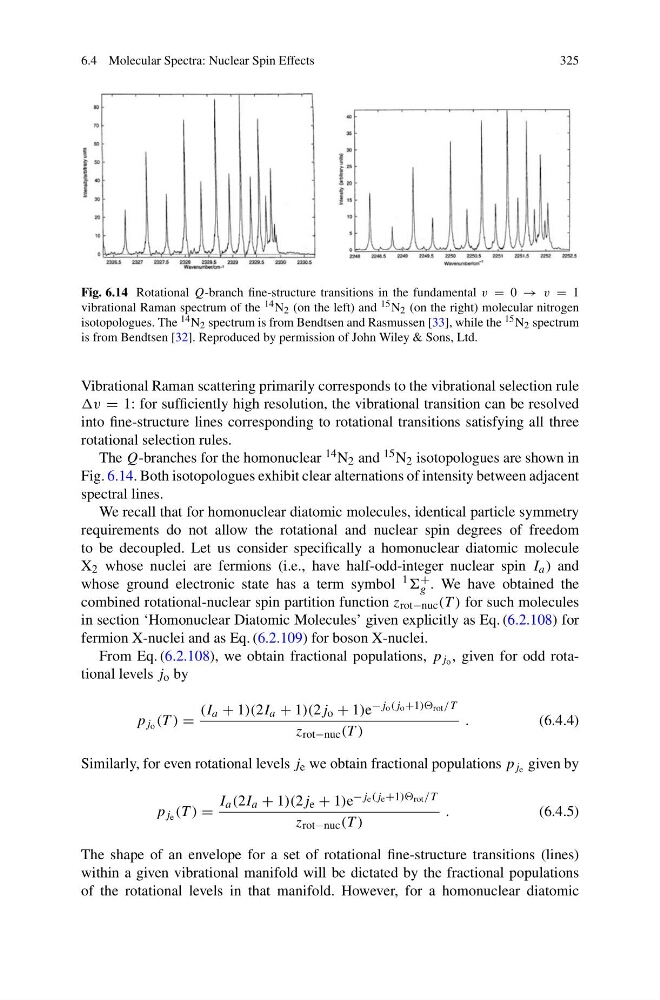
Fig. 6.14 Rotational Q-branch fine-structure transitions in the fundamental v = 0 → v = 1
vibrational Raman spectrum of the 14 N 2 (on the left) and 15 N 2 (on the right) molecular nitrogen
isotopologues. The 14 N 2 spectrum is from Bendtsen and Rasmussen [33], while the 15 N 2 spectrum
is from Bendtsen [32]. Reproduced by permission of John Wiley & Sons, Ltd.
Vibrational Raman scattering primarily corresponds to the vibrational selection rule
= 1: for sufficiently high resolution, the vibrational transition can be resolved
into fine-structure lines corresponding to rotational transitions satisfying all three
rotational selection rules.
The Q-branches for the homonuclear 14 N 2 and 15 N 2 isotopologues are shown in
Fig. 6.14. Both isotopologues exhibit clear alternations of intensity between adjacent
spectral lines.
We recall that for homonuclear diatomic molecules, identical particle symmetry
requirements do not allow the rotational and nuclear spin degrees of freedom
to be decoupled. Let us consider specifically a homonuclear diatomic molecule
X 2 whose nuclei are fermions (i.e., have half-odd-integer nuclear spin I a ) and
whose ground electronic state has a term symbol 1 +
g . We have obtained the
combined rotational-nuclear spin partition function z rot−nuc (T ) for such molecules
in section ‘Homonuclear Diatomic Molecules’ given explicitly as Eq. (6.2.108) for
fermion X-nuclei and as Eq. (6.2.109) for boson X-nuclei.
From Eq. (6.2.108), we obtain fractional populations, p j o , given for odd rotational levels j o by
p j o (T ) =
(I a + 1)(2I a + 1)(2j o + 1)e −j o (j o +1)) rot /T
z rot−nuc (T )
.
(6.4.4)
Similarly, for even rotational levels j e we obtain fractional populations p j e given by
p j e (T ) =
I a (2I a + 1)(2j e + 1)e −j e (j e +1)) rot /T
z rot−nuc (T )
.
(6.4.5)
The shape of an envelope for a set of rotational fine-structure transitions (lines)
within a given vibrational manifold will be dictated by the fractional populations
of the rotational levels in that manifold. However, for a homonuclear diatomic
325
Fig. 6.14 Rotational Q-branch fine-structure transitions in the fundamental v = 0 → v = 1
vibrational Raman spectrum of the 14 N 2 (on the left) and 15 N 2 (on the right) molecular nitrogen
isotopologues. The 14 N 2 spectrum is from Bendtsen and Rasmussen [33], while the 15 N 2 spectrum
is from Bendtsen [32]. Reproduced by permission of John Wiley & Sons, Ltd.
Vibrational Raman scattering primarily corresponds to the vibrational selection rule
= 1: for sufficiently high resolution, the vibrational transition can be resolved
into fine-structure lines corresponding to rotational transitions satisfying all three
rotational selection rules.
The Q-branches for the homonuclear 14 N 2 and 15 N 2 isotopologues are shown in
Fig. 6.14. Both isotopologues exhibit clear alternations of intensity between adjacent
spectral lines.
We recall that for homonuclear diatomic molecules, identical particle symmetry
requirements do not allow the rotational and nuclear spin degrees of freedom
to be decoupled. Let us consider specifically a homonuclear diatomic molecule
X 2 whose nuclei are fermions (i.e., have half-odd-integer nuclear spin I a ) and
whose ground electronic state has a term symbol 1 +
g . We have obtained the
combined rotational-nuclear spin partition function z rot−nuc (T ) for such molecules
in section ‘Homonuclear Diatomic Molecules’ given explicitly as Eq. (6.2.108) for
fermion X-nuclei and as Eq. (6.2.109) for boson X-nuclei.
From Eq. (6.2.108), we obtain fractional populations, p j o , given for odd rotational levels j o by
p j o (T ) =
(I a + 1)(2I a + 1)(2j o + 1)e −j o (j o +1)) rot /T
z rot−nuc (T )
.
(6.4.4)
Similarly, for even rotational levels j e we obtain fractional populations p j e given by
p j e (T ) =
I a (2I a + 1)(2j e + 1)e −j e (j e +1)) rot /T
z rot−nuc (T )
.
(6.4.5)
The shape of an envelope for a set of rotational fine-structure transitions (lines)
within a given vibrational manifold will be dictated by the fractional populations
of the rotational levels in that manifold. However, for a homonuclear diatomic