

324
6 Molecular Systems
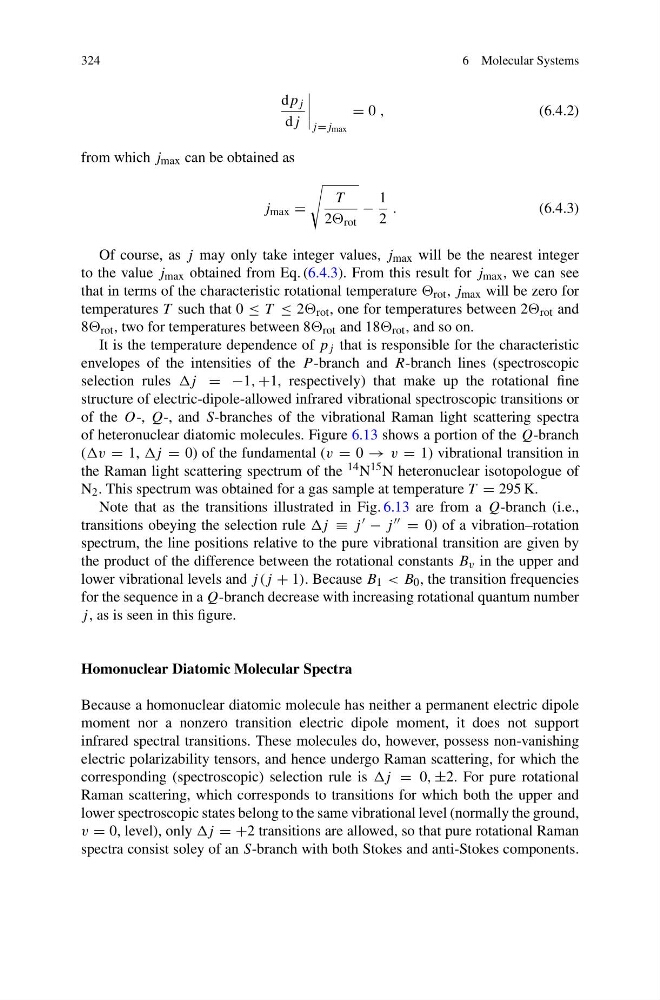
dp j
dj
j =j max
= 0 ,
(6.4.2)
from which j max can be obtained as
j max =
T
2 rot
−
1
2
.
(6.4.3)
Of course, as j may only take integer values, j max will be the nearest integer
to the value j max obtained from Eq. (6.4.3). From this result for j max , we can see
that in terms of the characteristic rotational temperature rot , j max will be zero for
temperatures T such that 0 ≤ T ≤ 2 rot , one for temperatures between 2 rot and
8 rot , two for temperatures between 8 rot and 18 rot , and so on.
It is the temperature dependence of p j that is responsible for the characteristic
envelopes of the intensities of the P -branch and R-branch lines (spectroscopic
selection rules j = −1, +1, respectively) that make up the rotational fine
structure of electric-dipole-allowed infrared vibrational spectroscopic transitions or
of the O-, Q-, and S-branches of the vibrational Raman light scattering spectra
of heteronuclear diatomic molecules. Figure 6.13 shows a portion of the Q-branch
(v = 1, j = 0) of the fundamental (v = 0 → v = 1) vibrational transition in
the Raman light scattering spectrum of the 14 N 15 N heteronuclear isotopologue of
N 2 . This spectrum was obtained for a gas sample at temperature T = 295 K.
Note that as the transitions illustrated in Fig. 6.13 are from a Q-branch (i.e.,
transitions obeying the selection rule j ≡ j − j = 0) of a vibration–rotation
spectrum, the line positions relative to the pure vibrational transition are given by
the product of the difference between the rotational constants B v in the upper and
lower vibrational levels and j (j + 1). Because B 1 < B 0 , the transition frequencies
for the sequence in a Q-branch decrease with increasing rotational quantum number
j , as is seen in this figure.
Homonuclear Diatomic Molecular Spectra
Because a homonuclear diatomic molecule has neither a permanent electric dipole
moment nor a nonzero transition electric dipole moment, it does not support
infrared spectral transitions. These molecules do, however, possess non-vanishing
electric polarizability tensors, and hence undergo Raman scattering, for which the
corresponding (spectroscopic) selection rule is j = 0, ±2. For pure rotational
Raman scattering, which corresponds to transitions for which both the upper and
lower spectroscopic states belong to the same vibrational level (normally the ground,
v = 0, level), only j = +2 transitions are allowed, so that pure rotational Raman
spectra consist soley of an S-branch with both Stokes and anti-Stokes components.
6 Molecular Systems
dp j
dj
j =j max
= 0 ,
(6.4.2)
from which j max can be obtained as
j max =
T
2 rot
−
1
2
.
(6.4.3)
Of course, as j may only take integer values, j max will be the nearest integer
to the value j max obtained from Eq. (6.4.3). From this result for j max , we can see
that in terms of the characteristic rotational temperature rot , j max will be zero for
temperatures T such that 0 ≤ T ≤ 2 rot , one for temperatures between 2 rot and
8 rot , two for temperatures between 8 rot and 18 rot , and so on.
It is the temperature dependence of p j that is responsible for the characteristic
envelopes of the intensities of the P -branch and R-branch lines (spectroscopic
selection rules j = −1, +1, respectively) that make up the rotational fine
structure of electric-dipole-allowed infrared vibrational spectroscopic transitions or
of the O-, Q-, and S-branches of the vibrational Raman light scattering spectra
of heteronuclear diatomic molecules. Figure 6.13 shows a portion of the Q-branch
(v = 1, j = 0) of the fundamental (v = 0 → v = 1) vibrational transition in
the Raman light scattering spectrum of the 14 N 15 N heteronuclear isotopologue of
N 2 . This spectrum was obtained for a gas sample at temperature T = 295 K.
Note that as the transitions illustrated in Fig. 6.13 are from a Q-branch (i.e.,
transitions obeying the selection rule j ≡ j − j = 0) of a vibration–rotation
spectrum, the line positions relative to the pure vibrational transition are given by
the product of the difference between the rotational constants B v in the upper and
lower vibrational levels and j (j + 1). Because B 1 < B 0 , the transition frequencies
for the sequence in a Q-branch decrease with increasing rotational quantum number
j , as is seen in this figure.
Homonuclear Diatomic Molecular Spectra
Because a homonuclear diatomic molecule has neither a permanent electric dipole
moment nor a nonzero transition electric dipole moment, it does not support
infrared spectral transitions. These molecules do, however, possess non-vanishing
electric polarizability tensors, and hence undergo Raman scattering, for which the
corresponding (spectroscopic) selection rule is j = 0, ±2. For pure rotational
Raman scattering, which corresponds to transitions for which both the upper and
lower spectroscopic states belong to the same vibrational level (normally the ground,
v = 0, level), only j = +2 transitions are allowed, so that pure rotational Raman
spectra consist soley of an S-branch with both Stokes and anti-Stokes components.