

6.3 Extension to the Ideal Polyatomic Gas
319
function at temperatures for which the substances remain gaseous. Indeed, all
molecules satisfying this requirement have tetrahedral symmetry: the best known
examples are methane (CH 4 ), fully deuterated methane (CD 4 ), silane (SiH 4 ), and
germane (GeH 4 ), with moments-of-inertia having values [23] 5.34117 × 10 −47
kg m 2 , 10.633 × 10 −47 kg m 2 , 9.79106 × 10 −47 kg m 2 , and 10.380 × 10 −47 kg m 2 ,
respectively, and with corresponding characteristic rotational temperatures 7.541,
3.788, 4.11, and 3.88 K.
Corrections to the rigid-rotor classical limit (6.3.4) for the rotational partition
function for spherical top molecules have been available in one form or another
since Kassel’s review [4] in 1936. These corrections have been considered in
detail by Fox [24] and by McDowell [25]. The usual Euler–Maclaurin expansion
procedure fails for spherical top molecules, and it is necessary to use an alternative
procedure involving what are known as (Jacobi) theta functions to obtain appropriate corrections [4, 23]. However, these corrections turn out to be negligible in
comparison both to low-temperature quantum effects and to centrifugal distortion
corrections. Rotation-vibration interaction corrections remain largely unknown for
most polyatomic molecules, including spherical top molecules.
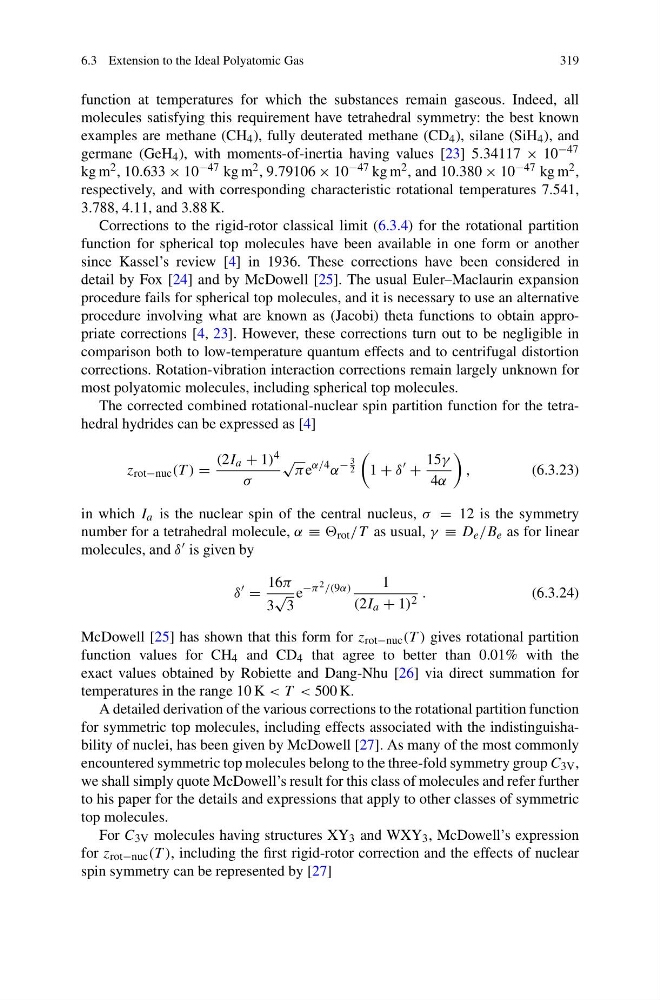
The corrected combined rotational-nuclear spin partition function for the tetrahedral hydrides can be expressed as [4]
z rot−nuc (T ) =
(2I a + 1) 4
σ
√
π e
α/4 α
−
3
2
1 + δ
+
15γ
4α
,
(6.3.23)
in which I a is the nuclear spin of the central nucleus, σ = 12 is the symmetry
number for a tetrahedral molecule, α ≡ rot /T as usual, γ ≡ D e /B e as for linear
molecules, and δ is given by
δ
=
16π
3
√
3
e
−π 2 /(9α)
1
(2I a + 1) 2 .
(6.3.24)
McDowell [25] has shown that this form for z rot−nuc (T ) gives rotational partition
function values for CH 4 and CD 4 that agree to better than 0.01% with the
exact values obtained by Robiette and Dang-Nhu [26] via direct summation for
temperatures in the range 10 K < T < 500 K.
A detailed derivation of the various corrections to the rotational partition function
for symmetric top molecules, including effects associated with the indistinguishability of nuclei, has been given by McDowell [27]. As many of the most commonly
encountered symmetric top molecules belong to the three-fold symmetry group C 3V ,
we shall simply quote McDowell’s result for this class of molecules and refer further
to his paper for the details and expressions that apply to other classes of symmetric
top molecules.
For C 3V molecules having structures XY 3 and WXY 3 , McDowell’s expression
for z rot−nuc (T ), including the first rigid-rotor correction and the effects of nuclear
spin symmetry can be represented by [27]
319
function at temperatures for which the substances remain gaseous. Indeed, all
molecules satisfying this requirement have tetrahedral symmetry: the best known
examples are methane (CH 4 ), fully deuterated methane (CD 4 ), silane (SiH 4 ), and
germane (GeH 4 ), with moments-of-inertia having values [23] 5.34117 × 10 −47
kg m 2 , 10.633 × 10 −47 kg m 2 , 9.79106 × 10 −47 kg m 2 , and 10.380 × 10 −47 kg m 2 ,
respectively, and with corresponding characteristic rotational temperatures 7.541,
3.788, 4.11, and 3.88 K.
Corrections to the rigid-rotor classical limit (6.3.4) for the rotational partition
function for spherical top molecules have been available in one form or another
since Kassel’s review [4] in 1936. These corrections have been considered in
detail by Fox [24] and by McDowell [25]. The usual Euler–Maclaurin expansion
procedure fails for spherical top molecules, and it is necessary to use an alternative
procedure involving what are known as (Jacobi) theta functions to obtain appropriate corrections [4, 23]. However, these corrections turn out to be negligible in
comparison both to low-temperature quantum effects and to centrifugal distortion
corrections. Rotation-vibration interaction corrections remain largely unknown for
most polyatomic molecules, including spherical top molecules.
The corrected combined rotational-nuclear spin partition function for the tetrahedral hydrides can be expressed as [4]
z rot−nuc (T ) =
(2I a + 1) 4
σ
√
π e
α/4 α
−
3
2
1 + δ
+
15γ
4α
,
(6.3.23)
in which I a is the nuclear spin of the central nucleus, σ = 12 is the symmetry
number for a tetrahedral molecule, α ≡ rot /T as usual, γ ≡ D e /B e as for linear
molecules, and δ is given by
δ
=
16π
3
√
3
e
−π 2 /(9α)
1
(2I a + 1) 2 .
(6.3.24)
McDowell [25] has shown that this form for z rot−nuc (T ) gives rotational partition
function values for CH 4 and CD 4 that agree to better than 0.01% with the
exact values obtained by Robiette and Dang-Nhu [26] via direct summation for
temperatures in the range 10 K < T < 500 K.
A detailed derivation of the various corrections to the rotational partition function
for symmetric top molecules, including effects associated with the indistinguishability of nuclei, has been given by McDowell [27]. As many of the most commonly
encountered symmetric top molecules belong to the three-fold symmetry group C 3V ,
we shall simply quote McDowell’s result for this class of molecules and refer further
to his paper for the details and expressions that apply to other classes of symmetric
top molecules.
For C 3V molecules having structures XY 3 and WXY 3 , McDowell’s expression
for z rot−nuc (T ), including the first rigid-rotor correction and the effects of nuclear
spin symmetry can be represented by [27]