

318
6 Molecular Systems
z rot (T ) =
1
σ
e
α/3 α
−1
1 +
α 2
90
+ · · ·
,
(6.3.21)
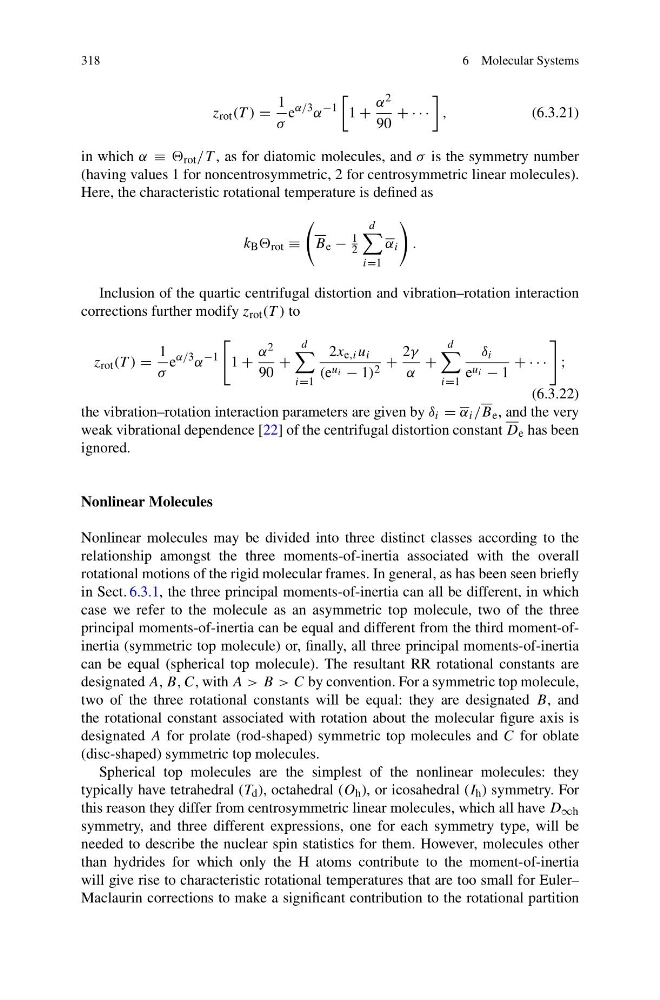
in which α ≡ rot /T , as for diatomic molecules, and σ is the symmetry number
(having values 1 for noncentrosymmetric, 2 for centrosymmetric linear molecules).
Here, the characteristic rotational temperature is defined as
k B rot ≡
B e −
1
2
d
i=1
α i
.
Inclusion of the quartic centrifugal distortion and vibration–rotation interaction
corrections further modify z rot (T ) to
z rot (T ) =
1
σ
e
α/3 α
−1
1 +
α 2
90
+
d
i=1
2x e,i u i
(e u i − 1) 2 +
2γ
α
+
d
i=1
δ i
e u i − 1
+ · · ·
;
(6.3.22)
the vibration–rotation interaction parameters are given by δ i = α i /B e , and the very
weak vibrational dependence [22] of the centrifugal distortion constant D e has been
ignored.
Nonlinear Molecules
Nonlinear molecules may be divided into three distinct classes according to the
relationship amongst the three moments-of-inertia associated with the overall
rotational motions of the rigid molecular frames. In general, as has been seen briefly
in Sect. 6.3.1, the three principal moments-of-inertia can all be different, in which
case we refer to the molecule as an asymmetric top molecule, two of the three
principal moments-of-inertia can be equal and different from the third moment-ofinertia (symmetric top molecule) or, finally, all three principal moments-of-inertia
can be equal (spherical top molecule). The resultant RR rotational constants are
designated A, B, C, with A > B > C by convention. For a symmetric top molecule,
two of the three rotational constants will be equal: they are designated B, and
the rotational constant associated with rotation about the molecular figure axis is
designated A for prolate (rod-shaped) symmetric top molecules and C for oblate
(disc-shaped) symmetric top molecules.
Spherical top molecules are the simplest of the nonlinear molecules: they
typically have tetrahedral (T d ), octahedral (O h ), or icosahedral (I h ) symmetry. For
this reason they differ from centrosymmetric linear molecules, which all have D ∞h
symmetry, and three different expressions, one for each symmetry type, will be
needed to describe the nuclear spin statistics for them. However, molecules other
than hydrides for which only the H atoms contribute to the moment-of-inertia
will give rise to characteristic rotational temperatures that are too small for Euler–
Maclaurin corrections to make a significant contribution to the rotational partition
6 Molecular Systems
z rot (T ) =
1
σ
e
α/3 α
−1
1 +
α 2
90
+ · · ·
,
(6.3.21)
in which α ≡ rot /T , as for diatomic molecules, and σ is the symmetry number
(having values 1 for noncentrosymmetric, 2 for centrosymmetric linear molecules).
Here, the characteristic rotational temperature is defined as
k B rot ≡
B e −
1
2
d
i=1
α i
.
Inclusion of the quartic centrifugal distortion and vibration–rotation interaction
corrections further modify z rot (T ) to
z rot (T ) =
1
σ
e
α/3 α
−1
1 +
α 2
90
+
d
i=1
2x e,i u i
(e u i − 1) 2 +
2γ
α
+
d
i=1
δ i
e u i − 1
+ · · ·
;
(6.3.22)
the vibration–rotation interaction parameters are given by δ i = α i /B e , and the very
weak vibrational dependence [22] of the centrifugal distortion constant D e has been
ignored.
Nonlinear Molecules
Nonlinear molecules may be divided into three distinct classes according to the
relationship amongst the three moments-of-inertia associated with the overall
rotational motions of the rigid molecular frames. In general, as has been seen briefly
in Sect. 6.3.1, the three principal moments-of-inertia can all be different, in which
case we refer to the molecule as an asymmetric top molecule, two of the three
principal moments-of-inertia can be equal and different from the third moment-ofinertia (symmetric top molecule) or, finally, all three principal moments-of-inertia
can be equal (spherical top molecule). The resultant RR rotational constants are
designated A, B, C, with A > B > C by convention. For a symmetric top molecule,
two of the three rotational constants will be equal: they are designated B, and
the rotational constant associated with rotation about the molecular figure axis is
designated A for prolate (rod-shaped) symmetric top molecules and C for oblate
(disc-shaped) symmetric top molecules.
Spherical top molecules are the simplest of the nonlinear molecules: they
typically have tetrahedral (T d ), octahedral (O h ), or icosahedral (I h ) symmetry. For
this reason they differ from centrosymmetric linear molecules, which all have D ∞h
symmetry, and three different expressions, one for each symmetry type, will be
needed to describe the nuclear spin statistics for them. However, molecules other
than hydrides for which only the H atoms contribute to the moment-of-inertia
will give rise to characteristic rotational temperatures that are too small for Euler–
Maclaurin corrections to make a significant contribution to the rotational partition