

20
1 Basic Background Material
All that has been said above is fine, provided that we know all values of p r ,
but what do we do to find such averages without knowing all these values? Let us
examine a concrete case, that of an ideal gas of N statistically independent atoms
enclosed in a container of volume V T and divided into two parts, with volumes V
and V , and let us construct an ensemble of such containers, each with N ideal gas
atoms. For each member of this ensemble, if p is the probability that an atom will
be found in volume V , then q ≡ 1 − p is the probability that the atom will be found
in volume V . Since at equilibrium we expect the atoms to be uniformly distributed
throughout the volume V T , we may represent the probabilities p and q as
p ≡
V
V T
,
q ≡
V
V T
.
We have shown in Appendix A that the probability p(n, N) that n out of the N
atoms will be found in volume V (with N − n hence found in V ) is given by the
binomial distribution
p(N, n) =
N !
n!(N − n)!
p
n q
N −n ,
(1.4.7)
in which N ! ≡ N(N − 1)(N − 2) . . . 2 · 1 is termed factorial N . The behaviour
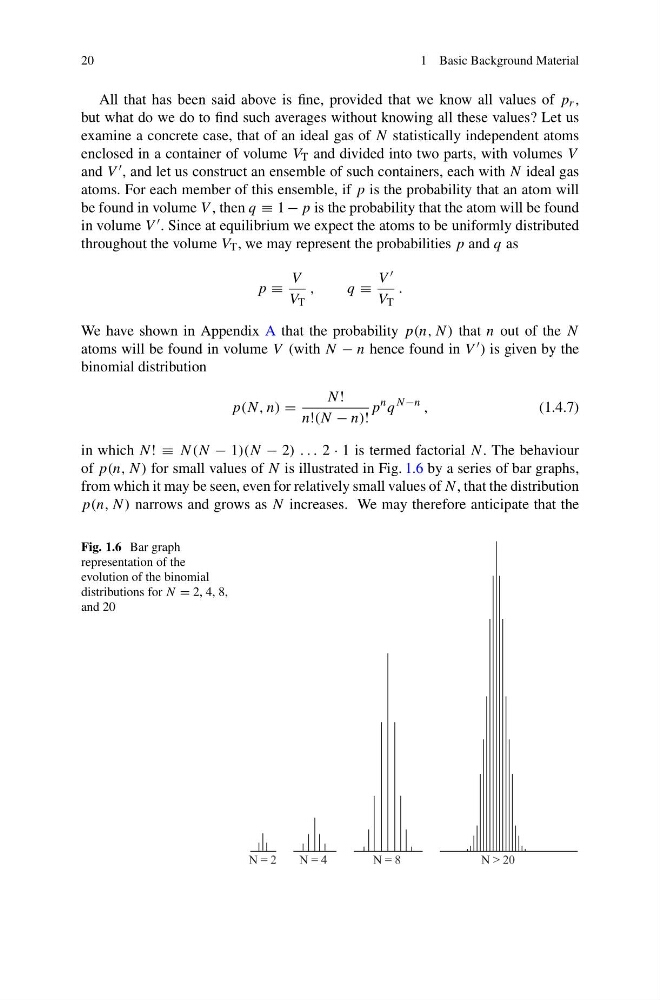
of p(n, N) for small values of N is illustrated in Fig. 1.6 by a series of bar graphs,
from which it may be seen, even for relatively small values of N , that the distribution
p(n, N) narrows and grows as N increases. We may therefore anticipate that the
Fig. 1.6 Bar graph
representation of the
evolution of the binomial
distributions for N = 2, 4, 8,
and 20
1 Basic Background Material
All that has been said above is fine, provided that we know all values of p r ,
but what do we do to find such averages without knowing all these values? Let us
examine a concrete case, that of an ideal gas of N statistically independent atoms
enclosed in a container of volume V T and divided into two parts, with volumes V
and V , and let us construct an ensemble of such containers, each with N ideal gas
atoms. For each member of this ensemble, if p is the probability that an atom will
be found in volume V , then q ≡ 1 − p is the probability that the atom will be found
in volume V . Since at equilibrium we expect the atoms to be uniformly distributed
throughout the volume V T , we may represent the probabilities p and q as
p ≡
V
V T
,
q ≡
V
V T
.
We have shown in Appendix A that the probability p(n, N) that n out of the N
atoms will be found in volume V (with N − n hence found in V ) is given by the
binomial distribution
p(N, n) =
N !
n!(N − n)!
p
n q
N −n ,
(1.4.7)
in which N ! ≡ N(N − 1)(N − 2) . . . 2 · 1 is termed factorial N . The behaviour
of p(n, N) for small values of N is illustrated in Fig. 1.6 by a series of bar graphs,
from which it may be seen, even for relatively small values of N , that the distribution
p(n, N) narrows and grows as N increases. We may therefore anticipate that the
Fig. 1.6 Bar graph
representation of the
evolution of the binomial
distributions for N = 2, 4, 8,
and 20