

18
1 Basic Background Material
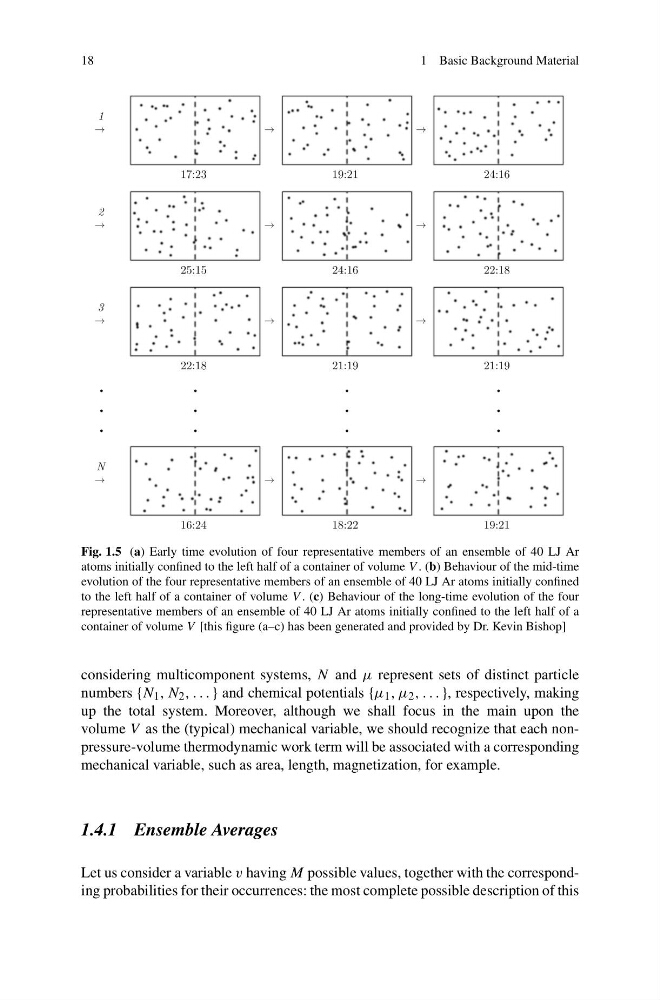
Fig. 1.5 (a) Early time evolution of four representative members of an ensemble of 40 LJ Ar
atoms initially confined to the left half of a container of volume V . (b) Behaviour of the mid-time
evolution of the four representative members of an ensemble of 40 LJ Ar atoms initially confined
to the left half of a container of volume V . (c) Behaviour of the long-time evolution of the four
representative members of an ensemble of 40 LJ Ar atoms initially confined to the left half of a
container of volume V [this figure (a–c) has been generated and provided by Dr. Kevin Bishop]
considering multicomponent systems, N and μ represent sets of distinct particle
numbers {N 1 , N 2 , . . . } and chemical potentials {μ 1 , μ 2 , . . . }, respectively, making
up the total system. Moreover, although we shall focus in the main upon the
volume V as the (typical) mechanical variable, we should recognize that each nonpressure-volume thermodynamic work term will be associated with a corresponding
mechanical variable, such as area, length, magnetization, for example.
1.4.1 Ensemble Averages
Let us consider a variable v having M possible values, together with the corresponding probabilities for their occurrences: the most complete possible description of this
1 Basic Background Material
Fig. 1.5 (a) Early time evolution of four representative members of an ensemble of 40 LJ Ar
atoms initially confined to the left half of a container of volume V . (b) Behaviour of the mid-time
evolution of the four representative members of an ensemble of 40 LJ Ar atoms initially confined
to the left half of a container of volume V . (c) Behaviour of the long-time evolution of the four
representative members of an ensemble of 40 LJ Ar atoms initially confined to the left half of a
container of volume V [this figure (a–c) has been generated and provided by Dr. Kevin Bishop]
considering multicomponent systems, N and μ represent sets of distinct particle
numbers {N 1 , N 2 , . . . } and chemical potentials {μ 1 , μ 2 , . . . }, respectively, making
up the total system. Moreover, although we shall focus in the main upon the
volume V as the (typical) mechanical variable, we should recognize that each nonpressure-volume thermodynamic work term will be associated with a corresponding
mechanical variable, such as area, length, magnetization, for example.
1.4.1 Ensemble Averages
Let us consider a variable v having M possible values, together with the corresponding probabilities for their occurrences: the most complete possible description of this