

6.2 Diatomic Molecules
291
The result obtained above allows us to conclude, finally, that ψ
total for a diatomic
molecule in a 1 +
g electronic state is unchanged by (symmetric to) inversion of the
coordinates for j even, and changes sign (is antisymmetric) upon inversion of the
coordinates for j odd. This conclusion will be reversed if ψ el is antisymmetric under
inversion of the electronic coordinates. All of what we have just said is, of course,
exclusive of nuclear spin.
Molecular Hydrogen: The Role of Nuclear Spin Symmetry
Let us now consider the H 2 molecule as a concrete example of how to introduce
the effect of the nuclear spin symmetry for homonuclear diatomic molecules. The
H atom has 1 proton (spin1
2 ) which has two magnetic states, which we shall
loosely refer to as ‘spin-up’ and ‘spin-down’, and symbolize by an ‘up-arrow’ ↑,
respectively, by a ‘down-arrow’ ↓. The hydrogen molecule has two protons, whose
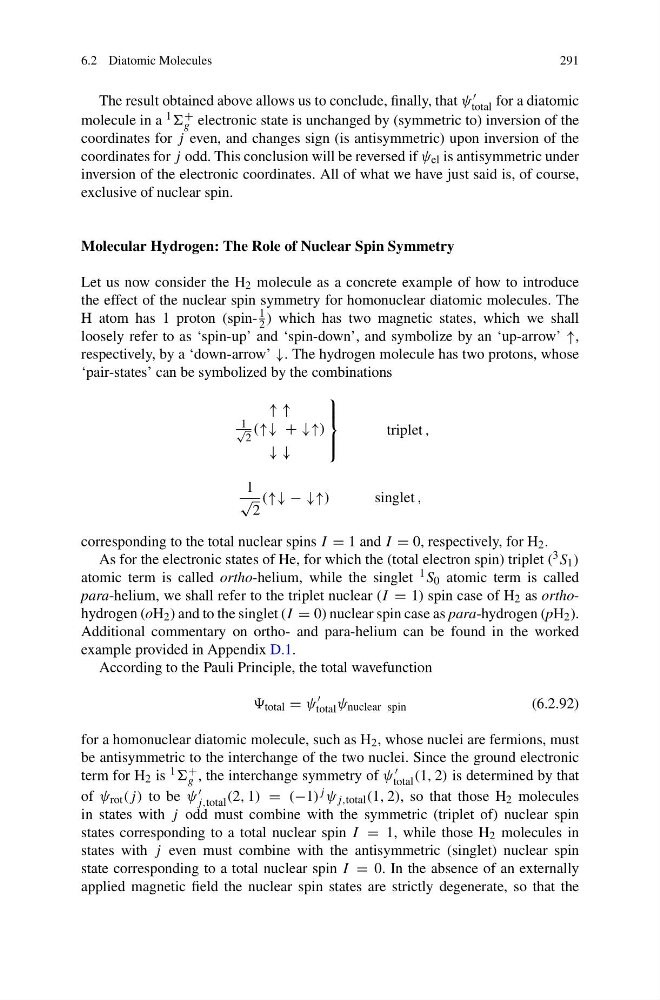
‘pair-states’ can be symbolized by the combinations
↑ ↑
1
√
2
(↑↓ + ↓↑)
↓ ↓
⎫
⎪ ⎬
⎪ ⎭
triplet ,
1
√
2
(↑↓ − ↓↑)
singlet ,
corresponding to the total nuclear spins I = 1 and I = 0, respectively, for H 2 .
As for the electronic states of He, for which the (total electron spin) triplet ( 3 S 1 )
atomic term is called ortho-helium, while the singlet 1 S 0 atomic term is called
para-helium, we shall refer to the triplet nuclear (I = 1) spin case of H 2 as orthohydrogen (oH 2 ) and to the singlet (I = 0) nuclear spin case as para-hydrogen (pH 2 ).
Additional commentary on ortho- and para-helium can be found in the worked
example provided in Appendix D.1.
According to the Pauli Principle, the total wavefunction
total = ψ
total ψ nuclear spin
(6.2.92)
for a homonuclear diatomic molecule, such as H 2 , whose nuclei are fermions, must
be antisymmetric to the interchange of the two nuclei. Since the ground electronic
term for H 2 is 1 +
g , the interchange symmetry of ψ
total (1, 2) is determined by that
of ψ rot (j ) to be ψ
j,total (2, 1) = (−1) j ψ j,total (1, 2), so that those H 2 molecules
in states with j odd must combine with the symmetric (triplet of) nuclear spin
states corresponding to a total nuclear spin I = 1, while those H 2 molecules in
states with j even must combine with the antisymmetric (singlet) nuclear spin
state corresponding to a total nuclear spin I = 0. In the absence of an externally
applied magnetic field the nuclear spin states are strictly degenerate, so that the
291
The result obtained above allows us to conclude, finally, that ψ
total for a diatomic
molecule in a 1 +
g electronic state is unchanged by (symmetric to) inversion of the
coordinates for j even, and changes sign (is antisymmetric) upon inversion of the
coordinates for j odd. This conclusion will be reversed if ψ el is antisymmetric under
inversion of the electronic coordinates. All of what we have just said is, of course,
exclusive of nuclear spin.
Molecular Hydrogen: The Role of Nuclear Spin Symmetry
Let us now consider the H 2 molecule as a concrete example of how to introduce
the effect of the nuclear spin symmetry for homonuclear diatomic molecules. The
H atom has 1 proton (spin1
2 ) which has two magnetic states, which we shall
loosely refer to as ‘spin-up’ and ‘spin-down’, and symbolize by an ‘up-arrow’ ↑,
respectively, by a ‘down-arrow’ ↓. The hydrogen molecule has two protons, whose
‘pair-states’ can be symbolized by the combinations
↑ ↑
1
√
2
(↑↓ + ↓↑)
↓ ↓
⎫
⎪ ⎬
⎪ ⎭
triplet ,
1
√
2
(↑↓ − ↓↑)
singlet ,
corresponding to the total nuclear spins I = 1 and I = 0, respectively, for H 2 .
As for the electronic states of He, for which the (total electron spin) triplet ( 3 S 1 )
atomic term is called ortho-helium, while the singlet 1 S 0 atomic term is called
para-helium, we shall refer to the triplet nuclear (I = 1) spin case of H 2 as orthohydrogen (oH 2 ) and to the singlet (I = 0) nuclear spin case as para-hydrogen (pH 2 ).
Additional commentary on ortho- and para-helium can be found in the worked
example provided in Appendix D.1.
According to the Pauli Principle, the total wavefunction
total = ψ
total ψ nuclear spin
(6.2.92)
for a homonuclear diatomic molecule, such as H 2 , whose nuclei are fermions, must
be antisymmetric to the interchange of the two nuclei. Since the ground electronic
term for H 2 is 1 +
g , the interchange symmetry of ψ
total (1, 2) is determined by that
of ψ rot (j ) to be ψ
j,total (2, 1) = (−1) j ψ j,total (1, 2), so that those H 2 molecules
in states with j odd must combine with the symmetric (triplet of) nuclear spin
states corresponding to a total nuclear spin I = 1, while those H 2 molecules in
states with j even must combine with the antisymmetric (singlet) nuclear spin
state corresponding to a total nuclear spin I = 0. In the absence of an externally
applied magnetic field the nuclear spin states are strictly degenerate, so that the