

290
6 Molecular Systems
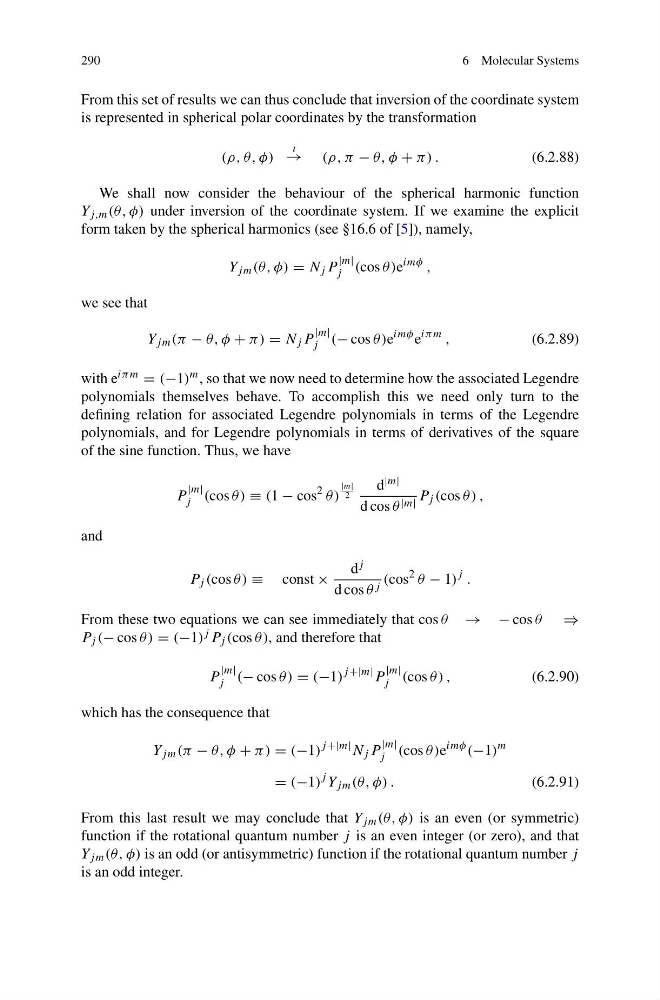
From this set of results we can thus conclude that inversion of the coordinate system
is represented in spherical polar coordinates by the transformation
(ρ, θ, φ)
ı
→ (ρ, π − θ, φ + π) .
(6.2.88)
We shall now consider the behaviour of the spherical harmonic function
Y j,m (θ, φ) under inversion of the coordinate system. If we examine the explicit
form taken by the spherical harmonics (see §16.6 of [5]), namely,
Y jm (θ, φ) = N j P
|m|
j (cos θ)e
imφ ,
we see that
Y jm (π − θ, φ + π) = N j P
|m|
j (− cos θ)e
imφ e
iπm ,
(6.2.89)
with e iπm = (−1) m , so that we now need to determine how the associated Legendre
polynomials themselves behave. To accomplish this we need only turn to the
defining relation for associated Legendre polynomials in terms of the Legendre
polynomials, and for Legendre polynomials in terms of derivatives of the square
of the sine function. Thus, we have
P
|m|
j (cos θ) ≡ (1 − cos
2 θ)
|m|
2
d |m|
d cos θ |m| P j (cos θ) ,
and
P j (cos θ) ≡ const ×
d j
d cos θ j (cos
2 θ − 1)
j .
From these two equations we can see immediately that cos θ → −cos θ ⇒
P j (− cos θ) = (−1) j P j (cos θ), and therefore that
P
|m|
j (− cos θ) = (−1)
j +|m| P
|m|
j (cos θ) ,
(6.2.90)
which has the consequence that
Y jm (π − θ, φ + π) = (−1)
j +|m| N j P
|m|
j (cos θ)e
imφ (−1)
m
= (−1)
j Y jm (θ, φ) .
(6.2.91)
From this last result we may conclude that Y jm (θ, φ) is an even (or symmetric)
function if the rotational quantum number j is an even integer (or zero), and that
Y jm (θ, φ) is an odd (or antisymmetric) function if the rotational quantum number j
is an odd integer.
6 Molecular Systems
From this set of results we can thus conclude that inversion of the coordinate system
is represented in spherical polar coordinates by the transformation
(ρ, θ, φ)
ı
→ (ρ, π − θ, φ + π) .
(6.2.88)
We shall now consider the behaviour of the spherical harmonic function
Y j,m (θ, φ) under inversion of the coordinate system. If we examine the explicit
form taken by the spherical harmonics (see §16.6 of [5]), namely,
Y jm (θ, φ) = N j P
|m|
j (cos θ)e
imφ ,
we see that
Y jm (π − θ, φ + π) = N j P
|m|
j (− cos θ)e
imφ e
iπm ,
(6.2.89)
with e iπm = (−1) m , so that we now need to determine how the associated Legendre
polynomials themselves behave. To accomplish this we need only turn to the
defining relation for associated Legendre polynomials in terms of the Legendre
polynomials, and for Legendre polynomials in terms of derivatives of the square
of the sine function. Thus, we have
P
|m|
j (cos θ) ≡ (1 − cos
2 θ)
|m|
2
d |m|
d cos θ |m| P j (cos θ) ,
and
P j (cos θ) ≡ const ×
d j
d cos θ j (cos
2 θ − 1)
j .
From these two equations we can see immediately that cos θ → −cos θ ⇒
P j (− cos θ) = (−1) j P j (cos θ), and therefore that
P
|m|
j (− cos θ) = (−1)
j +|m| P
|m|
j (cos θ) ,
(6.2.90)
which has the consequence that
Y jm (π − θ, φ + π) = (−1)
j +|m| N j P
|m|
j (cos θ)e
imφ (−1)
m
= (−1)
j Y jm (θ, φ) .
(6.2.91)
From this last result we may conclude that Y jm (θ, φ) is an even (or symmetric)
function if the rotational quantum number j is an even integer (or zero), and that
Y jm (θ, φ) is an odd (or antisymmetric) function if the rotational quantum number j
is an odd integer.