

6.1 Introduction
259
freedom. In this chapter, we shall focus upon the contributions to the thermodynamic
properties of substances that arise from the various types of internal states that
molecules possess.
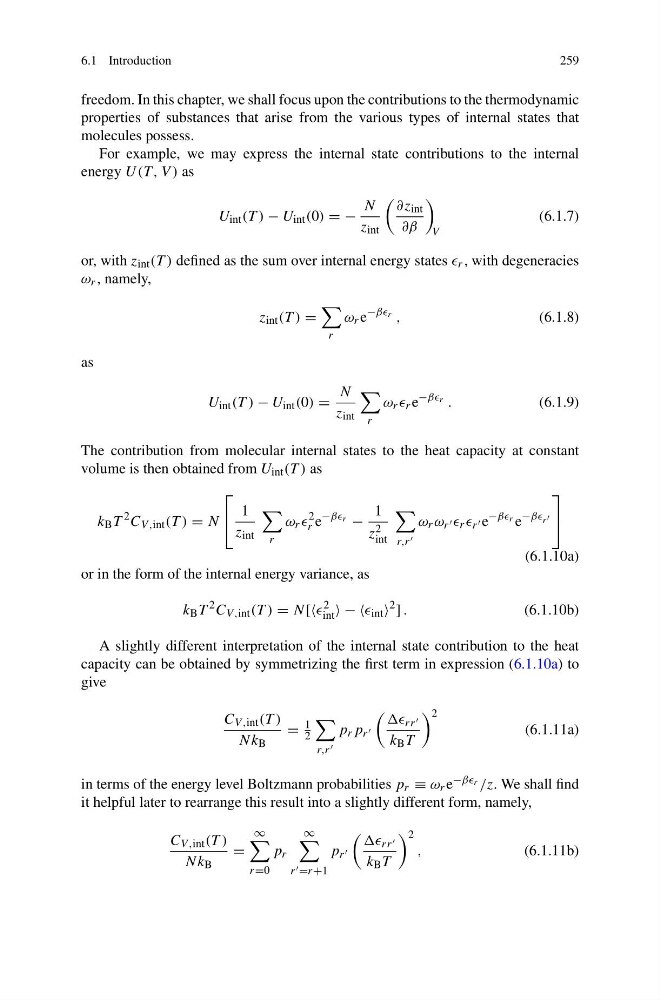
For example, we may express the internal state contributions to the internal
energy U(T , V ) as
U int (T ) − U int (0) = −
N
z int
∂z int
∂β
V
(6.1.7)
or, with z int (T ) defined as the sum over internal energy states r , with degeneracies
ω r , namely,
z int (T ) =
r
ω r e
−ββ r ,
(6.1.8)
as
U int (T ) − U int (0) =
N
z int
r
ω r r e
−ββ r .
(6.1.9)
The contribution from molecular internal states to the heat capacity at constant
volume is then obtained from U int (T ) as
k B T
2 C V ,int (T ) = N
⎡
⎣ 1
z int
r
ω r
2
r e
−ββ r −
1
z 2
int
r,r
ω r ω r r r e
−ββ r e
−ββ r
⎤
⎦
(6.1.10a)
or in the form of the internal energy variance, as
k B T
2 C V ,int (T ) = N[[
2
int − − int
2
] .
(6.1.10b)
A slightly different interpretation of the internal state contribution to the heat
capacity can be obtained by symmetrizing the first term in expression (6.1.10a) to
give
C V ,int (T )
Nk B
=
1
2
r,r
p r p r
rr
k B T
2
(6.1.11a)
in terms of the energy level Boltzmann probabilities p r ≡ ω r e −ββ r /z. We shall find
it helpful later to rearrange this result into a slightly different form, namely,
C V ,int (T )
Nk B
=
∞
r=0
p r
∞
r =r+1
p r
rr
k B T
2
,
(6.1.11b)
259
freedom. In this chapter, we shall focus upon the contributions to the thermodynamic
properties of substances that arise from the various types of internal states that
molecules possess.
For example, we may express the internal state contributions to the internal
energy U(T , V ) as
U int (T ) − U int (0) = −
N
z int
∂z int
∂β
V
(6.1.7)
or, with z int (T ) defined as the sum over internal energy states r , with degeneracies
ω r , namely,
z int (T ) =
r
ω r e
−ββ r ,
(6.1.8)
as
U int (T ) − U int (0) =
N
z int
r
ω r r e
−ββ r .
(6.1.9)
The contribution from molecular internal states to the heat capacity at constant
volume is then obtained from U int (T ) as
k B T
2 C V ,int (T ) = N
⎡
⎣ 1
z int
r
ω r
2
r e
−ββ r −
1
z 2
int
r,r
ω r ω r r r e
−ββ r e
−ββ r
⎤
⎦
(6.1.10a)
or in the form of the internal energy variance, as
k B T
2 C V ,int (T ) = N[[
2
int − − int
2
] .
(6.1.10b)
A slightly different interpretation of the internal state contribution to the heat
capacity can be obtained by symmetrizing the first term in expression (6.1.10a) to
give
C V ,int (T )
Nk B
=
1
2
r,r
p r p r
rr
k B T
2
(6.1.11a)
in terms of the energy level Boltzmann probabilities p r ≡ ω r e −ββ r /z. We shall find
it helpful later to rearrange this result into a slightly different form, namely,
C V ,int (T )
Nk B
=
∞
r=0
p r
∞
r =r+1
p r
rr
k B T
2
,
(6.1.11b)