

258
6 Molecular Systems
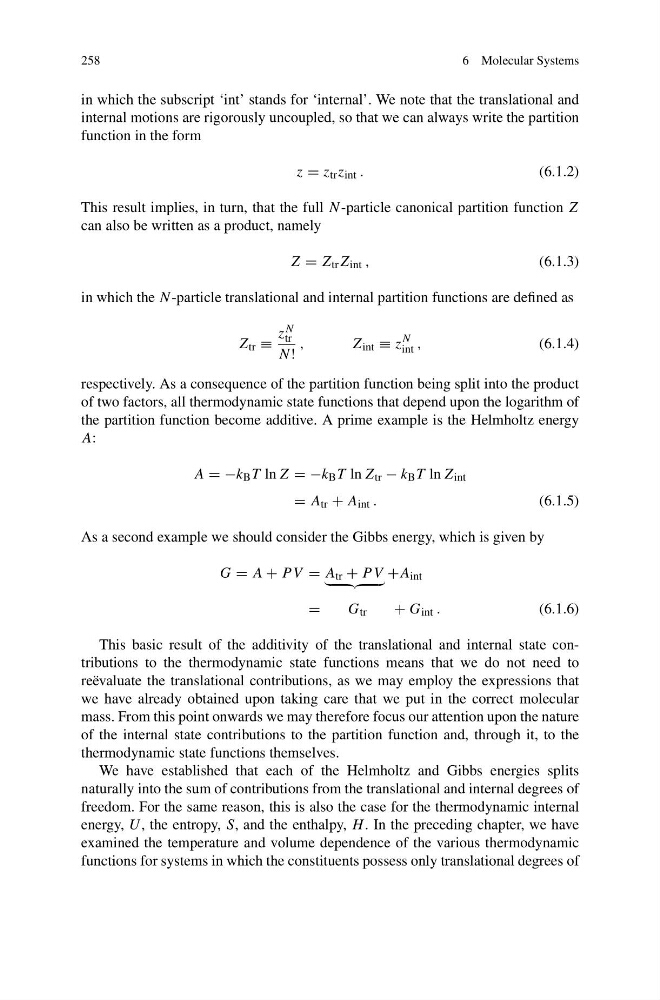
in which the subscript ‘int’ stands for ‘internal’. We note that the translational and
internal motions are rigorously uncoupled, so that we can always write the partition
function in the form
z = z tr z int .
(6.1.2)
This result implies, in turn, that the full N-particle canonical partition function Z
can also be written as a product, namely
Z = Z tr Z int ,
(6.1.3)
in which the N -particle translational and internal partition functions are defined as
Z tr ≡
z N
tr
N!
,
Z int ≡ z
N
int ,
(6.1.4)
respectively. As a consequence of the partition function being split into the product
of two factors, all thermodynamic state functions that depend upon the logarithm of
the partition function become additive. A prime example is the Helmholtz energy
A:
A = −k B T ln Z = −k B T ln Z tr − k B T ln Z int
= A tr + A int .
(6.1.5)
As a second example we should consider the Gibbs energy, which is given by
G = A + P V = A tr + P V
+A int
=
G tr
+ G int .
(6.1.6)
This basic result of the additivity of the translational and internal state contributions to the thermodynamic state functions means that we do not need to
reëvaluate the translational contributions, as we may employ the expressions that
we have already obtained upon taking care that we put in the correct molecular
mass. From this point onwards we may therefore focus our attention upon the nature
of the internal state contributions to the partition function and, through it, to the
thermodynamic state functions themselves.
We have established that each of the Helmholtz and Gibbs energies splits
naturally into the sum of contributions from the translational and internal degrees of
freedom. For the same reason, this is also the case for the thermodynamic internal
energy, U , the entropy, S, and the enthalpy, H . In the preceding chapter, we have
examined the temperature and volume dependence of the various thermodynamic
functions for systems in which the constituents possess only translational degrees of
6 Molecular Systems
in which the subscript ‘int’ stands for ‘internal’. We note that the translational and
internal motions are rigorously uncoupled, so that we can always write the partition
function in the form
z = z tr z int .
(6.1.2)
This result implies, in turn, that the full N-particle canonical partition function Z
can also be written as a product, namely
Z = Z tr Z int ,
(6.1.3)
in which the N -particle translational and internal partition functions are defined as
Z tr ≡
z N
tr
N!
,
Z int ≡ z
N
int ,
(6.1.4)
respectively. As a consequence of the partition function being split into the product
of two factors, all thermodynamic state functions that depend upon the logarithm of
the partition function become additive. A prime example is the Helmholtz energy
A:
A = −k B T ln Z = −k B T ln Z tr − k B T ln Z int
= A tr + A int .
(6.1.5)
As a second example we should consider the Gibbs energy, which is given by
G = A + P V = A tr + P V
+A int
=
G tr
+ G int .
(6.1.6)
This basic result of the additivity of the translational and internal state contributions to the thermodynamic state functions means that we do not need to
reëvaluate the translational contributions, as we may employ the expressions that
we have already obtained upon taking care that we put in the correct molecular
mass. From this point onwards we may therefore focus our attention upon the nature
of the internal state contributions to the partition function and, through it, to the
thermodynamic state functions themselves.
We have established that each of the Helmholtz and Gibbs energies splits
naturally into the sum of contributions from the translational and internal degrees of
freedom. For the same reason, this is also the case for the thermodynamic internal
energy, U , the entropy, S, and the enthalpy, H . In the preceding chapter, we have
examined the temperature and volume dependence of the various thermodynamic
functions for systems in which the constituents possess only translational degrees of