

252
5 Atomic Systems
6. Rearrange the Sackur–Tetrode equation for the translational entropy of a gas of
N particles possessing only translational motion to obtain S tr in terms of the
translational internal energy, U tr (T ), and the volume, V , of the gas. Invert your
result to obtain U tr as a function of S tr and V . Obtain an expression for the total
differential dU tr of U tr (S tr , V ).
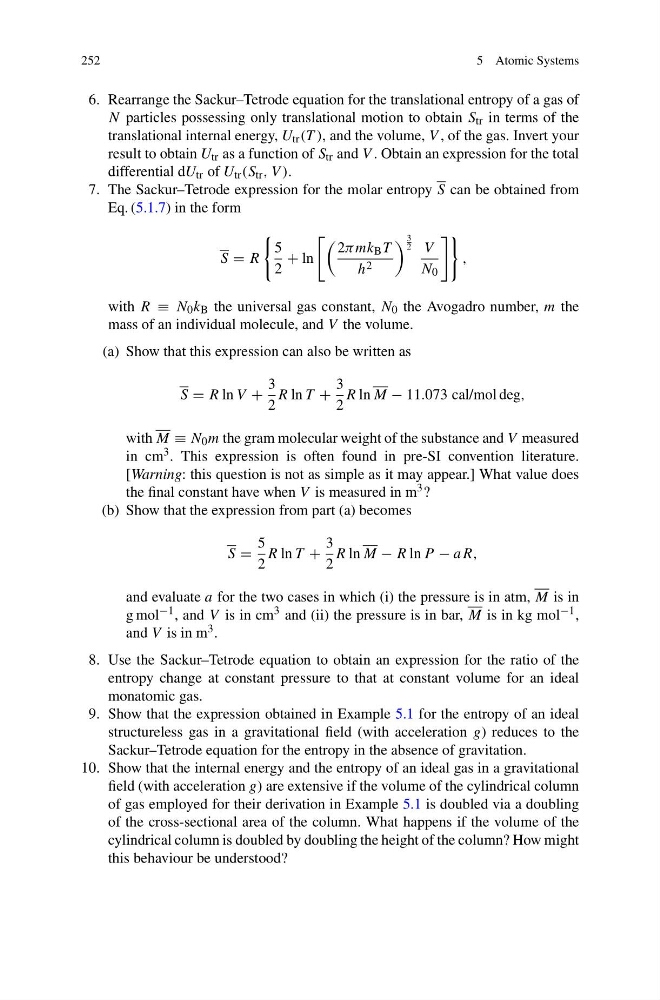
7. The Sackur–Tetrode expression for the molar entropy S can be obtained from
Eq. (5.1.7) in the form
S = R
5
2
+ ln
2πmk B T
h 2
3
2 V
N 0
,
with R ≡ N 0 k B the universal gas constant, N 0 the Avogadro number, m the
mass of an individual molecule, and V the volume.
(a) Show that this expression can also be written as
S = R ln V +
3
2
R ln T +
3
2
R ln M − 11.073 cal/mol deg,
with M ≡ N 0 m the gram molecular weight of the substance and V measured
in cm 3 . This expression is often found in pre-SI convention literature.
[Warning: this question is not as simple as it may appear.] What value does
the final constant have when V is measured in m 3 ?
(b) Show that the expression from part (a) becomes
S =
5
2
R ln T +
3
2
R ln M − R ln P − aR,
and evaluate a for the two cases in which (i) the pressure is in atm, M is in
g mol −1 , and V is in cm 3 and (ii) the pressure is in bar, M is in kg mol −1 ,
and V is in m 3 .
8. Use the Sackur–Tetrode equation to obtain an expression for the ratio of the
entropy change at constant pressure to that at constant volume for an ideal
monatomic gas.
9. Show that the expression obtained in Example 5.1 for the entropy of an ideal
structureless gas in a gravitational field (with acceleration g) reduces to the
Sackur–Tetrode equation for the entropy in the absence of gravitation.
10. Show that the internal energy and the entropy of an ideal gas in a gravitational
field (with acceleration g) are extensive if the volume of the cylindrical column
of gas employed for their derivation in Example 5.1 is doubled via a doubling
of the cross-sectional area of the column. What happens if the volume of the
cylindrical column is doubled by doubling the height of the column? How might
this behaviour be understood?
5 Atomic Systems
6. Rearrange the Sackur–Tetrode equation for the translational entropy of a gas of
N particles possessing only translational motion to obtain S tr in terms of the
translational internal energy, U tr (T ), and the volume, V , of the gas. Invert your
result to obtain U tr as a function of S tr and V . Obtain an expression for the total
differential dU tr of U tr (S tr , V ).
7. The Sackur–Tetrode expression for the molar entropy S can be obtained from
Eq. (5.1.7) in the form
S = R
5
2
+ ln
2πmk B T
h 2
3
2 V
N 0
,
with R ≡ N 0 k B the universal gas constant, N 0 the Avogadro number, m the
mass of an individual molecule, and V the volume.
(a) Show that this expression can also be written as
S = R ln V +
3
2
R ln T +
3
2
R ln M − 11.073 cal/mol deg,
with M ≡ N 0 m the gram molecular weight of the substance and V measured
in cm 3 . This expression is often found in pre-SI convention literature.
[Warning: this question is not as simple as it may appear.] What value does
the final constant have when V is measured in m 3 ?
(b) Show that the expression from part (a) becomes
S =
5
2
R ln T +
3
2
R ln M − R ln P − aR,
and evaluate a for the two cases in which (i) the pressure is in atm, M is in
g mol −1 , and V is in cm 3 and (ii) the pressure is in bar, M is in kg mol −1 ,
and V is in m 3 .
8. Use the Sackur–Tetrode equation to obtain an expression for the ratio of the
entropy change at constant pressure to that at constant volume for an ideal
monatomic gas.
9. Show that the expression obtained in Example 5.1 for the entropy of an ideal
structureless gas in a gravitational field (with acceleration g) reduces to the
Sackur–Tetrode equation for the entropy in the absence of gravitation.
10. Show that the internal energy and the entropy of an ideal gas in a gravitational
field (with acceleration g) are extensive if the volume of the cylindrical column
of gas employed for their derivation in Example 5.1 is doubled via a doubling
of the cross-sectional area of the column. What happens if the volume of the
cylindrical column is doubled by doubling the height of the column? How might
this behaviour be understood?