

5.7 Problems for This Chapter
251
5.7 Problems for This Chapter
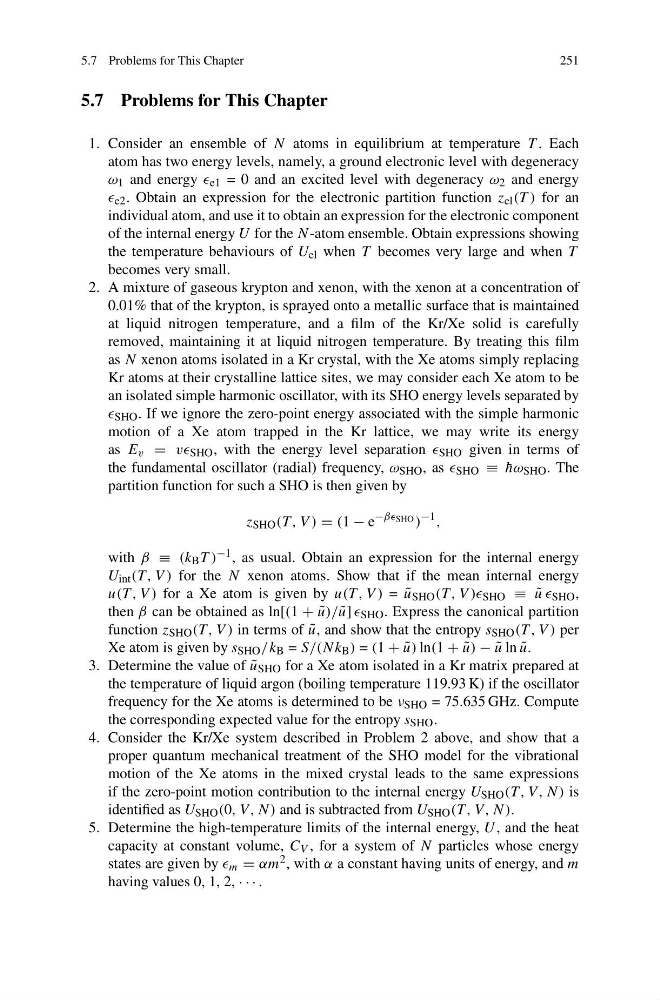
1. Consider an ensemble of N atoms in equilibrium at temperature T . Each
atom has two energy levels, namely, a ground electronic level with degeneracy
ω 1 and energy e1 = 0 and an excited level with degeneracy ω 2 and energy
e2 . Obtain an expression for the electronic partition function z el (T ) for an
individual atom, and use it to obtain an expression for the electronic component
of the internal energy U for the N-atom ensemble. Obtain expressions showing
the temperature behaviours of U el when T becomes very large and when T
becomes very small.
2. A mixture of gaseous krypton and xenon, with the xenon at a concentration of
0.01% that of the krypton, is sprayed onto a metallic surface that is maintained
at liquid nitrogen temperature, and a film of the Kr/Xe solid is carefully
removed, maintaining it at liquid nitrogen temperature. By treating this film
as N xenon atoms isolated in a Kr crystal, with the Xe atoms simply replacing
Kr atoms at their crystalline lattice sites, we may consider each Xe atom to be
an isolated simple harmonic oscillator, with its SHO energy levels separated by
SHO . If we ignore the zero-point energy associated with the simple harmonic
motion of a Xe atom trapped in the Kr lattice, we may write its energy
as E v = vv SHO , with the energy level separation SHO given in terms of
the fundamental oscillator (radial) frequency, ω SHO , as SHO ≡ ¯
hω SHO . The
partition function for such a SHO is then given by
z SHO (T , V ) = (1 − e
−ββ SHO )
−1 ,
with β ≡ (k B T ) −1 , as usual. Obtain an expression for the internal energy
U int (T , V ) for the N xenon atoms. Show that if the mean internal energy
u(T , V ) for a Xe atom is given by u(T , V ) = ˜
u SHO (T , V )) SHO ≡ ˜
u u SHO ,
then β can be obtained as ln[(1 + ˜
u)/ ˜
u] SHO . Express the canonical partition
function z SHO (T , V ) in terms of ˜
u, and show that the entropy s SHO (T , V ) per
Xe atom is given by s SHO /k B = S/(Nk B ) = (1 + ˜
u) ln(1 + ˜
u) − ˜
u ln ˜
u.
3. Determine the value of ˜
u SHO for a Xe atom isolated in a Kr matrix prepared at
the temperature of liquid argon (boiling temperature 119.93 K) if the oscillator
frequency for the Xe atoms is determined to be ν SHO = 75.635 GHz. Compute
the corresponding expected value for the entropy s SHO .
4. Consider the Kr/Xe system described in Problem 2 above, and show that a
proper quantum mechanical treatment of the SHO model for the vibrational
motion of the Xe atoms in the mixed crystal leads to the same expressions
if the zero-point motion contribution to the internal energy U SHO (T , V , N) is
identified as U SHO (0, V , N) and is subtracted from U SHO (T , V , N).
5. Determine the high-temperature limits of the internal energy, U , and the heat
capacity at constant volume, C V , for a system of N particles whose energy
states are given by m = αm 2 , with α a constant having units of energy, and m
having values 0, 1, 2, · · · .
251
5.7 Problems for This Chapter
1. Consider an ensemble of N atoms in equilibrium at temperature T . Each
atom has two energy levels, namely, a ground electronic level with degeneracy
ω 1 and energy e1 = 0 and an excited level with degeneracy ω 2 and energy
e2 . Obtain an expression for the electronic partition function z el (T ) for an
individual atom, and use it to obtain an expression for the electronic component
of the internal energy U for the N-atom ensemble. Obtain expressions showing
the temperature behaviours of U el when T becomes very large and when T
becomes very small.
2. A mixture of gaseous krypton and xenon, with the xenon at a concentration of
0.01% that of the krypton, is sprayed onto a metallic surface that is maintained
at liquid nitrogen temperature, and a film of the Kr/Xe solid is carefully
removed, maintaining it at liquid nitrogen temperature. By treating this film
as N xenon atoms isolated in a Kr crystal, with the Xe atoms simply replacing
Kr atoms at their crystalline lattice sites, we may consider each Xe atom to be
an isolated simple harmonic oscillator, with its SHO energy levels separated by
SHO . If we ignore the zero-point energy associated with the simple harmonic
motion of a Xe atom trapped in the Kr lattice, we may write its energy
as E v = vv SHO , with the energy level separation SHO given in terms of
the fundamental oscillator (radial) frequency, ω SHO , as SHO ≡ ¯
hω SHO . The
partition function for such a SHO is then given by
z SHO (T , V ) = (1 − e
−ββ SHO )
−1 ,
with β ≡ (k B T ) −1 , as usual. Obtain an expression for the internal energy
U int (T , V ) for the N xenon atoms. Show that if the mean internal energy
u(T , V ) for a Xe atom is given by u(T , V ) = ˜
u SHO (T , V )) SHO ≡ ˜
u u SHO ,
then β can be obtained as ln[(1 + ˜
u)/ ˜
u] SHO . Express the canonical partition
function z SHO (T , V ) in terms of ˜
u, and show that the entropy s SHO (T , V ) per
Xe atom is given by s SHO /k B = S/(Nk B ) = (1 + ˜
u) ln(1 + ˜
u) − ˜
u ln ˜
u.
3. Determine the value of ˜
u SHO for a Xe atom isolated in a Kr matrix prepared at
the temperature of liquid argon (boiling temperature 119.93 K) if the oscillator
frequency for the Xe atoms is determined to be ν SHO = 75.635 GHz. Compute
the corresponding expected value for the entropy s SHO .
4. Consider the Kr/Xe system described in Problem 2 above, and show that a
proper quantum mechanical treatment of the SHO model for the vibrational
motion of the Xe atoms in the mixed crystal leads to the same expressions
if the zero-point motion contribution to the internal energy U SHO (T , V , N) is
identified as U SHO (0, V , N) and is subtracted from U SHO (T , V , N).
5. Determine the high-temperature limits of the internal energy, U , and the heat
capacity at constant volume, C V , for a system of N particles whose energy
states are given by m = αm 2 , with α a constant having units of energy, and m
having values 0, 1, 2, · · · .