

232
5 Atomic Systems
A nuc (T ; N) = −Nk B T ln ω
n
0 .
(5.4.2)
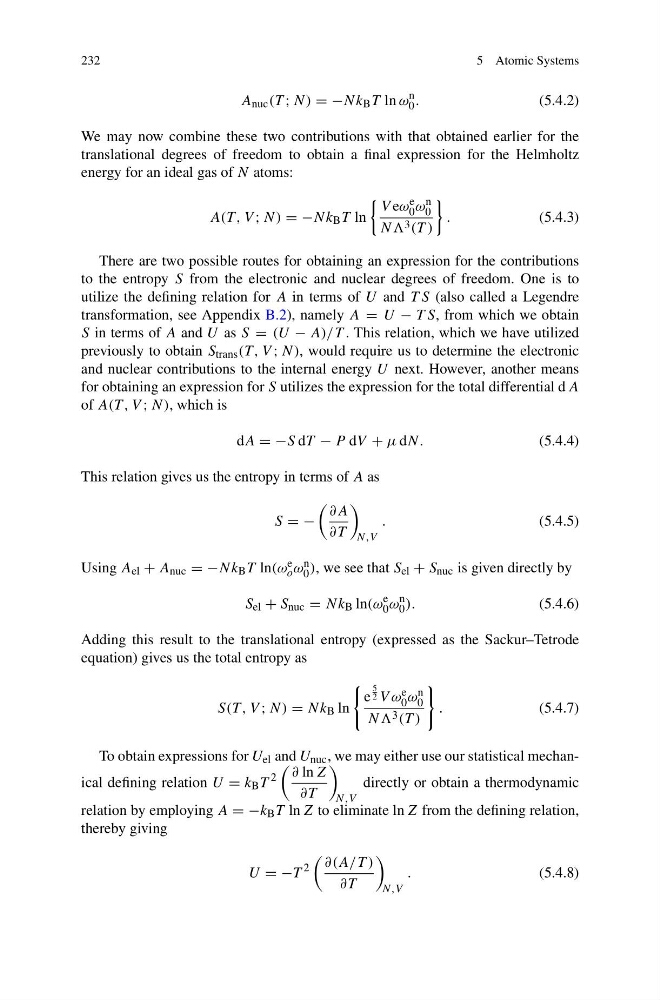
We may now combine these two contributions with that obtained earlier for the
translational degrees of freedom to obtain a final expression for the Helmholtz
energy for an ideal gas of N atoms:
A(T , V ; N) = −Nk B T ln
V eω e
0 ω n
0
NN 3 (T )
.
(5.4.3)
There are two possible routes for obtaining an expression for the contributions
to the entropy S from the electronic and nuclear degrees of freedom. One is to
utilize the defining relation for A in terms of U and T S (also called a Legendre
transformation, see Appendix B.2), namely A = U − T S, from which we obtain
S in terms of A and U as S = (U − A)/T . This relation, which we have utilized
previously to obtain S trans (T , V ; N), would require us to determine the electronic
and nuclear contributions to the internal energy U next. However, another means
for obtaining an expression for S utilizes the expression for the total differential d A
of A(T , V ; N), which is
dA = −S dT − P dV + μ dN.
(5.4.4)
This relation gives us the entropy in terms of A as
S = −
∂A
∂T
N,V
.
(5.4.5)
Using A el + A nuc = −Nk B T ln(ω e
o ω n
0 ), we see that S el + S nuc is given directly by
S el + S nuc = Nk B ln(ω
e
0 ω
n
0 ).
(5.4.6)
Adding this result to the translational entropy (expressed as the Sackur–Tetrode
equation) gives us the total entropy as
S(T , V ; N) = Nk B ln
e
5
2 V ω e
0 ω n
0
NN 3 (T )
.
(5.4.7)
To obtain expressions for U el and U nuc , we may either use our statistical mechanical defining relation U = k B T
2
∂ ln Z
∂T
N,V
directly or obtain a thermodynamic
relation by employing A = −k B T ln Z to eliminate ln Z from the defining relation,
thereby giving
U = −T
2
∂(A/T )
∂T
N,V
.
(5.4.8)
5 Atomic Systems
A nuc (T ; N) = −Nk B T ln ω
n
0 .
(5.4.2)
We may now combine these two contributions with that obtained earlier for the
translational degrees of freedom to obtain a final expression for the Helmholtz
energy for an ideal gas of N atoms:
A(T , V ; N) = −Nk B T ln
V eω e
0 ω n
0
NN 3 (T )
.
(5.4.3)
There are two possible routes for obtaining an expression for the contributions
to the entropy S from the electronic and nuclear degrees of freedom. One is to
utilize the defining relation for A in terms of U and T S (also called a Legendre
transformation, see Appendix B.2), namely A = U − T S, from which we obtain
S in terms of A and U as S = (U − A)/T . This relation, which we have utilized
previously to obtain S trans (T , V ; N), would require us to determine the electronic
and nuclear contributions to the internal energy U next. However, another means
for obtaining an expression for S utilizes the expression for the total differential d A
of A(T , V ; N), which is
dA = −S dT − P dV + μ dN.
(5.4.4)
This relation gives us the entropy in terms of A as
S = −
∂A
∂T
N,V
.
(5.4.5)
Using A el + A nuc = −Nk B T ln(ω e
o ω n
0 ), we see that S el + S nuc is given directly by
S el + S nuc = Nk B ln(ω
e
0 ω
n
0 ).
(5.4.6)
Adding this result to the translational entropy (expressed as the Sackur–Tetrode
equation) gives us the total entropy as
S(T , V ; N) = Nk B ln
e
5
2 V ω e
0 ω n
0
NN 3 (T )
.
(5.4.7)
To obtain expressions for U el and U nuc , we may either use our statistical mechanical defining relation U = k B T
2
∂ ln Z
∂T
N,V
directly or obtain a thermodynamic
relation by employing A = −k B T ln Z to eliminate ln Z from the defining relation,
thereby giving
U = −T
2
∂(A/T )
∂T
N,V
.
(5.4.8)