

5.4 Atomic Gas Thermodynamic Functions
231
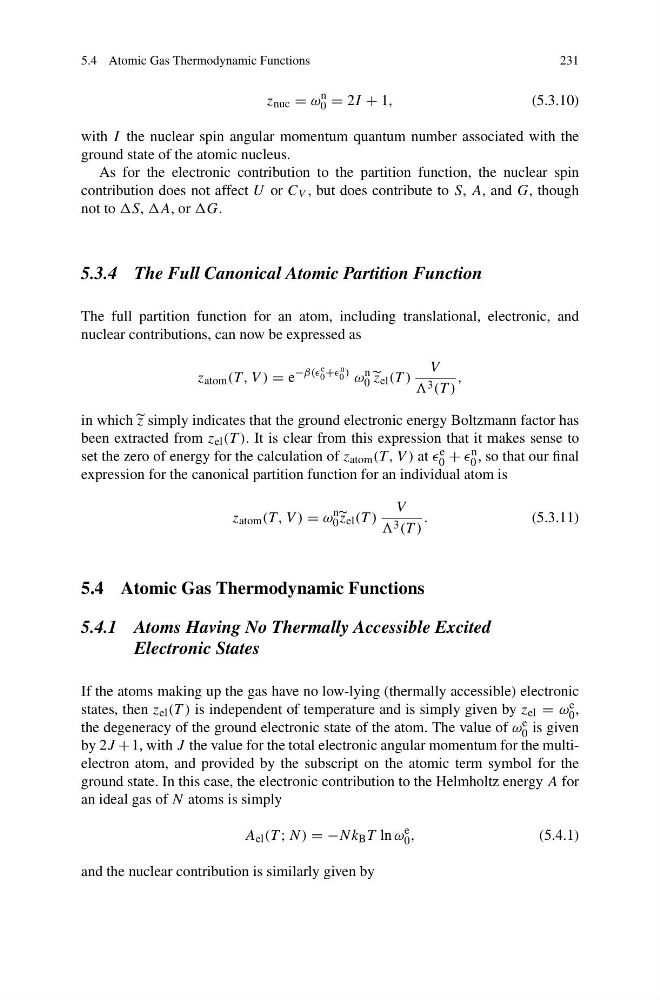
z nuc = ω
n
0 = 2I + 1,
(5.3.10)
with I the nuclear spin angular momentum quantum number associated with the
ground state of the atomic nucleus.
As for the electronic contribution to the partition function, the nuclear spin
contribution does not affect U or C V , but does contribute to S, A, and G, though
not to S, A, or G.
5.3.4 The Full Canonical Atomic Partition Function
The full partition function for an atom, including translational, electronic, and
nuclear contributions, can now be expressed as
z atom (T , V ) = e
−β(( e
0 + n
0 ) ω
n
0 z el (T )
V
3 (T )
,
in which z simply indicates that the ground electronic energy Boltzmann factor has
been extracted from z el (T ). It is clear from this expression that it makes sense to
set the zero of energy for the calculation of z atom (T , V ) at e
0 + n
0 , so that our final
expression for the canonical partition function for an individual atom is
z atom (T , V ) = ω
n
0 z el (T )
V
3 (T )
.
(5.3.11)
5.4 Atomic Gas Thermodynamic Functions
5.4.1 Atoms Having No Thermally Accessible Excited
Electronic States
If the atoms making up the gas have no low-lying (thermally accessible) electronic
states, then z el (T ) is independent of temperature and is simply given by z el = ω e
0 ,
the degeneracy of the ground electronic state of the atom. The value of ω e
0 is given
by 2J + 1, with J the value for the total electronic angular momentum for the multielectron atom, and provided by the subscript on the atomic term symbol for the
ground state. In this case, the electronic contribution to the Helmholtz energy A for
an ideal gas of N atoms is simply
A el (T ; N) = −Nk B T ln ω
e
0 ,
(5.4.1)
and the nuclear contribution is similarly given by
231
z nuc = ω
n
0 = 2I + 1,
(5.3.10)
with I the nuclear spin angular momentum quantum number associated with the
ground state of the atomic nucleus.
As for the electronic contribution to the partition function, the nuclear spin
contribution does not affect U or C V , but does contribute to S, A, and G, though
not to S, A, or G.
5.3.4 The Full Canonical Atomic Partition Function
The full partition function for an atom, including translational, electronic, and
nuclear contributions, can now be expressed as
z atom (T , V ) = e
−β(( e
0 + n
0 ) ω
n
0 z el (T )
V
3 (T )
,
in which z simply indicates that the ground electronic energy Boltzmann factor has
been extracted from z el (T ). It is clear from this expression that it makes sense to
set the zero of energy for the calculation of z atom (T , V ) at e
0 + n
0 , so that our final
expression for the canonical partition function for an individual atom is
z atom (T , V ) = ω
n
0 z el (T )
V
3 (T )
.
(5.3.11)
5.4 Atomic Gas Thermodynamic Functions
5.4.1 Atoms Having No Thermally Accessible Excited
Electronic States
If the atoms making up the gas have no low-lying (thermally accessible) electronic
states, then z el (T ) is independent of temperature and is simply given by z el = ω e
0 ,
the degeneracy of the ground electronic state of the atom. The value of ω e
0 is given
by 2J + 1, with J the value for the total electronic angular momentum for the multielectron atom, and provided by the subscript on the atomic term symbol for the
ground state. In this case, the electronic contribution to the Helmholtz energy A for
an ideal gas of N atoms is simply
A el (T ; N) = −Nk B T ln ω
e
0 ,
(5.4.1)
and the nuclear contribution is similarly given by