

220
5 Atomic Systems
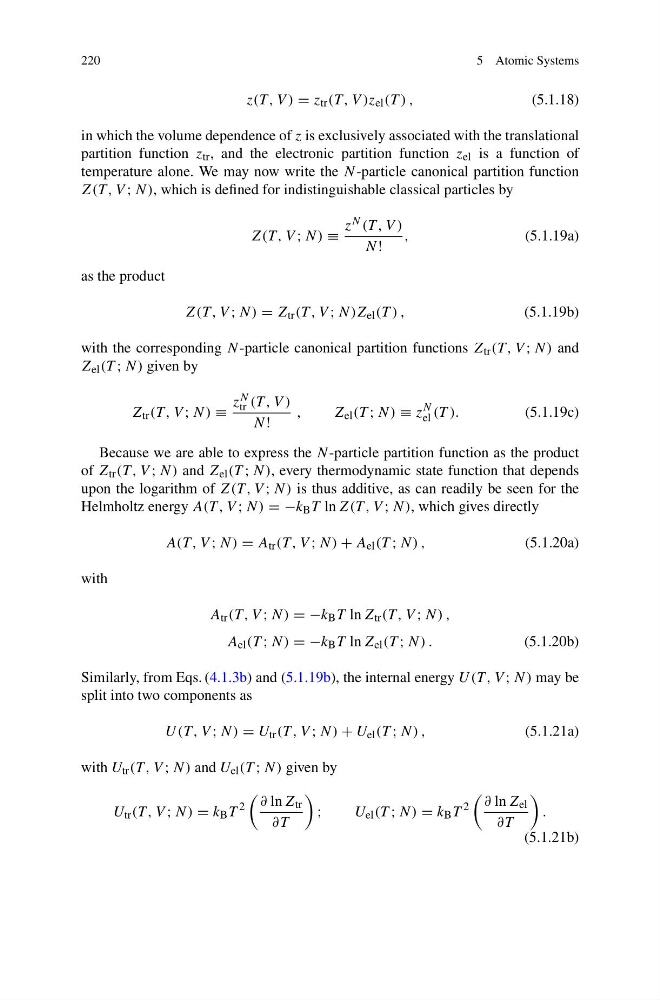
z(T , V ) = z tr (T , V )z el (T ) ,
(5.1.18)
in which the volume dependence of z is exclusively associated with the translational
partition function z tr , and the electronic partition function z el is a function of
temperature alone. We may now write the N -particle canonical partition function
Z(T , V ; N), which is defined for indistinguishable classical particles by
Z(T , V ; N) ≡
z N (T , V )
N!
,
(5.1.19a)
as the product
Z(T , V ; N) = Z tr (T , V ; N)Z el (T ) ,
(5.1.19b)
with the corresponding N-particle canonical partition functions Z tr (T , V ; N) and
Z el (T ; N) given by
Z tr (T , V ; N) ≡
z N
tr (T , V )
N!
,
Z el (T ; N) ≡ z
N
el (T ).
(5.1.19c)
Because we are able to express the N-particle partition function as the product
of Z tr (T , V ; N) and Z el (T ; N), every thermodynamic state function that depends
upon the logarithm of Z(T , V ; N) is thus additive, as can readily be seen for the
Helmholtz energy A(T , V ; N) = −k B T ln Z(T , V ; N), which gives directly
A(T , V ; N) = A tr (T , V ; N) + A el (T ; N) ,
(5.1.20a)
with
A tr (T , V ; N) = −k B T ln Z tr (T , V ; N) ,
A el (T ; N) = −k B T ln Z el (T ; N) .
(5.1.20b)
Similarly, from Eqs. (4.1.3b) and (5.1.19b), the internal energy U(T , V ; N) may be
split into two components as
U(T , V ; N) = U tr (T , V ; N) + U el (T ; N) ,
(5.1.21a)
with U tr (T , V ; N) and U el (T ; N) given by
U tr (T , V ; N) = k B T
2
∂ ln Z tr
∂T
;
U el (T ; N) = k B T
2
∂ ln Z el
∂T
.
(5.1.21b)
5 Atomic Systems
z(T , V ) = z tr (T , V )z el (T ) ,
(5.1.18)
in which the volume dependence of z is exclusively associated with the translational
partition function z tr , and the electronic partition function z el is a function of
temperature alone. We may now write the N -particle canonical partition function
Z(T , V ; N), which is defined for indistinguishable classical particles by
Z(T , V ; N) ≡
z N (T , V )
N!
,
(5.1.19a)
as the product
Z(T , V ; N) = Z tr (T , V ; N)Z el (T ) ,
(5.1.19b)
with the corresponding N-particle canonical partition functions Z tr (T , V ; N) and
Z el (T ; N) given by
Z tr (T , V ; N) ≡
z N
tr (T , V )
N!
,
Z el (T ; N) ≡ z
N
el (T ).
(5.1.19c)
Because we are able to express the N-particle partition function as the product
of Z tr (T , V ; N) and Z el (T ; N), every thermodynamic state function that depends
upon the logarithm of Z(T , V ; N) is thus additive, as can readily be seen for the
Helmholtz energy A(T , V ; N) = −k B T ln Z(T , V ; N), which gives directly
A(T , V ; N) = A tr (T , V ; N) + A el (T ; N) ,
(5.1.20a)
with
A tr (T , V ; N) = −k B T ln Z tr (T , V ; N) ,
A el (T ; N) = −k B T ln Z el (T ; N) .
(5.1.20b)
Similarly, from Eqs. (4.1.3b) and (5.1.19b), the internal energy U(T , V ; N) may be
split into two components as
U(T , V ; N) = U tr (T , V ; N) + U el (T ; N) ,
(5.1.21a)
with U tr (T , V ; N) and U el (T ; N) given by
U tr (T , V ; N) = k B T
2
∂ ln Z tr
∂T
;
U el (T ; N) = k B T
2
∂ ln Z el
∂T
.
(5.1.21b)