

5.1 Ground Electronic Term Atoms
219
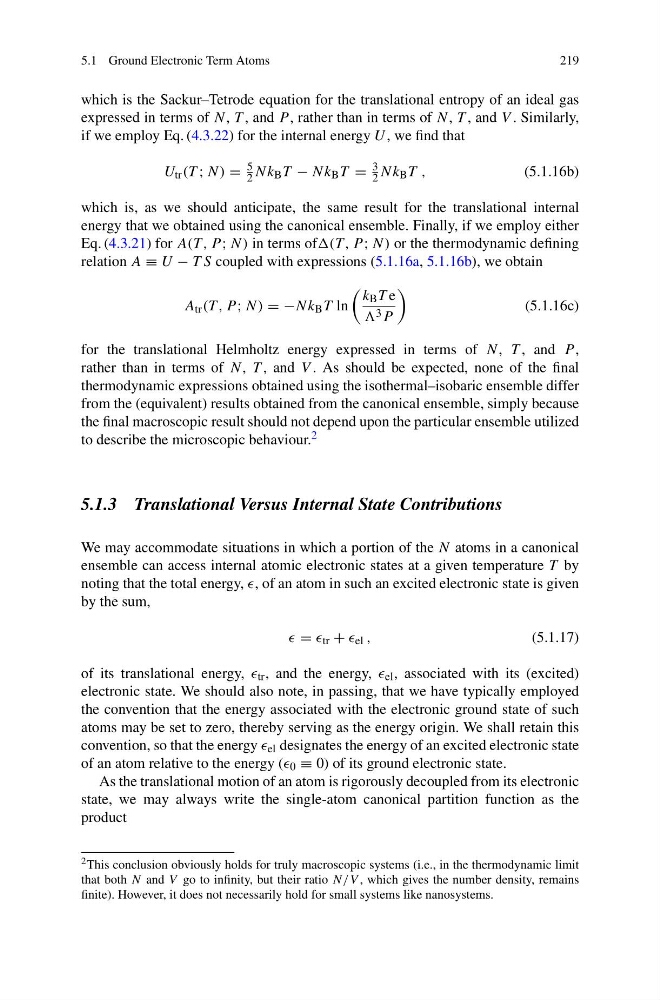
which is the Sackur–Tetrode equation for the translational entropy of an ideal gas
expressed in terms of N, T , and P , rather than in terms of N, T , and V . Similarly,
if we employ Eq. (4.3.22) for the internal energy U , we find that
U tr (T ; N) =
5
2 Nk B T − Nk B T =
3
2 Nk B T ,
(5.1.16b)
which is, as we should anticipate, the same result for the translational internal
energy that we obtained using the canonical ensemble. Finally, if we employ either
Eq. (4.3.21) for A(T , P ; N) in terms of , P ; N) or the thermodynamic defining
relation A ≡ U − T S coupled with expressions (5.1.16a, 5.1.16b), we obtain
A tr (T , P ; N) = −Nk B T ln
k B T e
3 P
(5.1.16c)
for the translational Helmholtz energy expressed in terms of N , T , and P ,
rather than in terms of N, T , and V . As should be expected, none of the final
thermodynamic expressions obtained using the isothermal–isobaric ensemble differ
from the (equivalent) results obtained from the canonical ensemble, simply because
the final macroscopic result should not depend upon the particular ensemble utilized
to describe the microscopic behaviour. 2
5.1.3 Translational Versus Internal State Contributions
We may accommodate situations in which a portion of the N atoms in a canonical
ensemble can access internal atomic electronic states at a given temperature T by
noting that the total energy, , of an atom in such an excited electronic state is given
by the sum,
= tr + el ,
(5.1.17)
of its translational energy, tr , and the energy, el , associated with its (excited)
electronic state. We should also note, in passing, that we have typically employed
the convention that the energy associated with the electronic ground state of such
atoms may be set to zero, thereby serving as the energy origin. We shall retain this
convention, so that the energy el designates the energy of an excited electronic state
of an atom relative to the energy ( 0 ≡ 0) of its ground electronic state.
As the translational motion of an atom is rigorously decoupled from its electronic
state, we may always write the single-atom canonical partition function as the
product
2 This conclusion obviously holds for truly macroscopic systems (i.e., in the thermodynamic limit
that both N and V go to infinity, but their ratio N/V , which gives the number density, remains
finite). However, it does not necessarily hold for small systems like nanosystems.
219
which is the Sackur–Tetrode equation for the translational entropy of an ideal gas
expressed in terms of N, T , and P , rather than in terms of N, T , and V . Similarly,
if we employ Eq. (4.3.22) for the internal energy U , we find that
U tr (T ; N) =
5
2 Nk B T − Nk B T =
3
2 Nk B T ,
(5.1.16b)
which is, as we should anticipate, the same result for the translational internal
energy that we obtained using the canonical ensemble. Finally, if we employ either
Eq. (4.3.21) for A(T , P ; N) in terms of , P ; N) or the thermodynamic defining
relation A ≡ U − T S coupled with expressions (5.1.16a, 5.1.16b), we obtain
A tr (T , P ; N) = −Nk B T ln
k B T e
3 P
(5.1.16c)
for the translational Helmholtz energy expressed in terms of N , T , and P ,
rather than in terms of N, T , and V . As should be expected, none of the final
thermodynamic expressions obtained using the isothermal–isobaric ensemble differ
from the (equivalent) results obtained from the canonical ensemble, simply because
the final macroscopic result should not depend upon the particular ensemble utilized
to describe the microscopic behaviour. 2
5.1.3 Translational Versus Internal State Contributions
We may accommodate situations in which a portion of the N atoms in a canonical
ensemble can access internal atomic electronic states at a given temperature T by
noting that the total energy, , of an atom in such an excited electronic state is given
by the sum,
= tr + el ,
(5.1.17)
of its translational energy, tr , and the energy, el , associated with its (excited)
electronic state. We should also note, in passing, that we have typically employed
the convention that the energy associated with the electronic ground state of such
atoms may be set to zero, thereby serving as the energy origin. We shall retain this
convention, so that the energy el designates the energy of an excited electronic state
of an atom relative to the energy ( 0 ≡ 0) of its ground electronic state.
As the translational motion of an atom is rigorously decoupled from its electronic
state, we may always write the single-atom canonical partition function as the
product
2 This conclusion obviously holds for truly macroscopic systems (i.e., in the thermodynamic limit
that both N and V go to infinity, but their ratio N/V , which gives the number density, remains
finite). However, it does not necessarily hold for small systems like nanosystems.