

4.2 Grand Ensemble: Open Systems
185
=
∞
N =0
e
−γ N Z(β, N)
(4.2.2a)
≡
N
λ
N Z N (β) ,
(4.2.2b)
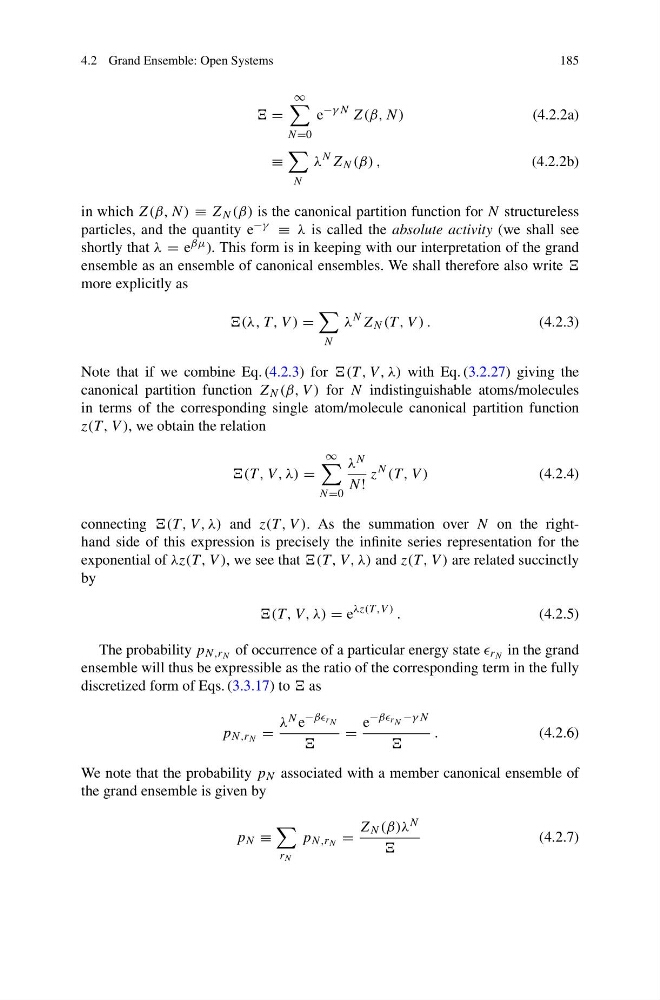
in which Z(β, N) ≡ Z N (β) is the canonical partition function for N structureless
particles, and the quantity e −γ ≡ λ is called the absolute activity (we shall see
shortly that λ = e βμ ). This form is in keeping with our interpretation of the grand
ensemble as an ensemble of canonical ensembles. We shall therefore also write
more explicitly as
T , V ) =
N
λ
N Z N (T , V ) .
(4.2.3)
Note that if we combine Eq. (4.2.3) for , V , λ) with Eq. (3.2.27) giving the
canonical partition function Z N (β, V ) for N indistinguishable atoms/molecules
in terms of the corresponding single atom/molecule canonical partition function
z(T , V ), we obtain the relation
, V , λ) =
∞
N =0
λ N
N!
z
N (T , V )
(4.2.4)
connecting (T , V , λ) and z(T , V ). As the summation over N on the righthand side of this expression is precisely the infinite series representation for the
exponential of λz(T , V ), we see that , V , λ) and z(T , V ) are related succinctly
by
(T , V , λ) = e
λz(T ,V ) .
(4.2.5)
The probability p N,r N of occurrence of a particular energy state r N in the grand
ensemble will thus be expressible as the ratio of the corresponding term in the fully
discretized form of Eqs. (3.3.17) to as
p N,r N =
λ N e
−ββ r N
=
e
−ββ r N −γ N
.
(4.2.6)
We note that the probability p N associated with a member canonical ensemble of
the grand ensemble is given by
p N ≡
r N
p N,r N =
Z N (β)λ N
(4.2.7)
185
=
∞
N =0
e
−γ N Z(β, N)
(4.2.2a)
≡
N
λ
N Z N (β) ,
(4.2.2b)
in which Z(β, N) ≡ Z N (β) is the canonical partition function for N structureless
particles, and the quantity e −γ ≡ λ is called the absolute activity (we shall see
shortly that λ = e βμ ). This form is in keeping with our interpretation of the grand
ensemble as an ensemble of canonical ensembles. We shall therefore also write
more explicitly as
T , V ) =
N
λ
N Z N (T , V ) .
(4.2.3)
Note that if we combine Eq. (4.2.3) for , V , λ) with Eq. (3.2.27) giving the
canonical partition function Z N (β, V ) for N indistinguishable atoms/molecules
in terms of the corresponding single atom/molecule canonical partition function
z(T , V ), we obtain the relation
, V , λ) =
∞
N =0
λ N
N!
z
N (T , V )
(4.2.4)
connecting (T , V , λ) and z(T , V ). As the summation over N on the righthand side of this expression is precisely the infinite series representation for the
exponential of λz(T , V ), we see that , V , λ) and z(T , V ) are related succinctly
by
(T , V , λ) = e
λz(T ,V ) .
(4.2.5)
The probability p N,r N of occurrence of a particular energy state r N in the grand
ensemble will thus be expressible as the ratio of the corresponding term in the fully
discretized form of Eqs. (3.3.17) to as
p N,r N =
λ N e
−ββ r N
=
e
−ββ r N −γ N
.
(4.2.6)
We note that the probability p N associated with a member canonical ensemble of
the grand ensemble is given by
p N ≡
r N
p N,r N =
Z N (β)λ N
(4.2.7)