

184
4 Mean Values and Thermodynamics
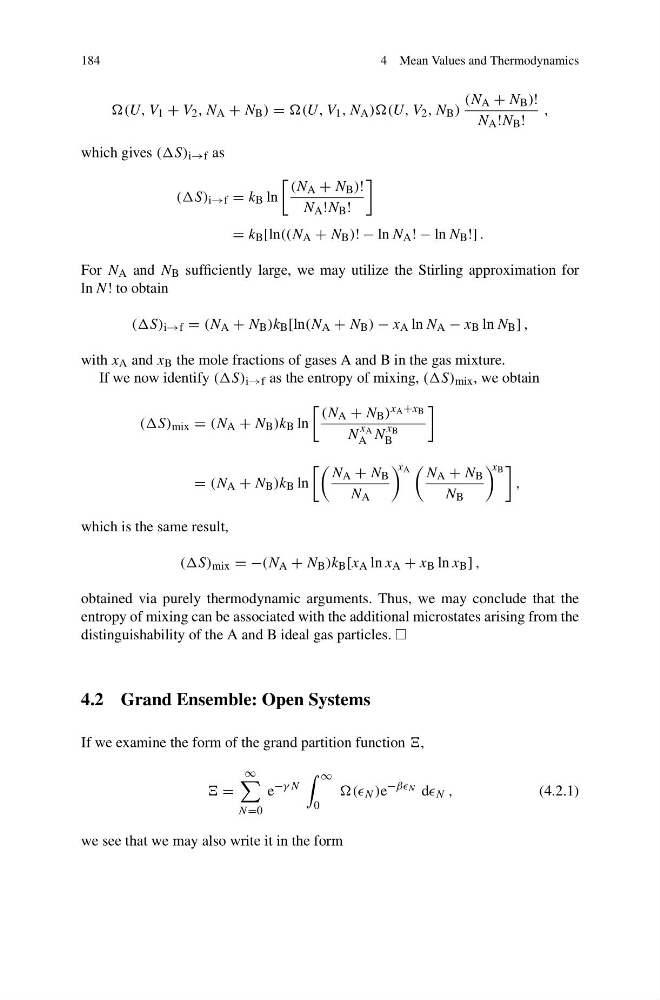
V 1 + V 2 , N A + N B ) = (U, V 1 , N A ))(U, V 2 , N B )
(N A + N B )!
N A !N B !
,
which gives ((S) i→f as
((S) i→f = k B ln
(N A + N B )!
N A !N B !
= k B [ln((N A + N B )! − ln N A ! − ln N B !] .
For N A and N B sufficiently large, we may utilize the Stirling approximation for
ln N! to obtain
((S) i→f = (N A + N B )k B [ln(N A + N B ) − x A ln N A − x B ln N B ] ,
with x A and x B the mole fractions of gases A and B in the gas mixture.
If we now identify ((S) i→f as the entropy of mixing, ((S) mix , we obtain
((S) mix = (N A + N B )k B ln
(N A + N B ) x A +x B
N
x A
A N
x B
B
= (N A + N B )k B ln
N A + N B
N A
x A
N A + N B
N B
x B
,
which is the same result,
((S) mix = −(N A + N B )k B [x A ln x A + x B ln x B ] ,
obtained via purely thermodynamic arguments. Thus, we may conclude that the
entropy of mixing can be associated with the additional microstates arising from the
distinguishability of the A and B ideal gas particles.
4.2 Grand Ensemble: Open Systems
If we examine the form of the grand partition function ,
=
∞
N =0
e
−γ N
∞
0
N )e
−ββ N d N ,
(4.2.1)
we see that we may also write it in the form
4 Mean Values and Thermodynamics
V 1 + V 2 , N A + N B ) = (U, V 1 , N A ))(U, V 2 , N B )
(N A + N B )!
N A !N B !
,
which gives ((S) i→f as
((S) i→f = k B ln
(N A + N B )!
N A !N B !
= k B [ln((N A + N B )! − ln N A ! − ln N B !] .
For N A and N B sufficiently large, we may utilize the Stirling approximation for
ln N! to obtain
((S) i→f = (N A + N B )k B [ln(N A + N B ) − x A ln N A − x B ln N B ] ,
with x A and x B the mole fractions of gases A and B in the gas mixture.
If we now identify ((S) i→f as the entropy of mixing, ((S) mix , we obtain
((S) mix = (N A + N B )k B ln
(N A + N B ) x A +x B
N
x A
A N
x B
B
= (N A + N B )k B ln
N A + N B
N A
x A
N A + N B
N B
x B
,
which is the same result,
((S) mix = −(N A + N B )k B [x A ln x A + x B ln x B ] ,
obtained via purely thermodynamic arguments. Thus, we may conclude that the
entropy of mixing can be associated with the additional microstates arising from the
distinguishability of the A and B ideal gas particles.
4.2 Grand Ensemble: Open Systems
If we examine the form of the grand partition function ,
=
∞
N =0
e
−γ N
∞
0
N )e
−ββ N d N ,
(4.2.1)
we see that we may also write it in the form