

6
1 Basic Background Material
′
′
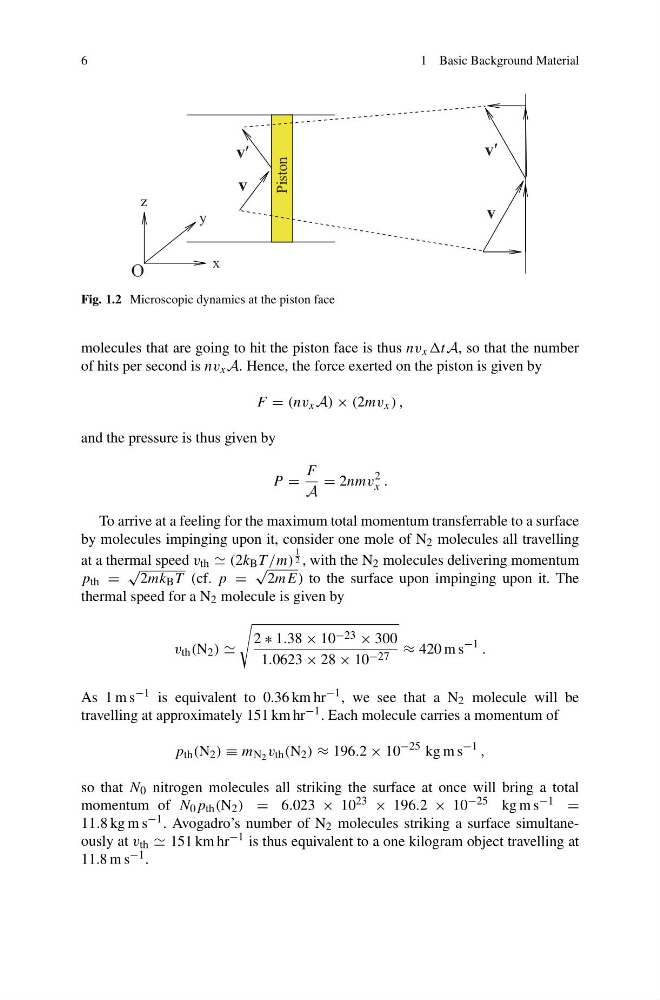
Fig. 1.2 Microscopic dynamics at the piston face
molecules that are going to hit the piston face is thus nv x tA, so that the number
of hits per second is nv x A. Hence, the force exerted on the piston is given by
F = (nv x A) × (2mv x ) ,
and the pressure is thus given by
P =
F
A
= 2nmv
2
x .
To arrive at a feeling for the maximum total momentum transferrable to a surface
by molecules impinging upon it, consider one mole of N 2 molecules all travelling
at a thermal speed v th (2k B T /m)
1
2 , with the N 2 molecules delivering momentum
p th =
√
2mk B T (cf. p =
√
2mE) to the surface upon impinging upon it. The
thermal speed for a N 2 molecule is given by
v th (N 2 )
2 ∗ 1.38 × 10 −23 × 300
1.0623 × 28 × 10 −27 ≈ 420 m s
−1 .
As 1 m s −1 is equivalent to 0.36 km hr
−1 , we see that a N 2 molecule will be
travelling at approximately 151 km hr
−1 . Each molecule carries a momentum of
p th (N 2 ) ≡ m N 2 v th (N 2 ) ≈ 196.2 × 10
−25 kg m s
−1 ,
so that N 0 nitrogen molecules all striking the surface at once will bring a total
momentum of N 0 p th (N 2 ) = 6.023 × 10 23 × 196.2 × 10 −25 kg m s −1 =
11.8 kg m s −1 . Avogadro’s number of N 2 molecules striking a surface simultaneously at v th 151 km hr
−1 is thus equivalent to a one kilogram object travelling at
11.8 m s −1 .
1 Basic Background Material
′
′
Fig. 1.2 Microscopic dynamics at the piston face
molecules that are going to hit the piston face is thus nv x tA, so that the number
of hits per second is nv x A. Hence, the force exerted on the piston is given by
F = (nv x A) × (2mv x ) ,
and the pressure is thus given by
P =
F
A
= 2nmv
2
x .
To arrive at a feeling for the maximum total momentum transferrable to a surface
by molecules impinging upon it, consider one mole of N 2 molecules all travelling
at a thermal speed v th (2k B T /m)
1
2 , with the N 2 molecules delivering momentum
p th =
√
2mk B T (cf. p =
√
2mE) to the surface upon impinging upon it. The
thermal speed for a N 2 molecule is given by
v th (N 2 )
2 ∗ 1.38 × 10 −23 × 300
1.0623 × 28 × 10 −27 ≈ 420 m s
−1 .
As 1 m s −1 is equivalent to 0.36 km hr
−1 , we see that a N 2 molecule will be
travelling at approximately 151 km hr
−1 . Each molecule carries a momentum of
p th (N 2 ) ≡ m N 2 v th (N 2 ) ≈ 196.2 × 10
−25 kg m s
−1 ,
so that N 0 nitrogen molecules all striking the surface at once will bring a total
momentum of N 0 p th (N 2 ) = 6.023 × 10 23 × 196.2 × 10 −25 kg m s −1 =
11.8 kg m s −1 . Avogadro’s number of N 2 molecules striking a surface simultaneously at v th 151 km hr
−1 is thus equivalent to a one kilogram object travelling at
11.8 m s −1 .