

1.2 The Ideal Gas
5
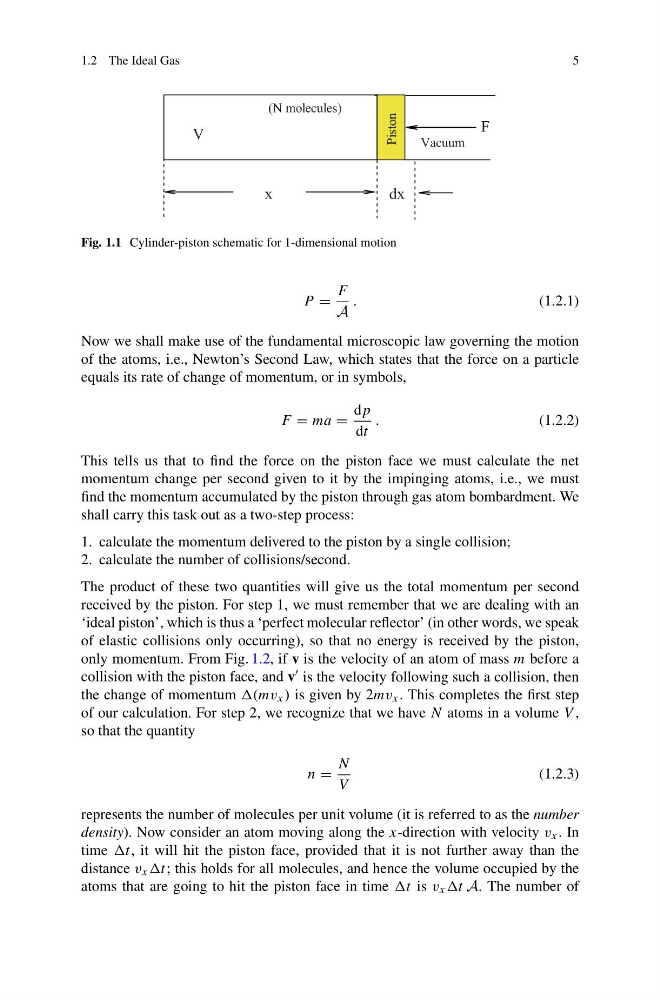
Fig. 1.1 Cylinder-piston schematic for 1-dimensional motion
P =
F
A
.
(1.2.1)
Now we shall make use of the fundamental microscopic law governing the motion
of the atoms, i.e., Newton’s Second Law, which states that the force on a particle
equals its rate of change of momentum, or in symbols,
F = ma =
dp
dt
.
(1.2.2)
This tells us that to find the force on the piston face we must calculate the net
momentum change per second given to it by the impinging atoms, i.e., we must
find the momentum accumulated by the piston through gas atom bombardment. We
shall carry this task out as a two-step process:
1. calculate the momentum delivered to the piston by a single collision;
2. calculate the number of collisions/second.
The product of these two quantities will give us the total momentum per second
received by the piston. For step 1, we must remember that we are dealing with an
‘ideal piston’, which is thus a ‘perfect molecular reflector’ (in other words, we speak
of elastic collisions only occurring), so that no energy is received by the piston,
only momentum. From Fig. 1.2, if v is the velocity of an atom of mass m before a
collision with the piston face, and v is the velocity following such a collision, then
the change of momentum (mv x ) is given by 2mv x . This completes the first step
of our calculation. For step 2, we recognize that we have N atoms in a volume V ,
so that the quantity
n =
N
V
(1.2.3)
represents the number of molecules per unit volume (it is referred to as the number
density). Now consider an atom moving along the x-direction with velocity v x . In
time t, it will hit the piston face, provided that it is not further away than the
distance v x t; this holds for all molecules, and hence the volume occupied by the
atoms that are going to hit the piston face in time t is v x t A. The number of
5
Fig. 1.1 Cylinder-piston schematic for 1-dimensional motion
P =
F
A
.
(1.2.1)
Now we shall make use of the fundamental microscopic law governing the motion
of the atoms, i.e., Newton’s Second Law, which states that the force on a particle
equals its rate of change of momentum, or in symbols,
F = ma =
dp
dt
.
(1.2.2)
This tells us that to find the force on the piston face we must calculate the net
momentum change per second given to it by the impinging atoms, i.e., we must
find the momentum accumulated by the piston through gas atom bombardment. We
shall carry this task out as a two-step process:
1. calculate the momentum delivered to the piston by a single collision;
2. calculate the number of collisions/second.
The product of these two quantities will give us the total momentum per second
received by the piston. For step 1, we must remember that we are dealing with an
‘ideal piston’, which is thus a ‘perfect molecular reflector’ (in other words, we speak
of elastic collisions only occurring), so that no energy is received by the piston,
only momentum. From Fig. 1.2, if v is the velocity of an atom of mass m before a
collision with the piston face, and v is the velocity following such a collision, then
the change of momentum (mv x ) is given by 2mv x . This completes the first step
of our calculation. For step 2, we recognize that we have N atoms in a volume V ,
so that the quantity
n =
N
V
(1.2.3)
represents the number of molecules per unit volume (it is referred to as the number
density). Now consider an atom moving along the x-direction with velocity v x . In
time t, it will hit the piston face, provided that it is not further away than the
distance v x t; this holds for all molecules, and hence the volume occupied by the
atoms that are going to hit the piston face in time t is v x t A. The number of