

3.3 The Grand Ensemble: Open Systems
157
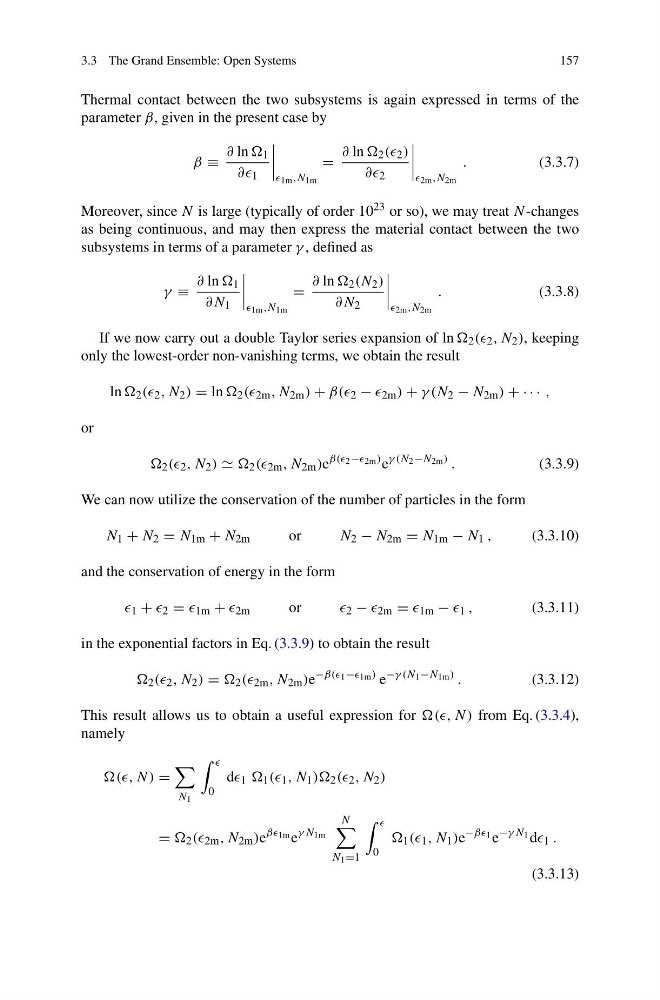
Thermal contact between the two subsystems is again expressed in terms of the
parameter β, given in the present case by
β ≡
∂ ln 1
∂∂ 1
1m ,N 1m
=
∂ ln 2 (( 2 )
∂∂ 2
2m ,N 2m
.
(3.3.7)
Moreover, since N is large (typically of order 10 23 or so), we may treat N-changes
as being continuous, and may then express the material contact between the two
subsystems in terms of a parameter γ , defined as
γ ≡
∂ ln 1
∂N 1
1m ,N 1m
=
∂ ln 2 (N 2 )
∂N 2
2m ,N 2m
.
(3.3.8)
If we now carry out a double Taylor series expansion of ln 2 (( 2 , N 2 ), keeping
only the lowest-order non-vanishing terms, we obtain the result
ln 2 (( 2 , N 2 ) = ln 2 (( 2m , N 2m ) + β(( 2 − 2m ) + γ (N 2 − N 2m ) + · · · ,
or
2 (( 2 , N 2 ) 2 (( 2m , N 2m )e
β(( 2 − 2m ) e
γ (N 2 −N 2m ) .
(3.3.9)
We can now utilize the conservation of the number of particles in the form
N 1 + N 2 = N 1m + N 2m
or
N 2 − N 2m = N 1m − N 1 ,
(3.3.10)
and the conservation of energy in the form
1 + 2 = 1m + 2m
or
2 − 2m = 1m − 1 ,
(3.3.11)
in the exponential factors in Eq. (3.3.9) to obtain the result
2 (( 2 , N 2 ) = 2 (( 2m , N 2m )e
−β(( 1 − 1m ) e
−γ (N 1 −N 1m ) .
(3.3.12)
This result allows us to obtain a useful expression for ((, N) from Eq. (3.3.4),
namely
N) =
N 1
0
d 1 1 (( 1 , N 1 )) 2 (( 2 , N 2 )
= 2 (( 2m , N 2m )e
ββ 1m e
γ N 1m
N
N 1 =1
0
1 (( 1 , N 1 )e
−ββ 1 e
−γ N 1 d 1 .
(3.3.13)
157
Thermal contact between the two subsystems is again expressed in terms of the
parameter β, given in the present case by
β ≡
∂ ln 1
∂∂ 1
1m ,N 1m
=
∂ ln 2 (( 2 )
∂∂ 2
2m ,N 2m
.
(3.3.7)
Moreover, since N is large (typically of order 10 23 or so), we may treat N-changes
as being continuous, and may then express the material contact between the two
subsystems in terms of a parameter γ , defined as
γ ≡
∂ ln 1
∂N 1
1m ,N 1m
=
∂ ln 2 (N 2 )
∂N 2
2m ,N 2m
.
(3.3.8)
If we now carry out a double Taylor series expansion of ln 2 (( 2 , N 2 ), keeping
only the lowest-order non-vanishing terms, we obtain the result
ln 2 (( 2 , N 2 ) = ln 2 (( 2m , N 2m ) + β(( 2 − 2m ) + γ (N 2 − N 2m ) + · · · ,
or
2 (( 2 , N 2 ) 2 (( 2m , N 2m )e
β(( 2 − 2m ) e
γ (N 2 −N 2m ) .
(3.3.9)
We can now utilize the conservation of the number of particles in the form
N 1 + N 2 = N 1m + N 2m
or
N 2 − N 2m = N 1m − N 1 ,
(3.3.10)
and the conservation of energy in the form
1 + 2 = 1m + 2m
or
2 − 2m = 1m − 1 ,
(3.3.11)
in the exponential factors in Eq. (3.3.9) to obtain the result
2 (( 2 , N 2 ) = 2 (( 2m , N 2m )e
−β(( 1 − 1m ) e
−γ (N 1 −N 1m ) .
(3.3.12)
This result allows us to obtain a useful expression for ((, N) from Eq. (3.3.4),
namely
N) =
N 1
0
d 1 1 (( 1 , N 1 )) 2 (( 2 , N 2 )
= 2 (( 2m , N 2m )e
ββ 1m e
γ N 1m
N
N 1 =1
0
1 (( 1 , N 1 )e
−ββ 1 e
−γ N 1 d 1 .
(3.3.13)