

3.3 The Grand Ensemble: Open Systems
155
3.3 The Grand Ensemble: Open Systems
The so-called grand ensemble is an ensemble, each of whose members is itself
a canonical ensemble with a fixed value for the number of particles, N. In this
way we allow the exchange both of energy and mass (via the number of particles),
so that the grand ensemble is appropriate for the description of an open system.
Strictly speaking, we should use the grand ensemble when we wish to describe
the thermodynamics of an open system, but as we shall see later on, there is
an artifice that will allow us to bypass this necessity so that we may obtain
appropriate expressions directly from the canonical ensemble. Let us nonetheless
briefly examine the development of the grand ensemble.
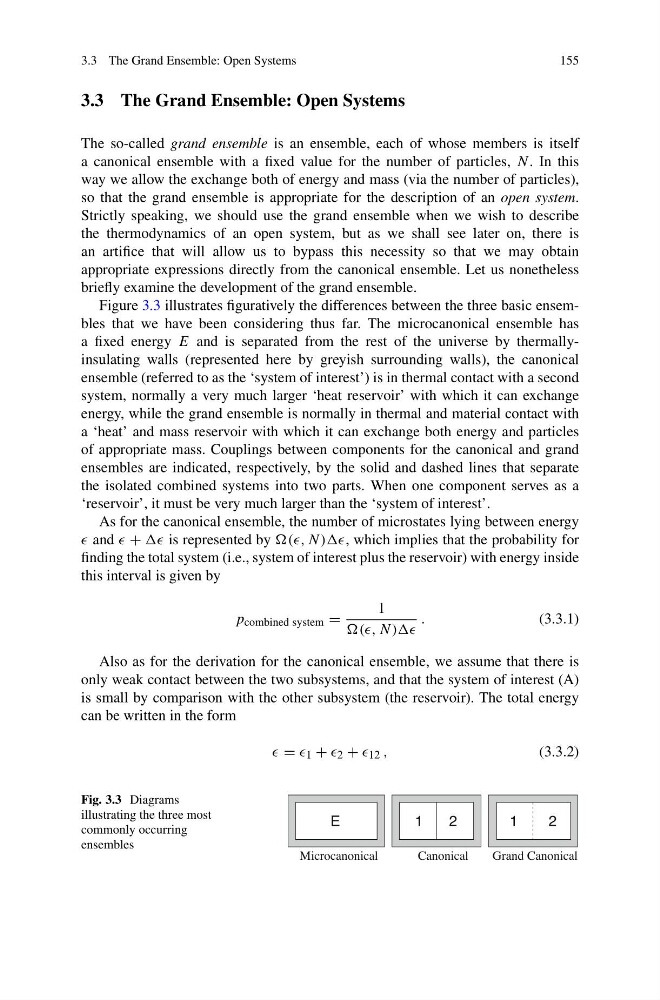
Figure 3.3 illustrates figuratively the differences between the three basic ensembles that we have been considering thus far. The microcanonical ensemble has
a fixed energy E and is separated from the rest of the universe by thermallyinsulating walls (represented here by greyish surrounding walls), the canonical
ensemble (referred to as the ‘system of interest’) is in thermal contact with a second
system, normally a very much larger ‘heat reservoir’ with which it can exchange
energy, while the grand ensemble is normally in thermal and material contact with
a ‘heat’ and mass reservoir with which it can exchange both energy and particles
of appropriate mass. Couplings between components for the canonical and grand
ensembles are indicated, respectively, by the solid and dashed lines that separate
the isolated combined systems into two parts. When one component serves as a
‘reservoir’, it must be very much larger than the ‘system of interest’.
As for the canonical ensemble, the number of microstates lying between energy
and + is represented by N))), which implies that the probability for
finding the total system (i.e., system of interest plus the reservoir) with energy inside
this interval is given by
p combined system =
1
((, N)))
.
(3.3.1)
Also as for the derivation for the canonical ensemble, we assume that there is
only weak contact between the two subsystems, and that the system of interest (A)
is small by comparison with the other subsystem (the reservoir). The total energy
can be written in the form
= 1 + 2 + 12 ,
(3.3.2)
Fig. 3.3 Diagrams
illustrating the three most
commonly occurring
ensembles
155
3.3 The Grand Ensemble: Open Systems
The so-called grand ensemble is an ensemble, each of whose members is itself
a canonical ensemble with a fixed value for the number of particles, N. In this
way we allow the exchange both of energy and mass (via the number of particles),
so that the grand ensemble is appropriate for the description of an open system.
Strictly speaking, we should use the grand ensemble when we wish to describe
the thermodynamics of an open system, but as we shall see later on, there is
an artifice that will allow us to bypass this necessity so that we may obtain
appropriate expressions directly from the canonical ensemble. Let us nonetheless
briefly examine the development of the grand ensemble.
Figure 3.3 illustrates figuratively the differences between the three basic ensembles that we have been considering thus far. The microcanonical ensemble has
a fixed energy E and is separated from the rest of the universe by thermallyinsulating walls (represented here by greyish surrounding walls), the canonical
ensemble (referred to as the ‘system of interest’) is in thermal contact with a second
system, normally a very much larger ‘heat reservoir’ with which it can exchange
energy, while the grand ensemble is normally in thermal and material contact with
a ‘heat’ and mass reservoir with which it can exchange both energy and particles
of appropriate mass. Couplings between components for the canonical and grand
ensembles are indicated, respectively, by the solid and dashed lines that separate
the isolated combined systems into two parts. When one component serves as a
‘reservoir’, it must be very much larger than the ‘system of interest’.
As for the canonical ensemble, the number of microstates lying between energy
and + is represented by N))), which implies that the probability for
finding the total system (i.e., system of interest plus the reservoir) with energy inside
this interval is given by
p combined system =
1
((, N)))
.
(3.3.1)
Also as for the derivation for the canonical ensemble, we assume that there is
only weak contact between the two subsystems, and that the system of interest (A)
is small by comparison with the other subsystem (the reservoir). The total energy
can be written in the form
= 1 + 2 + 12 ,
(3.3.2)
Fig. 3.3 Diagrams
illustrating the three most
commonly occurring
ensembles