

154
3 Ensembles: Systems of Particles
Z AA = Z A Z A
⇒
Z AA =
i
e
−ββ Ai
j
e
−ββ A j ≡ z
2 ,
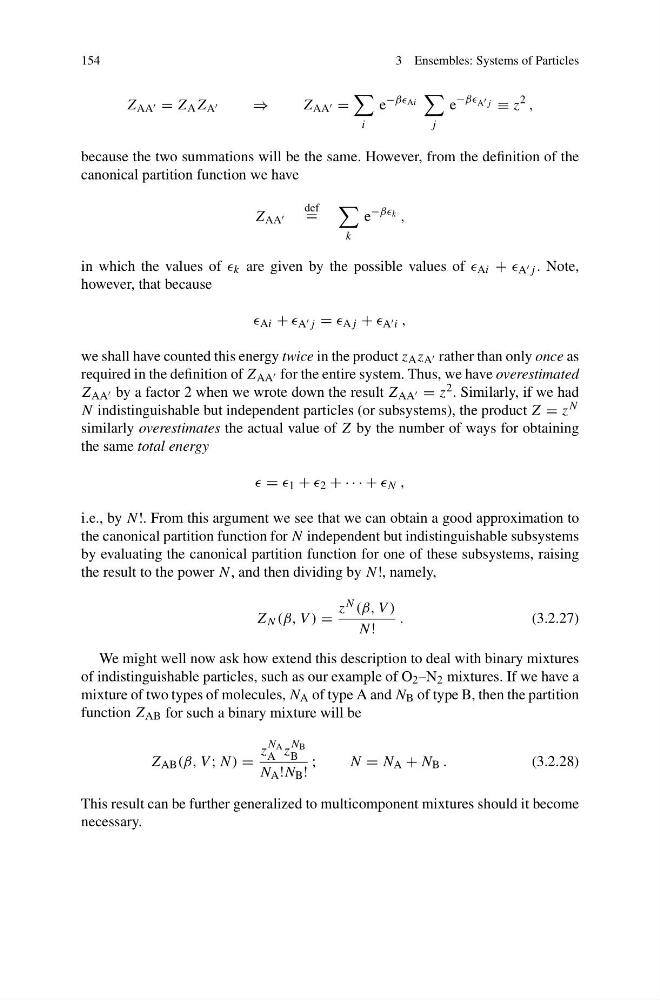
because the two summations will be the same. However, from the definition of the
canonical partition function we have
Z AA
def
=
k
e
−ββ k ,
in which the values of k are given by the possible values of Ai + A j . Note,
however, that because
Ai + A j = Aj + A i ,
we shall have counted this energy twice in the product z A z A rather than only once as
required in the definition of Z AA for the entire system. Thus, we have overestimated
Z AA by a factor 2 when we wrote down the result Z AA = z 2 . Similarly, if we had
N indistinguishable but independent particles (or subsystems), the product Z = z N
similarly overestimates the actual value of Z by the number of ways for obtaining
the same total energy
= 1 + 2 + · · · + N ,
i.e., by N !. From this argument we see that we can obtain a good approximation to
the canonical partition function for N independent but indistinguishable subsystems
by evaluating the canonical partition function for one of these subsystems, raising
the result to the power N, and then dividing by N!, namely,
Z N (β, V ) =
z N (β, V )
N!
.
(3.2.27)
We might well now ask how extend this description to deal with binary mixtures
of indistinguishable particles, such as our example of O 2 –N 2 mixtures. If we have a
mixture of two types of molecules, N A of type A and N B of type B, then the partition
function Z AB for such a binary mixture will be
Z AB (β, V ; N) =
z
N A
A z
N B
B
N A !N B !
;
N = N A + N B .
(3.2.28)
This result can be further generalized to multicomponent mixtures should it become
necessary.
3 Ensembles: Systems of Particles
Z AA = Z A Z A
⇒
Z AA =
i
e
−ββ Ai
j
e
−ββ A j ≡ z
2 ,
because the two summations will be the same. However, from the definition of the
canonical partition function we have
Z AA
def
=
k
e
−ββ k ,
in which the values of k are given by the possible values of Ai + A j . Note,
however, that because
Ai + A j = Aj + A i ,
we shall have counted this energy twice in the product z A z A rather than only once as
required in the definition of Z AA for the entire system. Thus, we have overestimated
Z AA by a factor 2 when we wrote down the result Z AA = z 2 . Similarly, if we had
N indistinguishable but independent particles (or subsystems), the product Z = z N
similarly overestimates the actual value of Z by the number of ways for obtaining
the same total energy
= 1 + 2 + · · · + N ,
i.e., by N !. From this argument we see that we can obtain a good approximation to
the canonical partition function for N independent but indistinguishable subsystems
by evaluating the canonical partition function for one of these subsystems, raising
the result to the power N, and then dividing by N!, namely,
Z N (β, V ) =
z N (β, V )
N!
.
(3.2.27)
We might well now ask how extend this description to deal with binary mixtures
of indistinguishable particles, such as our example of O 2 –N 2 mixtures. If we have a
mixture of two types of molecules, N A of type A and N B of type B, then the partition
function Z AB for such a binary mixture will be
Z AB (β, V ; N) =
z
N A
A z
N B
B
N A !N B !
;
N = N A + N B .
(3.2.28)
This result can be further generalized to multicomponent mixtures should it become
necessary.