

3.2 The Canonical Ensemble: Closed Systems
141
ln
(E
∗
− E r ) ln
(E
∗ ) − βE r ,
(3.2.8)
from which we obtain for ln p r the expression
ln p r = ln C
+ ln
(E
∗ ) − βE r ,
(3.2.9)
or
p r = C
(E
∗ )e
−βE r ≡ Ce
−βE r .
(3.2.10)
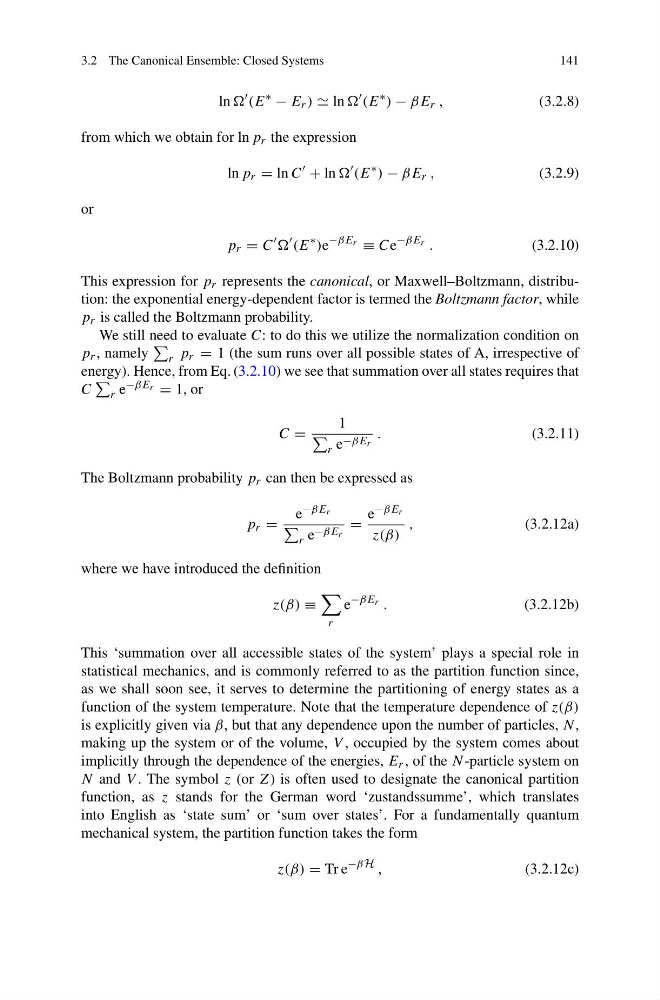
This expression for p r represents the canonical, or Maxwell–Boltzmann, distribution: the exponential energy-dependent factor is termed the Boltzmann factor, while
p r is called the Boltzmann probability.
We still need to evaluate C: to do this we utilize the normalization condition on
p r , namely
r p r = 1 (the sum runs over all possible states of A, irrespective of
energy). Hence, from Eq. (3.2.10) we see that summation over all states requires that
C
r e −βE r = 1, or
C =
1
r e −βE r
.
(3.2.11)
The Boltzmann probability p r can then be expressed as
p r =
e −βE r
r e −βE r
=
e −βE r
z(β)
,
(3.2.12a)
where we have introduced the definition
z(β) ≡
r
e
−βE r .
(3.2.12b)
This ‘summation over all accessible states of the system’ plays a special role in
statistical mechanics, and is commonly referred to as the partition function since,
as we shall soon see, it serves to determine the partitioning of energy states as a
function of the system temperature. Note that the temperature dependence of z(β)
is explicitly given via β, but that any dependence upon the number of particles, N ,
making up the system or of the volume, V , occupied by the system comes about
implicitly through the dependence of the energies, E r , of the N -particle system on
N and V . The symbol z (or Z) is often used to designate the canonical partition
function, as z stands for the German word ‘zustandssumme’, which translates
into English as ‘state sum’ or ‘sum over states’. For a fundamentally quantum
mechanical system, the partition function takes the form
z(β) = Tr e
−βH ,
(3.2.12c)
141
ln
(E
∗
− E r ) ln
(E
∗ ) − βE r ,
(3.2.8)
from which we obtain for ln p r the expression
ln p r = ln C
+ ln
(E
∗ ) − βE r ,
(3.2.9)
or
p r = C
(E
∗ )e
−βE r ≡ Ce
−βE r .
(3.2.10)
This expression for p r represents the canonical, or Maxwell–Boltzmann, distribution: the exponential energy-dependent factor is termed the Boltzmann factor, while
p r is called the Boltzmann probability.
We still need to evaluate C: to do this we utilize the normalization condition on
p r , namely
r p r = 1 (the sum runs over all possible states of A, irrespective of
energy). Hence, from Eq. (3.2.10) we see that summation over all states requires that
C
r e −βE r = 1, or
C =
1
r e −βE r
.
(3.2.11)
The Boltzmann probability p r can then be expressed as
p r =
e −βE r
r e −βE r
=
e −βE r
z(β)
,
(3.2.12a)
where we have introduced the definition
z(β) ≡
r
e
−βE r .
(3.2.12b)
This ‘summation over all accessible states of the system’ plays a special role in
statistical mechanics, and is commonly referred to as the partition function since,
as we shall soon see, it serves to determine the partitioning of energy states as a
function of the system temperature. Note that the temperature dependence of z(β)
is explicitly given via β, but that any dependence upon the number of particles, N ,
making up the system or of the volume, V , occupied by the system comes about
implicitly through the dependence of the energies, E r , of the N -particle system on
N and V . The symbol z (or Z) is often used to designate the canonical partition
function, as z stands for the German word ‘zustandssumme’, which translates
into English as ‘state sum’ or ‘sum over states’. For a fundamentally quantum
mechanical system, the partition function takes the form
z(β) = Tr e
−βH ,
(3.2.12c)