

140
3 Ensembles: Systems of Particles
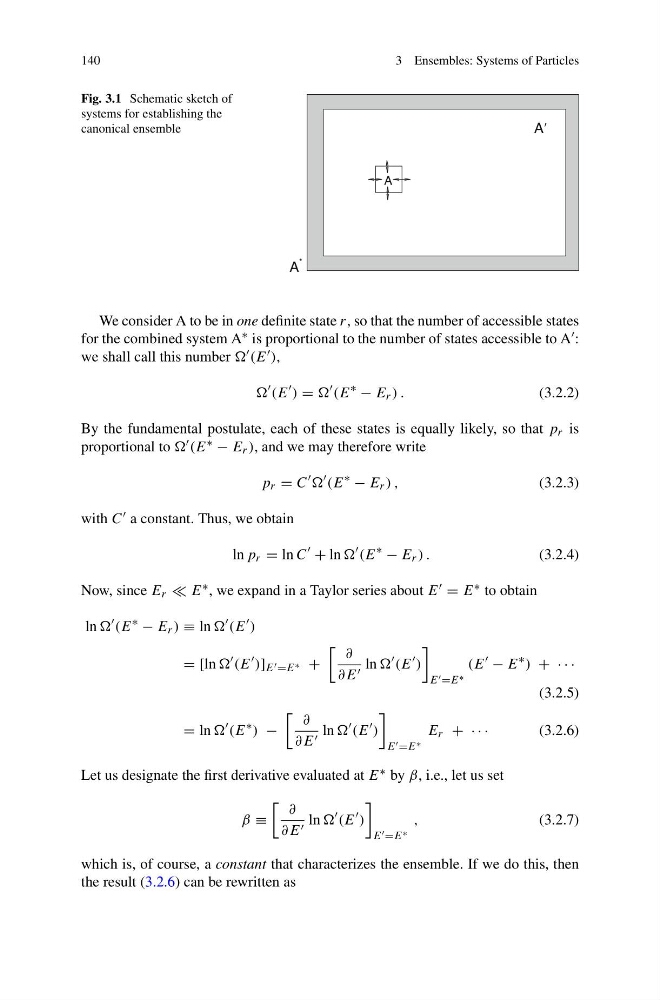
Fig. 3.1 Schematic sketch of
systems for establishing the
canonical ensemble
A
Aʹ
A
*
We consider A to be in one definite state r, so that the number of accessible states
for the combined system A ∗ is proportional to the number of states accessible to A :
we shall call this number (E ),
(E
) =
(E
∗
− E r ) .
(3.2.2)
By the fundamental postulate, each of these states is equally likely, so that p r is
proportional to (E ∗ − E r ), and we may therefore write
p r = C
(E
∗
− E r ) ,
(3.2.3)
with C a constant. Thus, we obtain
ln p r = ln C
+ ln
(E
∗
− E r ) .
(3.2.4)
Now, since E r E ∗ , we expand in a Taylor series about E = E ∗ to obtain
ln
(E
∗
− E r ) ≡ ln
(E
)
= [ln
(E
)] E =E ∗ +
∂
∂E ln
(E
)
E =E ∗
(E
− E
∗ ) + · · ·
(3.2.5)
= ln
(E
∗ ) −
∂
∂E ln
(E
)
E =E ∗
E r + · · ·
(3.2.6)
Let us designate the first derivative evaluated at E ∗ by β, i.e., let us set
β ≡
∂
∂E ln
(E
)
E =E ∗
,
(3.2.7)
which is, of course, a constant that characterizes the ensemble. If we do this, then
the result (3.2.6) can be rewritten as
3 Ensembles: Systems of Particles
Fig. 3.1 Schematic sketch of
systems for establishing the
canonical ensemble
A
Aʹ
A
*
We consider A to be in one definite state r, so that the number of accessible states
for the combined system A ∗ is proportional to the number of states accessible to A :
we shall call this number (E ),
(E
) =
(E
∗
− E r ) .
(3.2.2)
By the fundamental postulate, each of these states is equally likely, so that p r is
proportional to (E ∗ − E r ), and we may therefore write
p r = C
(E
∗
− E r ) ,
(3.2.3)
with C a constant. Thus, we obtain
ln p r = ln C
+ ln
(E
∗
− E r ) .
(3.2.4)
Now, since E r E ∗ , we expand in a Taylor series about E = E ∗ to obtain
ln
(E
∗
− E r ) ≡ ln
(E
)
= [ln
(E
)] E =E ∗ +
∂
∂E ln
(E
)
E =E ∗
(E
− E
∗ ) + · · ·
(3.2.5)
= ln
(E
∗ ) −
∂
∂E ln
(E
)
E =E ∗
E r + · · ·
(3.2.6)
Let us designate the first derivative evaluated at E ∗ by β, i.e., let us set
β ≡
∂
∂E ln
(E
)
E =E ∗
,
(3.2.7)
which is, of course, a constant that characterizes the ensemble. If we do this, then
the result (3.2.6) can be rewritten as