

90
2 Macroscopic Thermodynamics
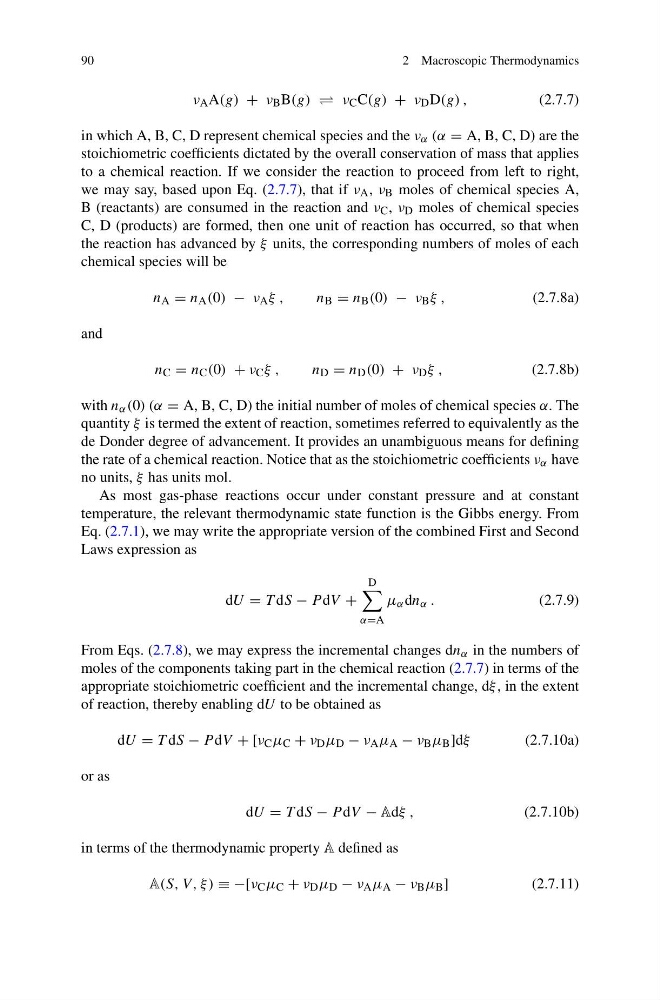
ν A A(g) + ν B B(g) ν C C(g) + ν D D(g) ,
(2.7.7)
in which A, B, C, D represent chemical species and the ν α (α = A, B, C, D) are the
stoichiometric coefficients dictated by the overall conservation of mass that applies
to a chemical reaction. If we consider the reaction to proceed from left to right,
we may say, based upon Eq. (2.7.7), that if ν A , ν B moles of chemical species A,
B (reactants) are consumed in the reaction and ν C , ν D moles of chemical species
C, D (products) are formed, then one unit of reaction has occurred, so that when
the reaction has advanced by ξ units, the corresponding numbers of moles of each
chemical species will be
n A = n A (0) − ν A ξ ,
n B = n B (0) − ν B ξ ,
(2.7.8a)
and
n C = n C (0) + ν C ξ ,
n D = n D (0) + ν D ξ ,
(2.7.8b)
with n α (0) (α = A, B, C, D) the initial number of moles of chemical species α. The
quantity ξ is termed the extent of reaction, sometimes referred to equivalently as the
de Donder degree of advancement. It provides an unambiguous means for defining
the rate of a chemical reaction. Notice that as the stoichiometric coefficients ν α have
no units, ξ has units mol.
As most gas-phase reactions occur under constant pressure and at constant
temperature, the relevant thermodynamic state function is the Gibbs energy. From
Eq. (2.7.1), we may write the appropriate version of the combined First and Second
Laws expression as
dU = T dS − P dV +
D
α=A
μ α dn α .
(2.7.9)
From Eqs. (2.7.8), we may express the incremental changes dn α in the numbers of
moles of the components taking part in the chemical reaction (2.7.7) in terms of the
appropriate stoichiometric coefficient and the incremental change, dξ , in the extent
of reaction, thereby enabling dU to be obtained as
dU = T dS − P dV + [ν C μ C + ν D μ D − ν A μ A − ν B μ B ]dξ
(2.7.10a)
or as
dU = T dS − P dV − Adξ ,
(2.7.10b)
in terms of the thermodynamic property A defined as
A(S, V , ξ) ≡ −[ν C μ C + ν D μ D − ν A μ A − ν B μ B ]
(2.7.11)
2 Macroscopic Thermodynamics
ν A A(g) + ν B B(g) ν C C(g) + ν D D(g) ,
(2.7.7)
in which A, B, C, D represent chemical species and the ν α (α = A, B, C, D) are the
stoichiometric coefficients dictated by the overall conservation of mass that applies
to a chemical reaction. If we consider the reaction to proceed from left to right,
we may say, based upon Eq. (2.7.7), that if ν A , ν B moles of chemical species A,
B (reactants) are consumed in the reaction and ν C , ν D moles of chemical species
C, D (products) are formed, then one unit of reaction has occurred, so that when
the reaction has advanced by ξ units, the corresponding numbers of moles of each
chemical species will be
n A = n A (0) − ν A ξ ,
n B = n B (0) − ν B ξ ,
(2.7.8a)
and
n C = n C (0) + ν C ξ ,
n D = n D (0) + ν D ξ ,
(2.7.8b)
with n α (0) (α = A, B, C, D) the initial number of moles of chemical species α. The
quantity ξ is termed the extent of reaction, sometimes referred to equivalently as the
de Donder degree of advancement. It provides an unambiguous means for defining
the rate of a chemical reaction. Notice that as the stoichiometric coefficients ν α have
no units, ξ has units mol.
As most gas-phase reactions occur under constant pressure and at constant
temperature, the relevant thermodynamic state function is the Gibbs energy. From
Eq. (2.7.1), we may write the appropriate version of the combined First and Second
Laws expression as
dU = T dS − P dV +
D
α=A
μ α dn α .
(2.7.9)
From Eqs. (2.7.8), we may express the incremental changes dn α in the numbers of
moles of the components taking part in the chemical reaction (2.7.7) in terms of the
appropriate stoichiometric coefficient and the incremental change, dξ , in the extent
of reaction, thereby enabling dU to be obtained as
dU = T dS − P dV + [ν C μ C + ν D μ D − ν A μ A − ν B μ B ]dξ
(2.7.10a)
or as
dU = T dS − P dV − Adξ ,
(2.7.10b)
in terms of the thermodynamic property A defined as
A(S, V , ξ) ≡ −[ν C μ C + ν D μ D − ν A μ A − ν B μ B ]
(2.7.11)