

2.7 Extension to Multicomponent Systems
89
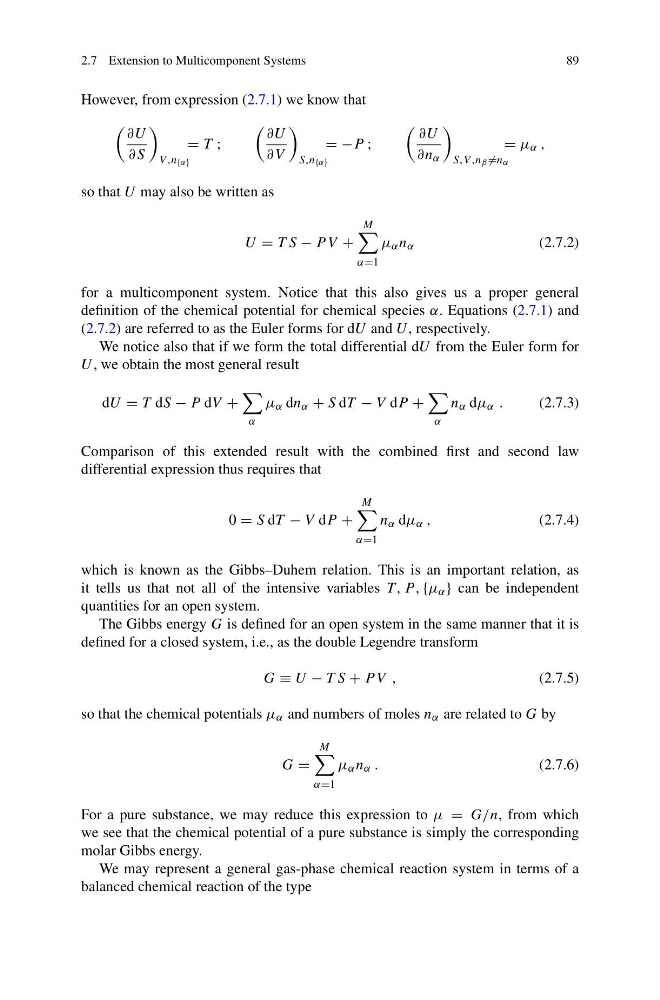
However, from expression (2.7.1) we know that
∂U
∂S
V ,n {α}
= T ;
∂U
∂V
S,n {α}
= −P ;
∂U
∂n α
S,V ,n β =n α
= μ α ,
so that U may also be written as
U = T S − P V +
M
α=1
μ α n α
(2.7.2)
for a multicomponent system. Notice that this also gives us a proper general
definition of the chemical potential for chemical species α. Equations (2.7.1) and
(2.7.2) are referred to as the Euler forms for dU and U , respectively.
We notice also that if we form the total differential dU from the Euler form for
U , we obtain the most general result
dU = T dS − P dV +
α
μ α dn α + S dT − V dP +
α
n α dμ α .
(2.7.3)
Comparison of this extended result with the combined first and second law
differential expression thus requires that
0 = S dT − V dP +
M
α=1
n α dμ α ,
(2.7.4)
which is known as the Gibbs–Duhem relation. This is an important relation, as
it tells us that not all of the intensive variables T , P , {μ α } can be independent
quantities for an open system.
The Gibbs energy G is defined for an open system in the same manner that it is
defined for a closed system, i.e., as the double Legendre transform
G ≡ U − T S + P V ,
(2.7.5)
so that the chemical potentials μ α and numbers of moles n α are related to G by
G =
M
α=1
μ α n α .
(2.7.6)
For a pure substance, we may reduce this expression to μ = G/n, from which
we see that the chemical potential of a pure substance is simply the corresponding
molar Gibbs energy.
We may represent a general gas-phase chemical reaction system in terms of a
balanced chemical reaction of the type
89
However, from expression (2.7.1) we know that
∂U
∂S
V ,n {α}
= T ;
∂U
∂V
S,n {α}
= −P ;
∂U
∂n α
S,V ,n β =n α
= μ α ,
so that U may also be written as
U = T S − P V +
M
α=1
μ α n α
(2.7.2)
for a multicomponent system. Notice that this also gives us a proper general
definition of the chemical potential for chemical species α. Equations (2.7.1) and
(2.7.2) are referred to as the Euler forms for dU and U , respectively.
We notice also that if we form the total differential dU from the Euler form for
U , we obtain the most general result
dU = T dS − P dV +
α
μ α dn α + S dT − V dP +
α
n α dμ α .
(2.7.3)
Comparison of this extended result with the combined first and second law
differential expression thus requires that
0 = S dT − V dP +
M
α=1
n α dμ α ,
(2.7.4)
which is known as the Gibbs–Duhem relation. This is an important relation, as
it tells us that not all of the intensive variables T , P , {μ α } can be independent
quantities for an open system.
The Gibbs energy G is defined for an open system in the same manner that it is
defined for a closed system, i.e., as the double Legendre transform
G ≡ U − T S + P V ,
(2.7.5)
so that the chemical potentials μ α and numbers of moles n α are related to G by
G =
M
α=1
μ α n α .
(2.7.6)
For a pure substance, we may reduce this expression to μ = G/n, from which
we see that the chemical potential of a pure substance is simply the corresponding
molar Gibbs energy.
We may represent a general gas-phase chemical reaction system in terms of a
balanced chemical reaction of the type