

3.4 Rh-Catalyzed C–H Bond Alkynylation
59
3-244
0.0
(kcal/mol)
3-245
3.6
3-246ts
9.0
3-247
3.6
Migratory Insertion
18.2
3-250
-17.7
3-249ts
3-251ts
1.0
3-252
-30.0
3-248
C-H Bond Cleavage
Reductive Elimination
Ph
Ph
3-244
3-245
3-246ts
3-247
3-249ts
3-250
3-251ts
3-252
G(M06)
Ru
N
O
N
O
O
Ru
N
O
N
O
O
H
Ru
N
O
N
O
O
H
Ru
N
O
N
OAc
H
Ru
N
O
N
OAc
Ph
Ph
H
Ru
N
O
N
OAc H
Ph
Ph
Ru
N
O
N
OAc
Ph
H
Ph
Ru
N
O
N
OAc
Ph
Ph
H
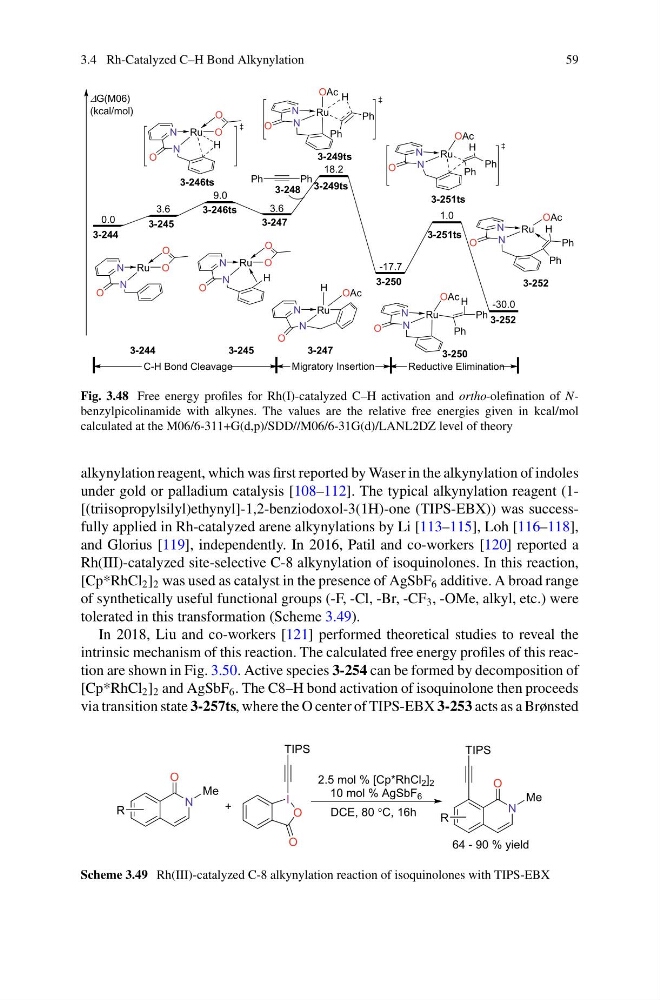
Fig. 3.48 Free energy profiles for Rh(I)-catalyzed C–H activation and ortho-olefination of Nbenzylpicolinamide with alkynes. The values are the relative free energies given in kcal/mol
calculated at the M06/6-311+G(d,p)/SDD//M06/6-31G(d)/LANL2DZ level of theory
alkynylation reagent, which was first reported by Waser in the alkynylation of indoles
under gold or palladium catalysis [108–112]. The typical alkynylation reagent (1[(triisopropylsilyl)ethynyl]-1,2-benziodoxol-3(1H)-one (TIPS-EBX)) was successfully applied in Rh-catalyzed arene alkynylations by Li [113–115], Loh [116–118],
and Glorius [119], independently. In 2016, Patil and co-workers [120] reported a
Rh(III)-catalyzed site-selective C-8 alkynylation of isoquinolones. In this reaction,
[Cp*RhCl 2 ] 2 was used as catalyst in the presence of AgSbF 6 additive. A broad range
of synthetically useful functional groups (-F, -Cl, -Br, -CF 3 , -OMe, alkyl, etc.) were
tolerated in this transformation (Scheme 3.49).
In 2018, Liu and co-workers [121] performed theoretical studies to reveal the
intrinsic mechanism of this reaction. The calculated free energy profiles of this reaction are shown in Fig. 3.50. Active species 3-254 can be formed by decomposition of
[Cp*RhCl 2 ] 2 and AgSbF 6 . The C8–H bond activation of isoquinolone then proceeds
via transition state 3-257ts, where the O center of TIPS-EBX 3-253 acts as a Brønsted
2.5 mol % [Cp*RhCl 2 ] 2
10 mol % AgSbF 6
DCE, 80 C, 16h
+
64 - 90 % yield
N
O
Me
O
I
O
TIPS
N
O
Me
TIPS
R
R
Scheme 3.49 Rh(III)-catalyzed C-8 alkynylation reaction of isoquinolones with TIPS-EBX
59
3-244
0.0
(kcal/mol)
3-245
3.6
3-246ts
9.0
3-247
3.6
Migratory Insertion
18.2
3-250
-17.7
3-249ts
3-251ts
1.0
3-252
-30.0
3-248
C-H Bond Cleavage
Reductive Elimination
Ph
Ph
3-244
3-245
3-246ts
3-247
3-249ts
3-250
3-251ts
3-252
G(M06)
Ru
N
O
N
O
O
Ru
N
O
N
O
O
H
Ru
N
O
N
O
O
H
Ru
N
O
N
OAc
H
Ru
N
O
N
OAc
Ph
Ph
H
Ru
N
O
N
OAc H
Ph
Ph
Ru
N
O
N
OAc
Ph
H
Ph
Ru
N
O
N
OAc
Ph
Ph
H
Fig. 3.48 Free energy profiles for Rh(I)-catalyzed C–H activation and ortho-olefination of Nbenzylpicolinamide with alkynes. The values are the relative free energies given in kcal/mol
calculated at the M06/6-311+G(d,p)/SDD//M06/6-31G(d)/LANL2DZ level of theory
alkynylation reagent, which was first reported by Waser in the alkynylation of indoles
under gold or palladium catalysis [108–112]. The typical alkynylation reagent (1[(triisopropylsilyl)ethynyl]-1,2-benziodoxol-3(1H)-one (TIPS-EBX)) was successfully applied in Rh-catalyzed arene alkynylations by Li [113–115], Loh [116–118],
and Glorius [119], independently. In 2016, Patil and co-workers [120] reported a
Rh(III)-catalyzed site-selective C-8 alkynylation of isoquinolones. In this reaction,
[Cp*RhCl 2 ] 2 was used as catalyst in the presence of AgSbF 6 additive. A broad range
of synthetically useful functional groups (-F, -Cl, -Br, -CF 3 , -OMe, alkyl, etc.) were
tolerated in this transformation (Scheme 3.49).
In 2018, Liu and co-workers [121] performed theoretical studies to reveal the
intrinsic mechanism of this reaction. The calculated free energy profiles of this reaction are shown in Fig. 3.50. Active species 3-254 can be formed by decomposition of
[Cp*RhCl 2 ] 2 and AgSbF 6 . The C8–H bond activation of isoquinolone then proceeds
via transition state 3-257ts, where the O center of TIPS-EBX 3-253 acts as a Brønsted
2.5 mol % [Cp*RhCl 2 ] 2
10 mol % AgSbF 6
DCE, 80 C, 16h
+
64 - 90 % yield
N
O
Me
O
I
O
TIPS
N
O
Me
TIPS
R
R
Scheme 3.49 Rh(III)-catalyzed C-8 alkynylation reaction of isoquinolones with TIPS-EBX