

58
3 Theoretical Study of Rh-Catalyzed …
2.5 mol % [Rh(cod)Cl] 2
5 mol %AgSbF 6
4.0 eq. NaOAc
DMF, 120 C, 24h,
+
43 - 84 % yield
Ar
Ar
NH
O
N
R
N 2
NH
O
N
R
Ar
Ar
Ar
Ar
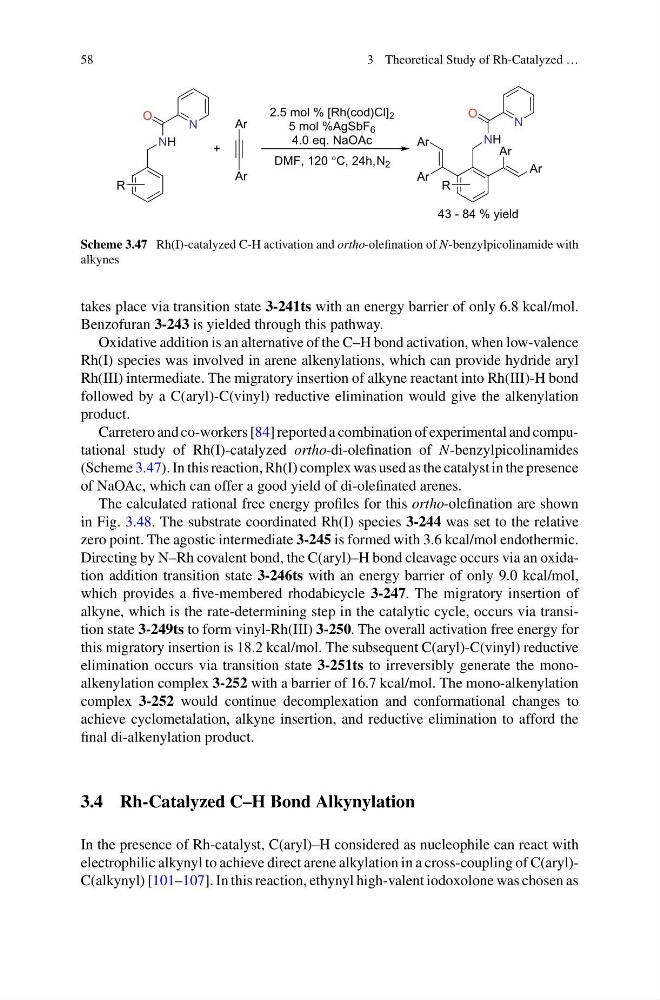
Scheme 3.47 Rh(I)-catalyzed C-H activation and ortho-olefination of N-benzylpicolinamide with
alkynes
takes place via transition state 3-241ts with an energy barrier of only 6.8 kcal/mol.
Benzofuran 3-243 is yielded through this pathway.
Oxidative addition is an alternative of the C–H bond activation, when low-valence
Rh(I) species was involved in arene alkenylations, which can provide hydride aryl
Rh(III) intermediate. The migratory insertion of alkyne reactant into Rh(III)-H bond
followed by a C(aryl)-C(vinyl) reductive elimination would give the alkenylation
product.
Carretero and co-workers [84] reported a combination of experimental and computational study of Rh(I)-catalyzed ortho-di-olefination of N-benzylpicolinamides
(Scheme 3.47). In this reaction, Rh(I) complex was used as the catalyst in the presence
of NaOAc, which can offer a good yield of di-olefinated arenes.
The calculated rational free energy profiles for this ortho-olefination are shown
in Fig. 3.48. The substrate coordinated Rh(I) species 3-244 was set to the relative
zero point. The agostic intermediate 3-245 is formed with 3.6 kcal/mol endothermic.
Directing by N–Rh covalent bond, the C(aryl)–H bond cleavage occurs via an oxidation addition transition state 3-246ts with an energy barrier of only 9.0 kcal/mol,
which provides a five-membered rhodabicycle 3-247. The migratory insertion of
alkyne, which is the rate-determining step in the catalytic cycle, occurs via transition state 3-249ts to form vinyl-Rh(III) 3-250. The overall activation free energy for
this migratory insertion is 18.2 kcal/mol. The subsequent C(aryl)-C(vinyl) reductive
elimination occurs via transition state 3-251ts to irreversibly generate the monoalkenylation complex 3-252 with a barrier of 16.7 kcal/mol. The mono-alkenylation
complex 3-252 would continue decomplexation and conformational changes to
achieve cyclometalation, alkyne insertion, and reductive elimination to afford the
final di-alkenylation product.
3.4 Rh-Catalyzed C–H Bond Alkynylation
In the presence of Rh-catalyst, C(aryl)–H considered as nucleophile can react with
electrophilic alkynyl to achieve direct arene alkylation in a cross-coupling of C(aryl)C(alkynyl) [101–107]. In this reaction, ethynyl high-valent iodoxolone was chosen as
3 Theoretical Study of Rh-Catalyzed …
2.5 mol % [Rh(cod)Cl] 2
5 mol %AgSbF 6
4.0 eq. NaOAc
DMF, 120 C, 24h,
+
43 - 84 % yield
Ar
Ar
NH
O
N
R
N 2
NH
O
N
R
Ar
Ar
Ar
Ar
Scheme 3.47 Rh(I)-catalyzed C-H activation and ortho-olefination of N-benzylpicolinamide with
alkynes
takes place via transition state 3-241ts with an energy barrier of only 6.8 kcal/mol.
Benzofuran 3-243 is yielded through this pathway.
Oxidative addition is an alternative of the C–H bond activation, when low-valence
Rh(I) species was involved in arene alkenylations, which can provide hydride aryl
Rh(III) intermediate. The migratory insertion of alkyne reactant into Rh(III)-H bond
followed by a C(aryl)-C(vinyl) reductive elimination would give the alkenylation
product.
Carretero and co-workers [84] reported a combination of experimental and computational study of Rh(I)-catalyzed ortho-di-olefination of N-benzylpicolinamides
(Scheme 3.47). In this reaction, Rh(I) complex was used as the catalyst in the presence
of NaOAc, which can offer a good yield of di-olefinated arenes.
The calculated rational free energy profiles for this ortho-olefination are shown
in Fig. 3.48. The substrate coordinated Rh(I) species 3-244 was set to the relative
zero point. The agostic intermediate 3-245 is formed with 3.6 kcal/mol endothermic.
Directing by N–Rh covalent bond, the C(aryl)–H bond cleavage occurs via an oxidation addition transition state 3-246ts with an energy barrier of only 9.0 kcal/mol,
which provides a five-membered rhodabicycle 3-247. The migratory insertion of
alkyne, which is the rate-determining step in the catalytic cycle, occurs via transition state 3-249ts to form vinyl-Rh(III) 3-250. The overall activation free energy for
this migratory insertion is 18.2 kcal/mol. The subsequent C(aryl)-C(vinyl) reductive
elimination occurs via transition state 3-251ts to irreversibly generate the monoalkenylation complex 3-252 with a barrier of 16.7 kcal/mol. The mono-alkenylation
complex 3-252 would continue decomplexation and conformational changes to
achieve cyclometalation, alkyne insertion, and reductive elimination to afford the
final di-alkenylation product.
3.4 Rh-Catalyzed C–H Bond Alkynylation
In the presence of Rh-catalyst, C(aryl)–H considered as nucleophile can react with
electrophilic alkynyl to achieve direct arene alkylation in a cross-coupling of C(aryl)C(alkynyl) [101–107]. In this reaction, ethynyl high-valent iodoxolone was chosen as