

46
3 Theoretical Study of Rh-Catalyzed …
3-136
3-138
0.0
-10.4
G(M11-L, 1,4-dioxane)
(kcal/mol)
migratory insertion
3-137
3-139
-59.9
3-140ts
-53.5
3-141
-65.4
3-136
-65.1
3-136
O
O
3-138
3-139
O
O
3-142
protonation
PivOH +
N
O
Ph
3-143ts
-49.2
3-140ts
Rh
Cp*
Ph
O
Ph
Ph
H
N
3-141
R
2
O
R
1
Ar
H
HN
3-142
3-143ts
Rh
OPiv
O
O
Rh
N
O
Ph
OPiv
Rh
N
O Ph
Ph
Ph
Rh
N
O
Ph
Ph
H
Ph
Rh
N
O
Ph
Ph
Ph
H
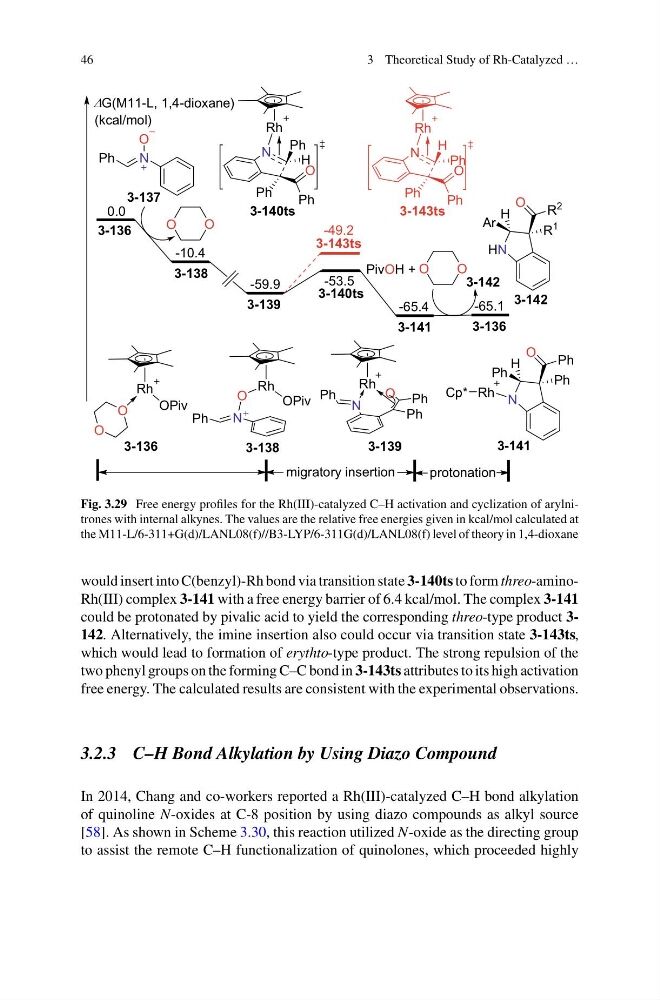
Fig. 3.29 Free energy profiles for the Rh(III)-catalyzed C–H activation and cyclization of arylnitrones with internal alkynes. The values are the relative free energies given in kcal/mol calculated at
the M11-L/6-311+G(d)/LANL08(f)//B3-LYP/6-311G(d)/LANL08(f) level of theory in 1,4-dioxane
would insert into C(benzyl)-Rh bond via transition state 3-140ts to form threo-aminoRh(III) complex 3-141 with a free energy barrier of 6.4 kcal/mol. The complex 3-141
could be protonated by pivalic acid to yield the corresponding threo-type product 3142. Alternatively, the imine insertion also could occur via transition state 3-143ts,
which would lead to formation of erythto-type product. The strong repulsion of the
two phenyl groups on the forming C–C bond in 3-143ts attributes to its high activation
free energy. The calculated results are consistent with the experimental observations.
3.2.3 C–H Bond Alkylation by Using Diazo Compound
In 2014, Chang and co-workers reported a Rh(III)-catalyzed C–H bond alkylation
of quinoline N-oxides at C-8 position by using diazo compounds as alkyl source
[58]. As shown in Scheme 3.30, this reaction utilized N-oxide as the directing group
to assist the remote C–H functionalization of quinolones, which proceeded highly
3 Theoretical Study of Rh-Catalyzed …
3-136
3-138
0.0
-10.4
G(M11-L, 1,4-dioxane)
(kcal/mol)
migratory insertion
3-137
3-139
-59.9
3-140ts
-53.5
3-141
-65.4
3-136
-65.1
3-136
O
O
3-138
3-139
O
O
3-142
protonation
PivOH +
N
O
Ph
3-143ts
-49.2
3-140ts
Rh
Cp*
Ph
O
Ph
Ph
H
N
3-141
R
2
O
R
1
Ar
H
HN
3-142
3-143ts
Rh
OPiv
O
O
Rh
N
O
Ph
OPiv
Rh
N
O Ph
Ph
Ph
Rh
N
O
Ph
Ph
H
Ph
Rh
N
O
Ph
Ph
Ph
H
Fig. 3.29 Free energy profiles for the Rh(III)-catalyzed C–H activation and cyclization of arylnitrones with internal alkynes. The values are the relative free energies given in kcal/mol calculated at
the M11-L/6-311+G(d)/LANL08(f)//B3-LYP/6-311G(d)/LANL08(f) level of theory in 1,4-dioxane
would insert into C(benzyl)-Rh bond via transition state 3-140ts to form threo-aminoRh(III) complex 3-141 with a free energy barrier of 6.4 kcal/mol. The complex 3-141
could be protonated by pivalic acid to yield the corresponding threo-type product 3142. Alternatively, the imine insertion also could occur via transition state 3-143ts,
which would lead to formation of erythto-type product. The strong repulsion of the
two phenyl groups on the forming C–C bond in 3-143ts attributes to its high activation
free energy. The calculated results are consistent with the experimental observations.
3.2.3 C–H Bond Alkylation by Using Diazo Compound
In 2014, Chang and co-workers reported a Rh(III)-catalyzed C–H bond alkylation
of quinoline N-oxides at C-8 position by using diazo compounds as alkyl source
[58]. As shown in Scheme 3.30, this reaction utilized N-oxide as the directing group
to assist the remote C–H functionalization of quinolones, which proceeded highly