

3.2 Rh-Catalyzed C–H Bond Alkylation
45
3-120
3-122
0.0
-10.2
G(M11-L, 1,4-dioxane)
(kcal/mol)
3-123ts
13.1
3-124
-2.8
3-125
-4.0
3-126ts
14.1
C-H bond cleavage
3-127
-7.8
migratory insertion
3-128ts
16.8
3-129
-7.4
3-130ts
-5.3
reductive elimination
3-121
3-131
-70.0
3-132
-55.7
3-133ts
-52.9
3-134
-54.3
3-120
-63.5
3-120
N
O
O
O
3-122
3-123ts
HOAc
3-124
Ph
Ph
3-124
3-126ts
3-127
3-128ts
3-129
3-130ts
3-131
HOAc
3-132
3-133ts
3-134
oxidation addition
O
O
N
Ph
O
Ph
3-135
3-135
protonation
Rh
OAc
O
O
Rh
OAc
N O
Rh
N
O
O
O
H
Rh
N
O
Rh
N
O
Ph
Ph
Rh
N
O
Ph
Ph
Rh
O
N
Ph
Ph
Rh
O
N
Ph
Ph
N
O
Ph
Ph
Rh
Rh
N
O Ph
Ph
N
O Ph
Ph
Rh
Rh
O
N
Ph
Ph
O
OH
Rh
O
N
Ph
Ph
H
O
O
Rh
OH
N
Ph
Ph
OAc
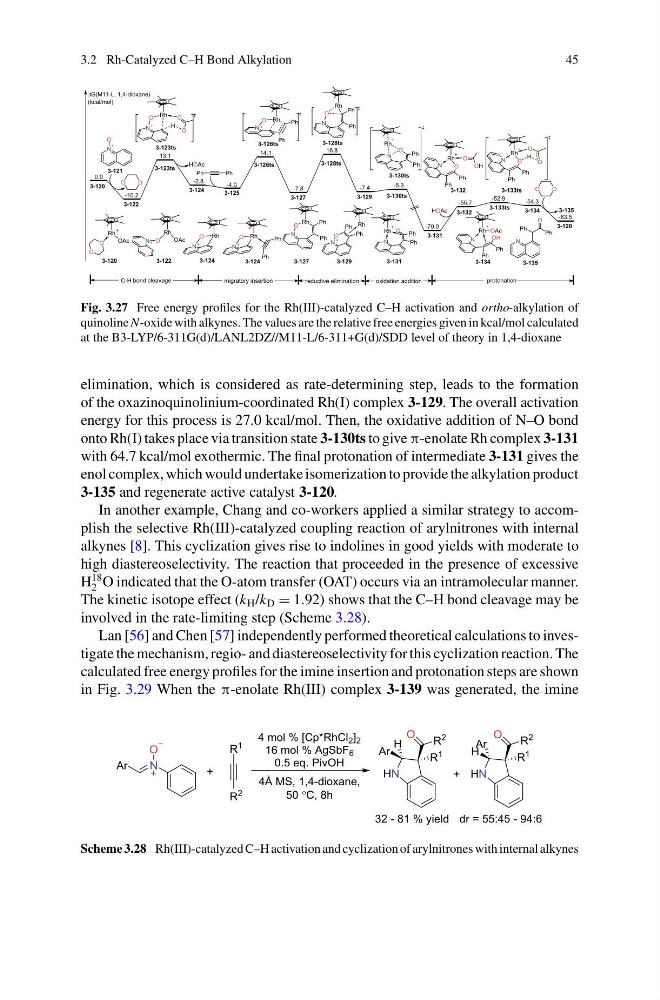
Fig. 3.27 Free energy profiles for the Rh(III)-catalyzed C–H activation and ortho-alkylation of
quinoline N-oxide with alkynes. The values are the relative free energies given in kcal/mol calculated
at the B3-LYP/6-311G(d)/LANL2DZ//M11-L/6-311+G(d)/SDD level of theory in 1,4-dioxane
elimination, which is considered as rate-determining step, leads to the formation
of the oxazinoquinolinium-coordinated Rh(I) complex 3-129. The overall activation
energy for this process is 27.0 kcal/mol. Then, the oxidative addition of N–O bond
onto Rh(I) takes place via transition state 3-130ts to give π-enolate Rh complex 3-131
with 64.7 kcal/mol exothermic. The final protonation of intermediate 3-131 gives the
enol complex, which would undertake isomerization to provide the alkylation product
3-135 and regenerate active catalyst 3-120.
In another example, Chang and co-workers applied a similar strategy to accomplish the selective Rh(III)-catalyzed coupling reaction of arylnitrones with internal
alkynes [8]. This cyclization gives rise to indolines in good yields with moderate to
high diastereoselectivity. The reaction that proceeded in the presence of excessive
H
18
2 O indicated that the O-atom transfer (OAT) occurs via an intramolecular manner.
The kinetic isotope effect (k H /k D = 1.92) shows that the C–H bond cleavage may be
involved in the rate-limiting step (Scheme 3.28).
Lan [56] and Chen [57] independently performed theoretical calculations to investigate the mechanism, regio- and diastereoselectivity for this cyclization reaction. The
calculated free energy profiles for the imine insertion and protonation steps are shown
in Fig. 3.29 When the π-enolate Rh(III) complex 3-139 was generated, the imine
4 mol % [Cp*RhCl 2 ] 2
16 mol % AgSbF 6
0.5 eq. PivOH
4Å MS, 1,4-dioxane,
50 C, 8h
+
32 - 81 % yield
R
1
R
2
R
2
O
R
1
Ar
H
HN
R
2
O
R
1
H
Ar
HN
+
dr = 55:45 - 94:6
N
O
Ar
Scheme 3.28 Rh(III)-catalyzed C–H activation and cyclization of arylnitrones with internal alkynes
45
3-120
3-122
0.0
-10.2
G(M11-L, 1,4-dioxane)
(kcal/mol)
3-123ts
13.1
3-124
-2.8
3-125
-4.0
3-126ts
14.1
C-H bond cleavage
3-127
-7.8
migratory insertion
3-128ts
16.8
3-129
-7.4
3-130ts
-5.3
reductive elimination
3-121
3-131
-70.0
3-132
-55.7
3-133ts
-52.9
3-134
-54.3
3-120
-63.5
3-120
N
O
O
O
3-122
3-123ts
HOAc
3-124
Ph
Ph
3-124
3-126ts
3-127
3-128ts
3-129
3-130ts
3-131
HOAc
3-132
3-133ts
3-134
oxidation addition
O
O
N
Ph
O
Ph
3-135
3-135
protonation
Rh
OAc
O
O
Rh
OAc
N O
Rh
N
O
O
O
H
Rh
N
O
Rh
N
O
Ph
Ph
Rh
N
O
Ph
Ph
Rh
O
N
Ph
Ph
Rh
O
N
Ph
Ph
N
O
Ph
Ph
Rh
Rh
N
O Ph
Ph
N
O Ph
Ph
Rh
Rh
O
N
Ph
Ph
O
OH
Rh
O
N
Ph
Ph
H
O
O
Rh
OH
N
Ph
Ph
OAc
Fig. 3.27 Free energy profiles for the Rh(III)-catalyzed C–H activation and ortho-alkylation of
quinoline N-oxide with alkynes. The values are the relative free energies given in kcal/mol calculated
at the B3-LYP/6-311G(d)/LANL2DZ//M11-L/6-311+G(d)/SDD level of theory in 1,4-dioxane
elimination, which is considered as rate-determining step, leads to the formation
of the oxazinoquinolinium-coordinated Rh(I) complex 3-129. The overall activation
energy for this process is 27.0 kcal/mol. Then, the oxidative addition of N–O bond
onto Rh(I) takes place via transition state 3-130ts to give π-enolate Rh complex 3-131
with 64.7 kcal/mol exothermic. The final protonation of intermediate 3-131 gives the
enol complex, which would undertake isomerization to provide the alkylation product
3-135 and regenerate active catalyst 3-120.
In another example, Chang and co-workers applied a similar strategy to accomplish the selective Rh(III)-catalyzed coupling reaction of arylnitrones with internal
alkynes [8]. This cyclization gives rise to indolines in good yields with moderate to
high diastereoselectivity. The reaction that proceeded in the presence of excessive
H
18
2 O indicated that the O-atom transfer (OAT) occurs via an intramolecular manner.
The kinetic isotope effect (k H /k D = 1.92) shows that the C–H bond cleavage may be
involved in the rate-limiting step (Scheme 3.28).
Lan [56] and Chen [57] independently performed theoretical calculations to investigate the mechanism, regio- and diastereoselectivity for this cyclization reaction. The
calculated free energy profiles for the imine insertion and protonation steps are shown
in Fig. 3.29 When the π-enolate Rh(III) complex 3-139 was generated, the imine
4 mol % [Cp*RhCl 2 ] 2
16 mol % AgSbF 6
0.5 eq. PivOH
4Å MS, 1,4-dioxane,
50 C, 8h
+
32 - 81 % yield
R
1
R
2
R
2
O
R
1
Ar
H
HN
R
2
O
R
1
H
Ar
HN
+
dr = 55:45 - 94:6
N
O
Ar
Scheme 3.28 Rh(III)-catalyzed C–H activation and cyclization of arylnitrones with internal alkynes