

1.1 A Brief History of Rh-Catalyzed C–H Functionalization
9
DG
X
DG
X
[RhLn]
DG RhLn
RhLn
DG
H
RhLn
DG
H
reductive elimination
protonation
Regeneration of
Active Catalyst
C-H Bond
Cleavage
C-Rh Bond
Transformation
CO insertion
olefin insertion
alkyne insertion
carbene insertion
nitrene insertion
X
Base
Base-H
CMD mechanism
oxidative addition
Friedel-Crafts-type
a-complex assisted metathesis
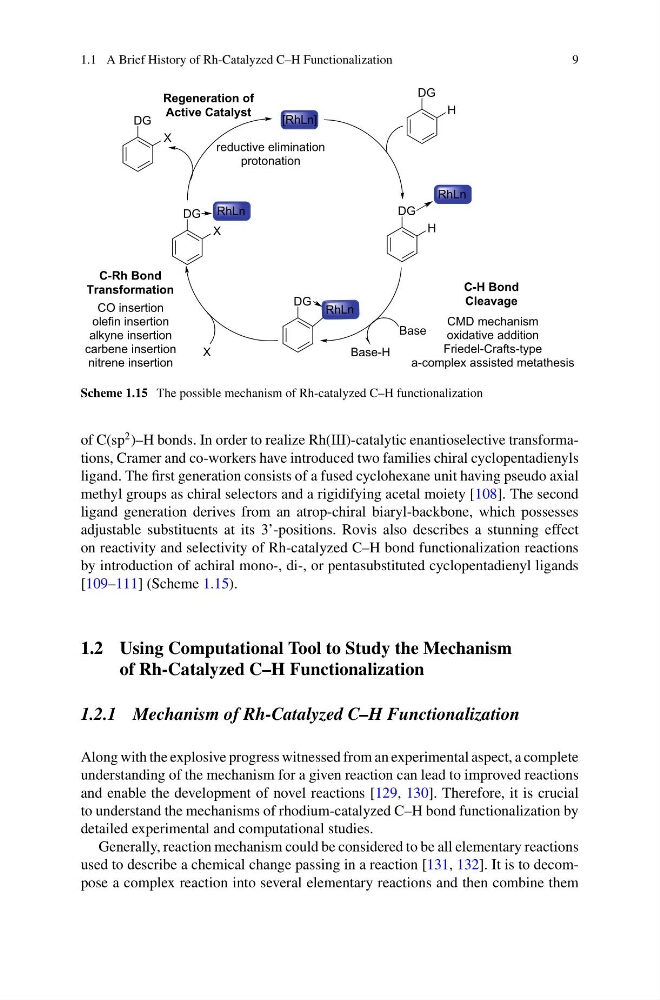
Scheme 1.15 The possible mechanism of Rh-catalyzed C–H functionalization
of C(sp
2 )–H bonds. In order to realize Rh(III)-catalytic enantioselective transformations, Cramer and co-workers have introduced two families chiral cyclopentadienyls
ligand. The first generation consists of a fused cyclohexane unit having pseudo axial
methyl groups as chiral selectors and a rigidifying acetal moiety [108]. The second
ligand generation derives from an atrop-chiral biaryl-backbone, which possesses
adjustable substituents at its 3’-positions. Rovis also describes a stunning effect
on reactivity and selectivity of Rh-catalyzed C–H bond functionalization reactions
by introduction of achiral mono-, di-, or pentasubstituted cyclopentadienyl ligands
[109–111] (Scheme 1.15).
1.2 Using Computational Tool to Study the Mechanism
of Rh-Catalyzed C–H Functionalization
1.2.1 Mechanism of Rh-Catalyzed C–H Functionalization
Along with the explosive progress witnessed from an experimental aspect, a complete
understanding of the mechanism for a given reaction can lead to improved reactions
and enable the development of novel reactions [129, 130]. Therefore, it is crucial
to understand the mechanisms of rhodium-catalyzed C–H bond functionalization by
detailed experimental and computational studies.
Generally, reaction mechanism could be considered to be all elementary reactions
used to describe a chemical change passing in a reaction [131, 132]. It is to decompose a complex reaction into several elementary reactions and then combine them
9
DG
X
DG
X
[RhLn]
DG RhLn
RhLn
DG
H
RhLn
DG
H
reductive elimination
protonation
Regeneration of
Active Catalyst
C-H Bond
Cleavage
C-Rh Bond
Transformation
CO insertion
olefin insertion
alkyne insertion
carbene insertion
nitrene insertion
X
Base
Base-H
CMD mechanism
oxidative addition
Friedel-Crafts-type
a-complex assisted metathesis
Scheme 1.15 The possible mechanism of Rh-catalyzed C–H functionalization
of C(sp
2 )–H bonds. In order to realize Rh(III)-catalytic enantioselective transformations, Cramer and co-workers have introduced two families chiral cyclopentadienyls
ligand. The first generation consists of a fused cyclohexane unit having pseudo axial
methyl groups as chiral selectors and a rigidifying acetal moiety [108]. The second
ligand generation derives from an atrop-chiral biaryl-backbone, which possesses
adjustable substituents at its 3’-positions. Rovis also describes a stunning effect
on reactivity and selectivity of Rh-catalyzed C–H bond functionalization reactions
by introduction of achiral mono-, di-, or pentasubstituted cyclopentadienyl ligands
[109–111] (Scheme 1.15).
1.2 Using Computational Tool to Study the Mechanism
of Rh-Catalyzed C–H Functionalization
1.2.1 Mechanism of Rh-Catalyzed C–H Functionalization
Along with the explosive progress witnessed from an experimental aspect, a complete
understanding of the mechanism for a given reaction can lead to improved reactions
and enable the development of novel reactions [129, 130]. Therefore, it is crucial
to understand the mechanisms of rhodium-catalyzed C–H bond functionalization by
detailed experimental and computational studies.
Generally, reaction mechanism could be considered to be all elementary reactions
used to describe a chemical change passing in a reaction [131, 132]. It is to decompose a complex reaction into several elementary reactions and then combine them